Home › Knowledge Hub › MDROs › MRSA Prevention and Management in Aged Care
MDROs
By Lyndon Forrest, Managing Director, Infection Prevention Services (IPS) · Clinically reviewed by Bridgette Mackie, RN & Dianne Newey, RN, Clinical Directors · July 2026 · 11 min read
MRSA Prevention and Management in Aged Care
TL;DR —
Methicillin-resistant Staphylococcus aureus (MRSA) is one of the most common MDROs in aged care. Prevention relies on rigorous hand hygiene, appropriate contact precautions for infected residents, enhanced environmental cleaning, and staff education. Decolonisation may be considered for selected residents. MRSA management must balance infection prevention with resident dignity and quality of life.
What Is MRSA and Why Is It a Concern in Aged Care?
Methicillin-resistant Staphylococcus aureus (MRSA) is a strain of Staphylococcus aureus that has developed resistance to methicillin and other beta-lactam antibiotics, including flucloxacillin and cephalosporins. This resistance significantly limits treatment options when MRSA causes infection.
MRSA is one of the most frequently encountered MDROs in Australian aged care. National surveillance data showed MRSA prevalence increasing from 11.5% in 2000 to 17.9% in 2012. Two distinct types circulate in aged care: community-associated MRSA (CA-MRSA) and healthcare-associated MRSA (HA-MRSA) (IPC Guide, 2025).
Staphylococcus aureus normally lives on the skin and in the nose of healthy people. Approximately 30% of the population carries S. aureus at any given time, and a proportion of these carry MRSA. In aged care, the prevalence of MRSA carriage is typically higher due to frequent antibiotic exposure, hospital admissions, and chronic wounds.
MRSA infections in older people can range from minor skin infections to severe conditions including bacteraemia (bloodstream infection), pneumonia, surgical site infections, and endocarditis. Older adults with MRSA bacteraemia have significantly higher mortality rates compared with those with methicillin-susceptible S. aureus (MSSA) bacteraemia.
For aged care facilities, MRSA management is not just a clinical issue — it is a regulatory requirement under the Strengthened Aged Care Quality Standards and an important component of accreditation readiness.
How Does MRSA Spread in Residential Aged Care Facilities?
MRSA spreads primarily through direct contact with an infected or colonised person, or through contact with surfaces and objects contaminated with the organism. In aged care, the most common transmission route is via the hands of healthcare workers during direct care activities.
MRSA can survive on environmental surfaces for extended periods (hours to weeks under certain conditions). This prolonged survival means that bed rails, door handles, call bells, shared equipment, and bathroom fixtures can all serve as reservoirs for transmission. Without adequate environmental cleaning, contaminated surfaces continuously re-expose residents and staff.
Nasal carriage is the most common colonisation site for MRSA. Colonised individuals may unknowingly shed the organism from their nose and skin, contaminating their immediate environment. Other colonisation sites include the groin, axillae, and chronic wounds.
Direct skin-to-skin contact during care activities
Contaminated hands of staff who have not performed hand hygiene
Contact with contaminated surfaces and shared equipment
Wound care procedures without appropriate PPE
Shared personal care items (towels, razors)
Transfer from hospital or other facilities without MRSA status alerts
Understanding these transmission pathways is essential for designing effective prevention strategies. Every pathway represents an opportunity for intervention — and a potential point of failure if not properly managed.
What Are the Signs and Symptoms of MRSA Infection in Older People?
MRSA infection in older adults may present differently from younger populations. Older people may have impaired immune responses, and the typical signs of infection may be subtle or absent. Clinical vigilance is essential to detect MRSA infections early.
Skin and soft tissue infections are the most common presentation of MRSA in aged care. These include boils, abscesses, cellulitis, and infected wounds. Residents with chronic wounds, pressure injuries, or indwelling devices are at particular risk.
| Infection Type | Common Signs | Risk Factors in Aged Care |
|---|---|---|
| Skin/soft tissue | Redness, warmth, swelling, purulent drainage | Chronic wounds, pressure injuries, diabetes |
| Urinary tract infection | Dysuria, frequency, cloudy urine, fever | Indwelling catheters, urinary retention |
| Bacteraemia | Fever, rigors, hypotension, new confusion | Indwelling devices, recent hospitalisation |
In older adults, the classic signs of infection may be replaced by non-specific symptoms such as new confusion (delirium), functional decline, reduced appetite, or falls. Staff must be trained to recognise these atypical presentations and report changes in condition promptly.
Any suspected MRSA infection should be assessed by an appropriate healthcare professional. Wound swabs, blood cultures, or other specimens should be collected before empirical antibiotics are started. Early identification allows targeted treatment and implementation of appropriate precautions.
Timely recognition of MRSA infection also supports antimicrobial stewardship. When culture results confirm MRSA, the antibiotic regimen can be narrowed from broad-spectrum empirical therapy to targeted treatment with agents known to be effective against the specific MRSA strain. This reduces unnecessary broad-spectrum antibiotic exposure and helps preserve antibiotic effectiveness.
Aged care staff should use validated clinical assessment tools – such as the ISBAR framework for communication and early warning scoring systems – to identify and escalate suspected infections. A structured approach ensures that clinical changes are not dismissed as normal ageing, and that residents receive timely medical assessment.
Need help implementing this in your facility? The IPS Hub gives your IPC Lead instant access to ready-made policies, procedures, and audit tools — updated monthly.
What Contact Precautions Are Required for MRSA-Positive Residents?
Contact precautions for MRSA-positive residents depend on whether the resident is colonised or infected, and their ability to manage personal hygiene independently. The IPC Guide (2025) recommends a risk-based approach rather than blanket isolation for all MRSA-positive residents.
For colonised residents who can manage their own hygiene independently, standard precautions are generally sufficient. These residents should not be excluded from communal activities, dining, or social events. Restricting their participation would be inconsistent with the person-centred care principles of the Strengthened Quality Standards and the Statement of Rights under the Aged Care Act 2024 (which commenced on 1 November 2025).
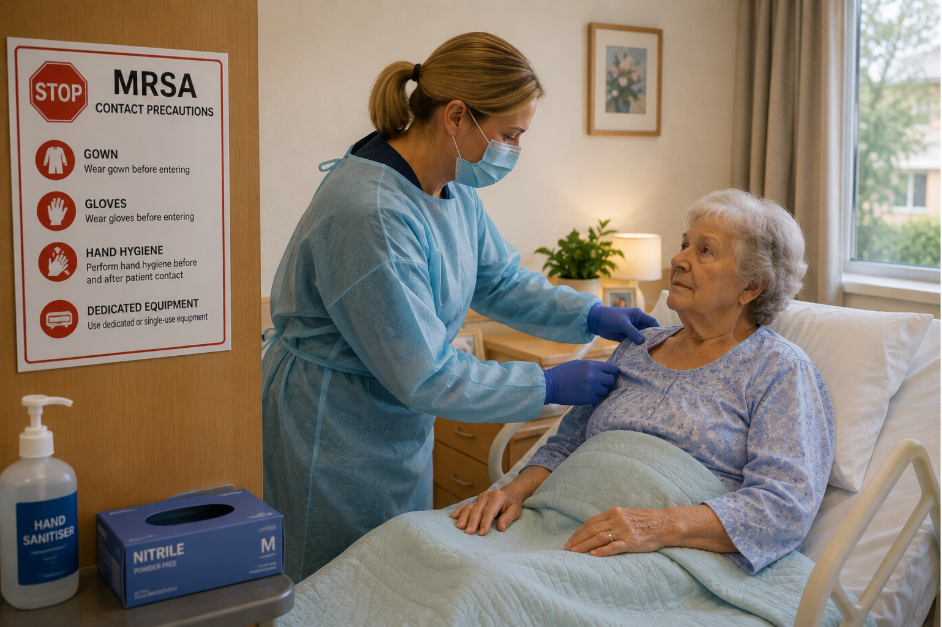
For residents with active MRSA infections (such as draining wounds or MRSA pneumonia), contact precautions should be implemented. Contact precautions include wearing gloves and gown for all direct care activities (surgical mask may be used where there is risk of respiratory secretion exposure), enhanced environmental cleaning, and where possible, the use of dedicated or single-use equipment.
Perform hand hygiene before and after every resident contact
Wear gloves and gown for direct care activities with infected residents where there is a risk of contact with body fluids, secretions, or contaminated surfaces
Use dedicated or single-use equipment where possible
Clean the resident’s room at least daily with hospital-grade disinfectant
Ensure MRSA status is documented in the care plan and communicated during handover
Provide education to the resident and family about MRSA and precautions
The decision to implement or step down contact precautions should be made in consultation with the resident’s treating medical practitioner and, where appropriate, an infection prevention specialist. Precautions should be regularly reviewed and adjusted based on the resident’s clinical status.
How Should Environmental Cleaning Be Enhanced for MRSA?
Environmental cleaning is a critical component of MRSA prevention because of the organism’s ability to survive on surfaces for extended periods. Standard routine cleaning is insufficient for rooms occupied by residents with active MRSA infections.
Enhanced cleaning involves increased frequency, use of hospital-grade disinfectants, and meticulous attention to high-touch surfaces. High-touch surfaces include bed rails, over-bed tables, call bells, light switches, door handles, bathroom fixtures, and any shared equipment in the room.
Clean and disinfect MRSA-positive resident rooms at least daily
Focus on high-touch surfaces: bed rails, call bells, door handles, light switches
Use hospital-grade disinfectant as listed on the ARTG (Australian Register of Therapeutic Goods)
Ensure cleaning staff are trained in correct disinfectant contact times
Perform terminal cleaning when the resident is transferred, discharged, or passes away
Audit cleaning quality using fluorescent markers or ATP bioluminescence testing
Terminal cleaning – a thorough clean of the entire room and its contents – must be performed whenever a room previously occupied by an MRSA-positive resident is vacated. This includes all furniture, fittings, walls (within touch height), curtains, and equipment.
Cleaning staff play a vital role in preventing MRSA. They must be included in IPC education programs and have access to the correct products and equipment. Cleaning schedules should be documented and auditable.
When Is MRSA Decolonisation Appropriate in Aged Care?
MRSA decolonisation involves the use of topical agents to reduce or eliminate MRSA carriage. Decolonisation regimens commonly include mupirocin nasal ointment and antiseptic body washes, as prescribed and tailored by the treating clinician. Chlorhexidine gluconate wash (typically 2% to 4% used in place of normal soap) is used for a defined treatment period (typically a 5-day course of antibacterial nasal ointment and antiseptic body wash).
Decolonisation is not routine in aged care and should only be considered in specific clinical situations. These include residents with recurrent MRSA infections, residents undergoing certain surgical procedures, or as part of an outbreak management strategy. The decision to decolonise should be made by the treating medical practitioner in consultation with an infectious diseases physician or clinical microbiologist.
Decolonisation is not always successful, and MRSA recolonisation can occur. Repeated decolonisation courses risk selecting for mupirocin resistance, which undermines future decolonisation efforts. For these reasons, decolonisation should be used judiciously and not applied as a blanket approach.
When decolonisation is undertaken, it is essential to ensure the full course is completed, the correct products are used, and the resident understands the purpose and process. Compliance can be challenging in aged care, and staff may need to assist with application.
Follow-up screening after decolonisation is recommended to confirm clearance. If clearance is not achieved, repeat courses should be discussed with the relevant specialist rather than automatically repeated.
How Should Staff Be Educated About MRSA Prevention?
Staff education is fundamental to effective MRSA prevention. All care workers – including nurses, personal care workers, allied health staff, cleaning staff, and agency personnel – need to understand how MRSA is transmitted and what they can do to prevent its spread.
Education should be practical and competency-based rather than purely theoretical. Staff need to demonstrate they can correctly perform hand hygiene, don and doff PPE, and implement contact precautions. Competency assessments should be conducted at orientation and at regular intervals.
Include MRSA education in orientation programs for all new staff
Provide annual refresher training on MDRO prevention and management
Use practical demonstrations for hand hygiene and PPE use
Include cleaning staff in IPC education programs
Ensure agency staff receive MDRO information before starting shifts
Use audit results (e.g., hand hygiene compliance) as educational feedback
Education should also address the emotional and social aspects of the management of MRSA. Staff need to understand the impact of isolation and restriction on residents’ wellbeing and know how to provide compassionate, person-centred care while maintaining infection prevention standards.
Facilities should maintain training records as evidence of compliance with the Strengthened Quality Standards. Assessors will look for evidence that education is ongoing, responsive to issues identified through surveillance, and effective in changing practice
What Should Facilities Communicate to Families About MRSA?
Open and honest communication with residents and their families about MRSA is essential. Families may be anxious or confused about what MRSA means, whether it is dangerous, and what precautions are needed. Facilities have a responsibility to provide clear, factual information.
Communication should explain what MRSA is, how it spreads, and what the facility is doing to manage it. It should clarify the difference between colonisation and infection and reassure families that colonised residents can continue to participate in normal activities.
Explain MRSA in plain language and avoid medical jargon
Clarify the difference between colonisation and infection
Outline the precautions the facility is implementing
Advise families on hand hygiene when visiting
Reassure that MRSA is manageable and does not require permanent isolation
Provide written information they can take away and refer to
Families should be informed of their role in preventing spread. This includes performing hand hygiene when visiting, informing the facility if they themselves are unwell, and supporting their family member’s care plan.
Transparent communication builds trust and supports the person-centred care approach required by the Strengthened Quality Standards. Facilities that communicate proactively are less likely to face complaints or concerns from families.
Internal Links
Multi-Drug Resistant Organisms (MDROs) in Aged Care
VRE in Aged Care — What Every Facility Needs to Know
CPE and Carbapenem Resistance in Aged Care
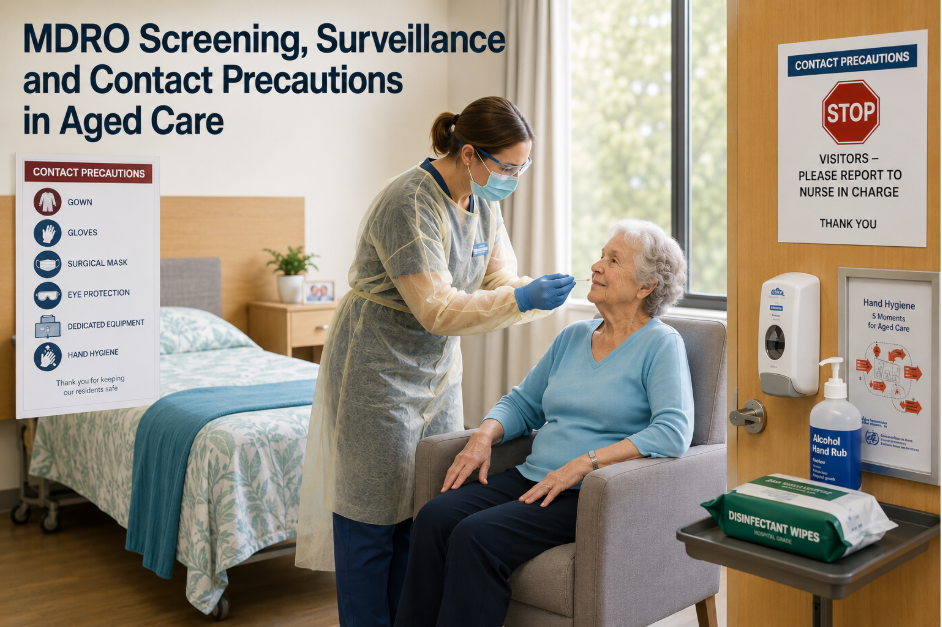
MDRO Screening, Surveillance and Contact Precautions in Aged Care
Frequently Asked Questions
Can MRSA-colonised residents share a room with other residents?
Yes, in most cases. The IPC Guide recommends that colonised residents who can independently manage their hygiene do not require single-room accommodation. A risk assessment should guide placement decisions, considering the colonised resident’s hygiene capacity and the roommate’s vulnerability.
How long does MRSA survive on surfaces?
MRSA can survive on dry surfaces for weeks to months. This is why enhanced environmental cleaning with hospital-grade disinfectants is essential in rooms occupied by MRSA-positive residents.
Should visitors wear gloves and gowns when visiting an MRSA-positive resident?
For colonised residents, visitors generally do not need to wear gloves and gowns. Hand hygiene before and after visiting is the key measure. For residents with active MRSA infections, the facility should advise visitors on any additional precautions required.
Can MRSA be permanently eradicated from a person?
Decolonisation can temporarily clear MRSA carriage, but recolonisation can occur, particularly in aged care settings where ongoing exposure risks exist. Permanent eradication is not guaranteed, and repeated decolonisation is not recommended without specialist advice.
Do staff who carry MRSA need to stop working?
Routine staff screening for MRSA is not recommended. Staff who are incidentally found to carry MRSA do not need to be excluded from work. Rigorous hand hygiene and standard precautions are sufficient to prevent transmission during care activities.
References
Australian Commission on Safety and Quality in Health Care (ACSQHC). (2025). Infection Prevention and Control Guide for Aged Care. ACSQHC.
Australian Commission on Safety and Quality in Health Care (ACSQHC). (2025). AURA Surveillance Report 2025. ACSQHC.
Australian Passive Antimicrobial Surveillance System (APAS). (2024). Antimicrobial Resistance Data 2023. ACSQHC.
Therapeutic Guidelines. (2024). Therapeutic Guidelines: Antibiotic. Therapeutic Guidelines Ltd.
Australian Government. (2024). Aged Care Act 2024. Federal Register of Legislation.
Copyright 2026 Bug Control Pty Ltd. All rights reserved.
In This Article
- What Is MRSA and Why Is It a Concern in Aged Care?
- How Does MRSA Spread in Residential Aged Care Facilities?
- What Are the Signs and Symptoms of MRSA Infection in Older People?
- What Contact Precautions Are Required for MRSA-Positive Residents?
- How Should Environmental Cleaning Be Enhanced for MRSA?
- When Is MRSA Decolonisation Appropriate in Aged Care?
- How Should Staff Be Educated About MRSA Prevention?
- What Should Facilities Communicate to Families About MRSA?
- Internal Links
- Frequently Asked Questions
- References
- Developer Section
About the Author
Lyndon Forrest is the Managing Director of Infection Prevention Services (IPS), with over 30 years’ experience supporting aged care facilities across Australia and New Zealand with infection prevention, antimicrobial stewardship, and accreditation readiness.
Clinically reviewed by Bridgette Mackie, RN & Dianne Newey, RN, Clinical Directors.
Ready to Strengthen Your Facility’s Infection Prevention?
The IPS Hub provides aged care facilities across Australia and New Zealand with continuously updated IPC policies, AMS tools, outbreak management resources, and direct support from experienced IPC professionals.