Home › Knowledge Hub › MDROs › MDRO Screening, Surveillance and Contact Precautions in Aged Care
MDROs
By Lyndon Forrest, Managing Director · Clinically reviewed by Bridgette Mackie & Dianne Newey, Clinical Directors · July 2026 · 11 min read
MDRO Screening, Surveillance and Contact Precautions in Aged Care
TL;DR —
The IPC Guide states that screening of contacts in residential aged care is not normally undertaken, and routine staff screening should not be performed. MDRO management should follow a risk-based approach, with standard precautions for colonised residents who can manage their hygiene independently. Surveillance through the Aged Care NAPS helps facilities benchmark and improve. MDRO status must be communicated during all care transitions.
When Should MDRO Screening Be Performed in Aged Care?
MDRO screening in aged care is not a routine activity. Unlike acute hospital settings where admission screening for specific MDROs may be standard practice, residential aged care adopts a more targeted, risk-based approach to screening decisions.
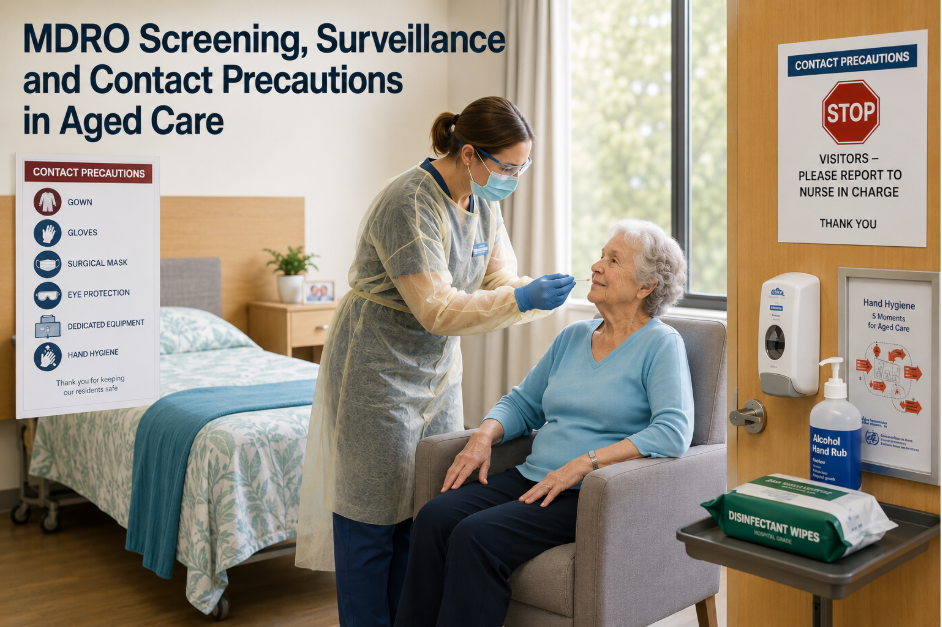
Screening may be considered in specific circumstances, such as when a resident is transferred from a hospital where they were identified as an MDRO contact, when an outbreak is suspected within the facility, or when directed by the relevant public health authority.
The decision to screen should be made in consultation with the resident’s treating medical practitioner, the facility’s infection prevention lead, and, where appropriate, the local public health unit or an infectious diseases specialist.
Screening may be indicated when directed by public health authorities during an outbreak
Screening may be considered for residents identified as MDRO contacts during hospitalisation
Routine admission screening is not recommended for most aged care residents
Routine staff screening should NOT be undertaken
Screening decisions should be documented and based on local risk assessment
When screening is performed, the type of specimens collected will depend on the MDRO being investigated. For MRSA, nasal swabs are the primary screening specimen. For VRE and CPE, rectal or perianal swabs are used. Specimens should be clearly labelled as screening specimens and processed by an accredited laboratory.
What Does the IPC Guide Say About Screening in Residential Aged Care?
The Infection Prevention and Control Guide for Aged Care (IPC Guide, 2025) provides clear guidance on MDRO screening in residential aged care. The Guide states that screening of contacts with MDRO in residential aged care is not normally undertaken (IPC Guide, 2025).
This position reflects the fundamental differences between acute hospital settings and residential aged care. In hospitals, patients are typically acutely unwell, have invasive devices, and stay for defined periods. In aged care, the facility is the resident’s home, and the focus is on quality of life alongside clinical care.
The IPC Guide also explicitly states that routine staff screening should not be undertaken. Staff who carry MDROs are not a significant transmission risk when standard precautions — particularly hand hygiene — are consistently applied.
The Guide advocates for a risk assessment approach, where local circumstances determine the level of precautions and any screening decisions. This allows facilities to respond proportionately to their specific risk profile rather than applying blanket measures that may be unnecessarily restrictive.
Facilities should ensure their MDRO policies align with the IPC Guide recommendations. Policies that mandate routine screening or blanket isolation for all MDRO-positive residents are inconsistent with current best practice and may unnecessarily restrict residents’ quality of life.
How Should Contact Precautions Be Applied for MDRO-Positive Residents?
Contact precautions for MDRO-positive residents should be applied based on individual risk assessment rather than a blanket approach. The level of precautions depends on whether the resident is colonised or infected, their ability to manage personal hygiene, and the specific MDRO involved.
For colonised residents who can independently manage their personal hygiene, standard precautions are sufficient. These residents should not be excluded from communal activities, dining, or social events. Unnecessary restriction is inconsistent with the person-centred care principles of the Strengthened Quality Standards.
For residents with active MDRO infections or who require assistance with personal hygiene, additional precautions may be needed. Contact precautions — gloves and gown for direct care — should be implemented when there is a risk of exposure to infectious body fluids or contaminated surfaces.
| Resident Status | Precaution Level | Activity Restrictions |
|---|---|---|
| Colonised, independent hygiene | Standard precautions | None — participate in all communal activities |
| Colonised, needs hygiene assistance | Standard + risk assessment | Minimal — based on individual assessment |
| MRSA/VRE infection | Contact precautions | May attend activities with appropriate hand hygiene |
| CPE (any status) | Contact precautions, single room preferred | Determined by risk assessment with specialist input |
Contact precautions should be reviewed regularly and adjusted as the resident’s clinical status changes. Stepping down precautions when no longer clinically indicated is just as important as implementing them — prolonged unnecessary restriction impacts resident wellbeing.
All precaution decisions should be documented in the resident’s care plan, communicated to all staff involved in the resident’s care, and discussed with the resident and family.
Need help implementing this in your facility? The IPS Hub gives your IPC Lead instant access to ready-made policies, procedures, and audit tools — updated monthly.
What Is the Difference Between Standard and Contact Precautions for MDROs?
Standard precautions are the baseline infection prevention practices applied to the care of all residents, regardless of their known infection status. They include hand hygiene, respiratory hygiene, safe use and disposal of sharps, environmental cleaning, and the use of PPE when there is a risk of exposure to blood or body fluids.
Contact precautions are additional measures implemented when a resident has a known or suspected MDRO infection. They add specific interventions over and above standard precautions to reduce the risk of transmission through direct or indirect contact.
| Measure | Standard Precautions | Contact Precautions (Additional) |
|---|---|---|
| Hand hygiene | 5 Moments for Hand Hygiene | Same — reinforced compliance |
| Gloves | When touching blood/body fluids | For all direct care activities |
| Gown | When clothing may be contaminated | For all direct care activities |
| Equipment | Clean between residents | Dedicate or single-use where possible |
| Cleaning | Routine cleaning schedule | Enhanced cleaning with hospital-grade disinfectant |
| Room placement | No specific requirement | Single room preferred (essential for CPE) |
The key principle is that standard precautions, when performed correctly and consistently, provide a high level of protection against MDRO transmission. Contact precautions add an additional layer of safety for situations where the risk of transmission is higher — specifically, when the resident has an active infection.
In aged care, the majority of MDRO-positive residents are colonised rather than infected. For these residents, well-executed standard precautions are the primary defence against transmission.
How Should Facilities Monitor MDRO Trends?
Monitoring MDRO trends within a facility is essential for detecting emerging risks, evaluating the effectiveness of prevention strategies, and meeting regulatory requirements. Facilities should maintain an infection surveillance system that captures MDRO cases and tracks patterns over time.
Surveillance data should include the type of MDRO, whether the resident is colonised or infected, the date of identification, and any associated outcomes. This data should be analysed regularly — at least quarterly — and presented to the infection prevention committee or equivalent governance body.
Record all new MDRO identifications in the infection surveillance database
Distinguish between colonisation and infection in surveillance records
Track MDRO trends over time (monthly, quarterly, annually)
Present surveillance data to the infection prevention committee regularly
Compare facility trends with national benchmarks where available
Use surveillance data to identify areas for quality improvement
Report MDRO data as part of clinical governance reporting
Trend analysis helps facilities detect clusters or increases in MDRO cases that may indicate a breakdown in infection prevention measures. Early detection of rising trends allows for prompt investigation and corrective action before a full outbreak develops.
Facilities should also benchmark their MDRO data against national and state-level data where available. This contextualises facility-level trends and helps identify whether local patterns reflect broader epidemiological changes or facility-specific issues.
What Role Does the Aged Care NAPS Play in MDRO Surveillance?
The Aged Care National Antimicrobial Prescribing Survey (Aged Care NAPS) is a voluntary point-prevalence survey that collects data on antibiotic prescribing and infection rates in residential aged care. In 2023, 852 aged care homes participated, auditing 53,843 residents (NCAS, 2023).
While the Aged Care NAPS does not specifically screen for MDROs, it provides valuable data on antibiotic use patterns that drive MDRO development. By understanding prescribing practices, facilities can identify opportunities to improve antimicrobial stewardship and reduce resistance pressure.
Participation in the Aged Care NAPS also provides facilities with benchmarking data, comparing their prescribing patterns against national averages. This benchmarking helps facilities identify whether their antibiotic use is higher or lower than expected and target improvement efforts accordingly.
Participate in the Aged Care NAPS annually
Use NAPS data to benchmark antibiotic prescribing against national averages
Identify opportunities to improve antimicrobial stewardship from NAPS results
Share NAPS findings with prescribers and the infection prevention committee
Use NAPS participation as evidence of compliance for accreditation
Participation in the Aged Care NAPS demonstrates a facility’s commitment to antimicrobial stewardship and infection surveillance. Assessors under the Strengthened Quality Standards may view NAPS participation as evidence of proactive engagement with quality improvement.
How Should MDRO Status Be Communicated During Care Transitions?
Communication of MDRO status during care transitions is a critical safety requirement. When a resident moves between care settings — from aged care to hospital, between aged care facilities, or from hospital back to aged care — the receiving facility must know the resident’s MDRO status to implement appropriate precautions.
Failure to communicate MDRO status can result in delayed precautions, increased transmission risk in the receiving facility, and potential harm to other patients or residents. Effective communication requires both documented and verbal handover.
Include MDRO status prominently in all transfer documentation
Provide verbal handover to the receiving facility or ambulance service
Specify the MDRO type, colonisation vs infection status, and current precaution level
Document when MDRO status was last confirmed and any recent changes
On return from hospital, review discharge documentation for new MDRO information
Update the resident’s care plan with any changes in MDRO status
The Strengthened Aged Care Quality Standards require effective clinical handover and communication during care transitions. MDRO status is a critical element of this communication, and facilities should audit their transfer processes to ensure it is consistently included.
Electronic health information systems can facilitate MDRO communication, but they should complement — not replace — direct verbal handover. Critical safety information such as MDRO status should be communicated through multiple channels to reduce the risk of information being missed.
How Can Facilities Balance Infection Prevention with Resident Quality of Life?
Balancing infection prevention with resident quality of life is one of the most important — and most challenging — aspects of MDRO management in aged care. Unlike hospitals, aged care facilities are the resident’s home, and infection prevention measures must be implemented in a way that respects this fundamental distinction.
The Aged Care Act 2024 Statement of Rights includes the right to social connection and participation in community. MDRO-positive residents retain these rights, and facilities must not impose unnecessary restrictions that compromise social participation, dignity, or quality of life.
Practical strategies for maintaining quality of life while managing MDROs include ensuring colonised residents can attend communal dining, social activities, and outings; providing clear, non-stigmatising information to the resident and family; and involving the resident in decisions about their care.
Allow colonised residents to participate in communal activities without restriction
Use clear, respectful language when discussing MDRO status with residents and families
Involve residents in decisions about their care and precaution levels
Avoid unnecessary labelling or stigmatisation of MDRO-positive residents
Facilitate family visits with appropriate hand hygiene guidance
Review precaution levels regularly to avoid unnecessary prolonged restriction
Ensure staff understand the balance between IPC and resident rights
Staff education should emphasise that MDRO management is not about isolating residents — it is about applying the right level of precautions at the right time. Overly restrictive approaches can cause psychological harm, social isolation, depression, and functional decline in older adults.
The goal is proportionate, person-centred infection prevention that protects the resident community while preserving the dignity, autonomy, and quality of life of every individual — including those who are MDRO-positive.
Internal Links
Multi-Drug Resistant Organisms (MDROs) in Aged Care
MRSA Prevention and Management in Aged Care
VRE in Aged Care — What Every Facility Needs to Know
CPE and Carbapenem Resistance in Aged Care
Frequently Asked Questions
Should aged care staff be routinely screened for MDROs?
No. The IPC Guide explicitly states that routine staff screening should not be undertaken. Consistent application of standard precautions — particularly hand hygiene — is the appropriate measure for preventing staff-mediated MDRO transmission.
Can MDRO-colonised residents use communal bathrooms?
Colonised residents who can independently manage their personal hygiene can generally use communal facilities. A local risk assessment should guide the decision, considering the resident’s hygiene practices, the MDRO involved, and the vulnerability of other residents sharing the facilities.
How often should MDRO surveillance data be reviewed?
MDRO surveillance data should be reviewed at least quarterly by the infection prevention committee or equivalent governance body. More frequent review (monthly) may be appropriate during periods of increased MDRO activity or during outbreak responses.
What information must be included in transfer documentation about MDROs?
Transfer documentation should include the MDRO type, whether the resident is colonised or infected, the current precaution level, when the MDRO was last confirmed, and any specific management requirements. This information should be communicated both in writing and verbally.
Does MDRO-positive status ever resolve?
This varies by organism. MRSA colonisation may clear spontaneously or after decolonisation treatment. VRE gut colonisation can persist for months to years. CPE colonisation may also persist for extended periods. The decision to consider a resident as MDRO-negative should involve specialist consultation and confirmatory testing.
References
Australian Commission on Safety and Quality in Health Care (ACSQHC). (2025). Infection Prevention and Control Guide for Aged Care. ACSQHC.
Australian Commission on Safety and Quality in Health Care (ACSQHC). (2025). AURA Surveillance Report 2025. ACSQHC.
National Centre for Antimicrobial Stewardship (NCAS). (2023). Aged Care National Antimicrobial Prescribing Survey 2023. NCAS.
Australian Government. (2024). Aged Care Act 2024. Federal Register of Legislation.
Strengthened Aged Care Quality Standards. (2024). Australian Government Department of Health and Aged Care.
Copyright 2026 Bug Control Pty Ltd. All rights reserved.
In This Article
- When Should MDRO Screening Be Performed in Aged Care?
- What Does the IPC Guide Say About Screening in Residential Aged Care?
- How Should Contact Precautions Be Applied for MDRO-Positive Residents?
- What Is the Difference Between Standard and Contact Precautions for MDROs?
- How Should Facilities Monitor MDRO Trends?
- What Role Does the Aged Care NAPS Play in MDRO Surveillance?
- How Should MDRO Status Be Communicated During Care Transitions?
- How Can Facilities Balance Infection Prevention with Resident Quality of Life?
- Internal Links
- Frequently Asked Questions
- References
- Developer Section
About the Author
Lyndon Forrest is the Managing Director of Bug Control — Infection Prevention Services, with over 30 years’ experience supporting aged care facilities across Australia and New Zealand with infection prevention, antimicrobial stewardship, and accreditation readiness.
Clinically reviewed by Bridgette Mackie & Dianne Newey, Clinical Directors.
Ready to Strengthen Your Facility’s Infection Prevention?
The IPS Hub provides aged care facilities across Australia and New Zealand with continuously updated IPC policies, AMS tools, outbreak management resources, and direct support from experienced IPC professionals.