Home › Knowledge Hub › Environmental Cleaning › Cleaning and Disinfection in Aged Care: What Is the Difference and Why It Matters
Environmental Cleaning
By Lyndon Forrest, Managing Director · Clinically reviewed by Bridgette Mackie & Dianne Newey, Clinical Directors · April 2026 · 9 min read
Cleaning and Disinfection in Aged Care: What’s the Difference and Why It Matters
Last updated: May 2026
TL;DR —
Cleaning and disinfection are two distinct processes that serve different purposes in aged care infection prevention. Cleaning uses a neutral detergent to physically remove soil and organic matter from surfaces. Disinfection uses a chemical agent (hospital-grade disinfectant) to kill or inactivate remaining microorganisms. The ACSQHC Aged Care IPC Guide (2024) recommends a two-step process — clean first, then disinfect — because organic matter inactivates most disinfectants. Routine cleaning under standard conditions requires only neutral detergent. Hospital-grade disinfectant is required during outbreaks, when transmission-based precautions are in place, or for specific situations (e.g., C. difficile, blood/body fluid spills). All hospital-grade disinfectants must be registered on the Australian Register of Therapeutic Goods (ARTG).
What Is the Difference Between Cleaning and Disinfection?
Cleaning and Disinfection are separate processes with distinct mechanisms and outcomes. Understanding the difference is fundamental to effective infection prevention. Conflating the two processes — or omitting one — undermines the entire environmental cleaning programme.
| Parameter | Cleaning | Disinfection |
|---|---|---|
| Purpose | Physically removes soil, organic matter, and most microorganisms | Kills or inactivates remaining microorganisms on a pre-cleaned surface |
| Product | Neutral detergent (pH 6–8) and water | Hospital-grade disinfectant (ARTG-registered) or sodium hypochlorite |
| Mechanism | Mechanical action (wiping, scrubbing) combined with surfactant action | Chemical action — disrupts microbial cell walls, membranes, or metabolic processes |
| When required | Always — every environmental cleaning event begins with cleaning | When infection risk is elevated: outbreaks, transmission-based precautions, specific organisms |
| Outcome | Surface is visibly clean and free of most organisms | Surface is microbiologically safe (pathogen load reduced to non-infectious levels) |
| Regulatory reference | ACSQHC Aged Care IPC Guide (2024), Chapter 6 | ACSQHC Aged Care IPC Guide (2024), Chapter 6; ARTG listing |
A critical principle: cleaning must always precede disinfection. Applying disinfectant to a surface that has not been cleaned first is ineffective. Organic matter (blood, body fluids, biofilm, food residue) creates a physical barrier that prevents the disinfectant from contacting the surface and can chemically neutralise the active ingredient.
How Does the Two-Step Cleaning and Disinfection Process Work?
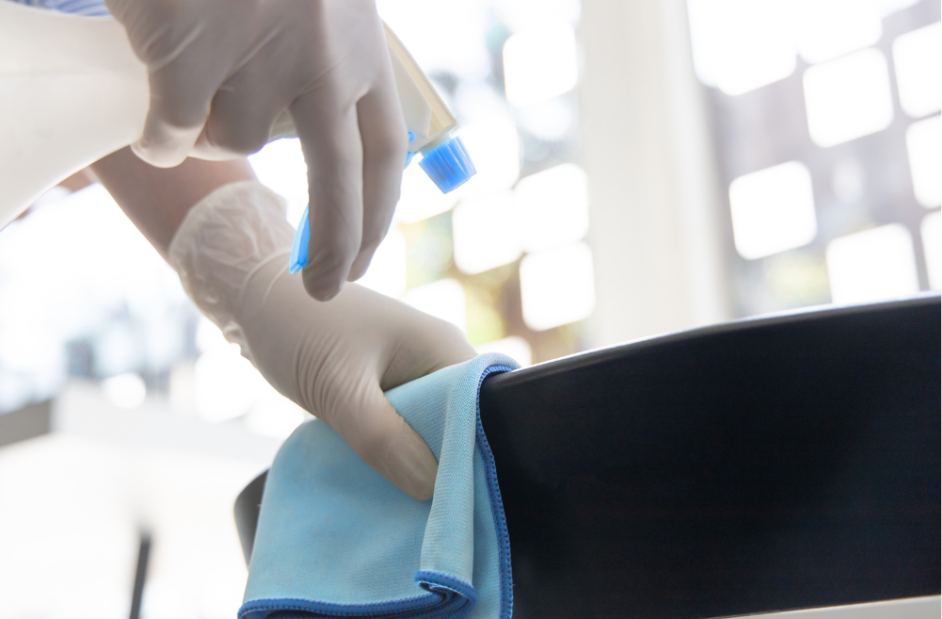
The two-step cleaning and disinfection process is the recommended method when disinfection is required in aged care. This process ensures that surfaces are both physically clean and microbiologically safe.
Need help implementing this in your facility? The IPS Hub gives your IPC Lead instant access to ready-made policies, procedures, and audit tools — updated monthly.
Step 1: Clean with Neutral Detergent
Prepare cleaning solution according to manufacturer instructions (correct dilution ratio)
Apply solution to the surface using a clean cloth or disposable wipe
Use appropriate technique: wipe in one direction using an S-shaped pattern (not back and forth); work from clean areas to dirty areas; work from high surfaces to low surfaces
Do not re-dip soiled cloths into cleaning solution — use fresh cloths or replace as needed
Allow the surface to dry (or dry with a clean cloth if immediate disinfection is required)
Dispose of used cloths appropriately
Step 2: Disinfect with Hospital-Grade Disinfectant
Prepare disinfectant solution according to manufacturer instructions (correct concentration)
Apply disinfectant to the cleaned surface using a fresh cloth or disposable wipe
Ensure the entire surface is wet with disinfectant
Allow the required contact time (dwell time) as specified on the product label — do not wipe off before contact time is complete
Allow to air dry (unless manufacturer instructs otherwise)
Dispose of used cloths and PPE appropriately
Contact time is the single most commonly violated parameter in disinfection. If a product requires 10 minutes of wet contact time and the surface is wiped dry after 2 minutes, the disinfection has not occurred. Staff must be trained to understand and comply with contact time requirements.
What Are Two-in-One Products and When Can They Be Used?
Two-in-one products (also called combined detergent-disinfectants) are formulated to clean and disinfect in a single application step. These products contain both a cleaning agent and a disinfectant agent. Two-in-one products can simplify the cleaning process and reduce time, but they must meet specific requirements.
Must be registered on the ARTG as a hospital-grade disinfectant
Must be used strictly according to manufacturer instructions for use (IFU)
Must demonstrate efficacy in the presence of organic matter (i.e., the product must work even when soil is present)
Are not suitable for all situations — heavily soiled surfaces may still require a pre-cleaning step
The ACSQHC Aged Care IPC Guide (2024) accepts two-in-one products as an alternative to the two-step process when manufacturer conditions are met
Facilities should evaluate whether two-in-one products are appropriate for their specific context. Factors include surface types, the range of organisms likely to be encountered, staff familiarity with the product, and cost. The two-step process remains the gold standard when maximum microbiological assurance is required (e.g., terminal cleaning, outbreak situations).
What Types of Disinfectants Are Used in Aged Care?
Disinfectants are classified by their level of antimicrobial activity. The Spaulding classification informs disinfectant selection based on the intended use. In environmental cleaning (non-critical surfaces), low-level and intermediate-level disinfectants are most commonly used.
| Level | Activity Spectrum | Common Agents | Aged Care Application |
|---|---|---|---|
| Low-level disinfection | Kills most vegetative bacteria, some fungi, some viruses; does NOT kill mycobacteria or bacterial spores | Quaternary ammonium compounds (QACs) | Routine disinfection of non-critical surfaces and equipment when disinfection is indicated |
| Intermediate-level disinfection | Kills vegetative bacteria, mycobacteria, most fungi, most viruses; does NOT reliably kill bacterial spores | Sodium hypochlorite (bleach) at 1,000 ppm; alcohol-based solutions (70% ethanol or isopropanol) | Disinfection when specific organisms are targeted (e.g., MRSA, VRE); blood/body fluid spill clean-up |
| High-level disinfection | Kills all microorganisms except high numbers of bacterial spores | Glutaraldehyde, ortho-phthalaldehyde (OPA), peracetic acid | Reprocessing semi-critical medical devices (per AS 5369:2023); rarely required for environmental surfaces |
Sodium hypochlorite (bleach) deserves special attention in aged care. It is effective against a broad spectrum of organisms including C. difficile spores and norovirus — two organisms that are resistant to many other disinfectants. However, sodium hypochlorite is corrosive to metals and some plastics, has an unpleasant odour, and can cause respiratory irritation. Safe use requires correct dilution, adequate ventilation, and avoidance of mixing with other chemicals (particularly acids and ammonia-based products, which produce toxic chlorine gas).
When Is Disinfection Required in Aged Care?
Disinfection is not required for every cleaning event. The ACSQHC Aged Care IPC Guide (2024) specifies that routine cleaning with neutral detergent is sufficient under standard conditions. Disinfection is required when the infection risk is elevated.
When a resident is on transmission-based precautions (contact, respiratory, or both)
During an outbreak (gastroenteritis, influenza, COVID-19, scabies, etc.)
When a resident has a known infection with an epidemiologically significant organism (MRSA, VRE, C. difficile, CRE)
After a blood or body fluid spill
During terminal cleaning of a room
When cleaning reusable equipment that has been contaminated with blood or body fluids
In clinical treatment areas after invasive procedures
A common mistake is applying disinfectant to all surfaces at all times, regardless of the infection risk. This practice increases chemical exposure for residents and staff, may contribute to antimicrobial resistance in environmental organisms, wastes product, and provides no additional benefit over neutral detergent cleaning under standard conditions.
What Are the ARTG Requirements for Hospital-Grade Disinfectants?
The Australian Register of Therapeutic Goods (ARTG) is maintained by the Therapeutic Goods Administration (TGA). Any product marketed as a hospital-grade disinfectant in Australia must be included on the ARTG. Registration confirms the product has been evaluated for safety, quality, and efficacy.
Check the product label for an ARTG number (AUST R or AUST L number)
Verify the ARTG listing at tga.gov.au if uncertain
Products labelled as ‘antibacterial’ or ‘sanitiser’ may NOT be hospital-grade disinfectants — check the ARTG listing
Using unregistered products for disinfection in aged care is a compliance risk under the Strengthened Aged Care Quality Standards
The ARTG listing specifies the product’s approved claims — use the product only for its registered purpose
What Are the Most Common Cleaning and Disinfection Mistakes in Aged Care?
Errors in cleaning and disinfection practice are widespread in aged care settings. The ACSQHC Aged Care IPC Guide (2024) and environmental cleaning audit literature identify recurring mistakes that undermine infection prevention.
| Common Mistake | Why It Matters | Correct Practice |
|---|---|---|
| Applying disinfectant without cleaning first | Organic matter inactivates disinfectants; surface remains contaminated | Always clean with detergent before applying disinfectant (two-step process) |
| Not allowing sufficient contact time | Disinfectant has not had time to kill organisms; surface is not disinfected | Follow manufacturer IFU — leave surface wet for the full specified contact time |
| Incorrect dilution of products | Too dilute = ineffective; too concentrated = surface damage, chemical exposure | Use manufacturer-specified dilution ratios; use measuring equipment, not estimation |
| Re-dipping soiled cloths into cleaning solution | Contaminates the entire bucket of solution; spreads organisms to subsequent surfaces | Use fresh cloths; do not re-dip; use spray-and-wipe or disposable wipe systems |
| Using the same cloth for multiple rooms | Cross-contamination between resident rooms | Use fresh cloths for each room; colour-code cloths by area |
| Not cleaning high-touch surfaces | High-touch surfaces are the primary transmission route for contact-spread organisms | Ensure cleaning schedules explicitly list all high-touch surfaces and train staff accordingly |
| Using household cleaning products instead of ARTG-registered disinfectants | Household products may not meet hospital-grade disinfection standards | Use only ARTG-registered hospital-grade disinfectants when disinfection is required |
How Does Chemical Disinfection Compare to Thermal Disinfection?
Disinfection can be achieved through chemical agents (as discussed above) or through thermal (heat-based) methods. Thermal disinfection uses hot water or steam at defined temperatures and exposure times to kill microorganisms. In aged care, thermal disinfection is most commonly encountered in laundry and dishwashing processes.
| Method | Application in Aged Care | Minimum Parameters | Advantages |
|---|---|---|---|
| Thermal — laundry | Hot water wash for linen | 65°C for 10 minutes, or 71°C for 3 minutes (AS/NZS 4146:2000) | No chemical residues; effective against most organisms; validated process |
| Thermal — dishwashing | Commercial dishwashers | Final rinse temperature of 80°C minimum | No chemical residues; automated process; consistent results |
| Chemical — surface disinfection | Environmental surfaces and equipment | Product-specific (per ARTG listing and manufacturer IFU) | No heat required; can be applied to heat-sensitive surfaces; portable |
Thermal disinfection is preferred where it is practicable because it does not introduce chemical residues and is not affected by organic matter to the same degree as chemical disinfectants. However, thermal methods are limited to items that can withstand the required temperatures.
Frequently Asked Questions
Can I use bleach for all disinfection in aged care?
Sodium hypochlorite (bleach) is effective against a broad spectrum of organisms, but it is not suitable for all surfaces due to its corrosive properties. Bleach is specifically recommended for C. difficile, norovirus, and blood/body fluid spills. For routine disinfection situations, a hospital-grade disinfectant (QAC or similar) may be more appropriate. Always check surface compatibility and follow manufacturer instructions.
What concentration of bleach should be used?
For general environmental disinfection: 1,000 ppm (parts per million) available chlorine. For blood and body fluid spills: an appropriate bleach or disinfectant concentration. Concentration depends on the starting strength of the bleach product — follow manufacturer dilution instructions. Pre-made solutions should be freshly prepared daily, as sodium hypochlorite degrades over time.
Is a two-in-one product as effective as the two-step process?
Two-in-one products can be effective when used according to manufacturer IFU and when the surface is not heavily soiled. However, the two-step process (clean then disinfect) provides greater assurance of microbiological cleanliness, particularly for terminal cleaning and outbreak situations. The ACSQHC Aged Care IPC Guide (2024) accepts both approaches when correctly applied.
Do I need to wear PPE when using cleaning chemicals?
Yes. The Safety Data Sheet (SDS) for each product specifies the required PPE. At minimum, gloves should be worn when handling detergents and disinfectants. Additional PPE (apron, eye protection) may be required for concentrated solutions, spray applications, or sodium hypochlorite. The Work Health and Safety Act 2011 requires employers to provide appropriate PPE and training in its use.
How do I check if a disinfectant is ARTG-registered?
Check the product label for an AUST R or AUST L number. Verify the registration at the TGA website (tga.gov.au) by searching the ARTG database. If the product does not have an ARTG number, it is not registered as a therapeutic good and should not be used as a hospital-grade disinfectant in aged care.
References and Further Reading
The following authoritative sources inform the clinical and regulatory guidance in this article. Links open in a new tab.
- Australian Commission on Safety and Quality in Health Care. Infection Prevention and Control Guide for Residential Aged Care Facilities, Version 1.1. Sydney: ACSQHC; January 2025.
- Aged Care Quality and Safety Commission. Strengthened Aged Care Quality Standards 2025 — Standard 5: Environmental management and cleaning. Canberra: ACQSC; 2025.
- Therapeutic Goods Administration. Disinfectants and sanitisers — regulatory requirements. Canberra: TGA; 2024.
- Centers for Disease Control and Prevention. Guidelines for Environmental Infection Control in Health-Care Facilities. Atlanta: CDC; 2003 (updated 2019).
- Department of Health and Aged Care. Environmental cleaning and infection prevention and control. Canberra: Commonwealth of Australia; 2024.
In This Article
- Cleaning and Disinfection in Aged Care: What’s the Difference and Why It Matters
- What Is the Difference Between Cleaning and Disinfection?
- How Does the Two-Step Cleaning and Disinfection Process Work?
- What Are Two-in-One Products and When Can They Be Used?
- What Types of Disinfectants Are Used in Aged Care?
- When Is Disinfection Required in Aged Care?
- What Are the ARTG Requirements for Hospital-Grade Disinfectants?
- What Are the Most Common Cleaning and Disinfection Mistakes in Aged Care?
- How Does Chemical Disinfection Compare to Thermal Disinfection?
- Frequently Asked Questions
About the Author
Lyndon Forrest is the Managing Director of Bug Control — Infection Prevention Services, with over 30 years’ experience supporting aged care facilities across Australia and New Zealand with infection prevention, antimicrobial stewardship, and accreditation readiness.
Clinically reviewed by Bridgette Mackie & Dianne Newey, Clinical Directors
Ready to Strengthen Your Facility’s Infection Prevention?
The IPS Hub provides aged care facilities across Australia and New Zealand with continuously updated IPC policies, AMS tools, outbreak management resources, and direct support from experienced IPC professionals.