Home › Knowledge Hub › Outbreak Management › Gastro Outbreak Step-by-Step Response in Aged Care
Outbreak Management
By Lyndon Forrest, Managing Director · Clinically reviewed by Bridgette Mackie & Dianne Newey, Clinical Directors · May 2026 · Updated November 2026 · 12 min read
Gastro Outbreak Step-by-Step Response in Aged Care
TL;DR —
A gastroenteritis outbreak in aged care is declared when two or more residents or staff develop vomiting or diarrhoea within 24 hours. Immediate actions include isolating symptomatic residents, implementing contact precautions, enhancing cleaning to twice daily, and collecting stool specimens as soon as possible. Staff must be excluded for 48 hours after symptoms cease. The outbreak is generally declared over when there have been no new cases for at least 72 hours after the last vomiting or diarrhoea episode in the last case (longer where the PHU advises, for example for a confirmed pathogen with a longer incubation period).
What Defines a Gastroenteritis Outbreak in Aged Care?
A gastroenteritis outbreak in a residential aged care facility is defined as two or more cases of vomiting or diarrhoea within a 24-hour period, where the symptoms are not attributable to non-infectious causes such as medication side effects, laxative use, or pre-existing conditions (CDNA, 2024). For the full definitions, see the outbreak definitions table.
Norovirus is the most common cause of gastro outbreaks in aged care, though other pathogens including rotavirus, sapovirus, and Clostridium difficile may also be responsible. Identifying the causative pathogen is important because it guides specific control measures and determines the required exclusion periods.
Review each case to see whether symptoms could be explained by medication, laxatives, diet or an underlying condition, but do not delay notification while you do this. If an outbreak is suspected, treat the cases as potentially infectious and notify your public health unit straight away.
Early recognition is critical. Facilities should have systems in place for staff to report gastrointestinal symptoms promptly. A centralised reporting mechanism — such as a daily symptom log reviewed by the IPC Lead — helps detect clusters before they become widespread outbreaks.
The threshold of two cases in 24 hours is deliberately low to trigger early investigation. Not every trigger will result in a confirmed outbreak, but early investigation is always preferable to delayed recognition. Facilities should err on the side of caution.
What Are the Immediate Steps When a Gastro Outbreak Is Suspected?
When a gastro outbreak is suspected, the IPC Lead should be notified immediately and the outbreak management plan activated. The first 24 hours are critical for containing transmission, and a delayed response significantly increases the infectious-resident attack rate and the duration of the outbreak.
Immediate steps include isolating symptomatic residents in their rooms, implementing contact precautions (gloves and gown for all direct contact), and enhancing hand hygiene practices. For norovirus, soap and water must be used in preference to alcohol-based hand rub (ABHR), as ABHR has limited effectiveness against non-enveloped viruses.
Notify the IPC Lead and activate the outbreak management plan
Notify the public health unit as soon as an outbreak is suspected, without waiting for test results (NSW: your local PHU on 1300 066 055; this is a legal requirement under the NSW Public Health Act 2010). Send the line list to the PHU daily while the outbreak is active.
Isolate symptomatic residents in their rooms
Implement contact precautions: gloves, gown and mask/face shield (if vomiting) for all direct contact
Switch hand hygiene to soap and water (not ABHR)
Commence a line list documenting all cases
Notify the facility manager and GP/medical officer
Initiate specimen collection from the first cases
Increase environmental cleaning frequency to twice daily minimum
Prepare family communication
A line list should be commenced immediately. This document records each case with their name, room number, symptom onset date and time, symptoms, specimen collection status, results, and outcome. The line list is the primary tool for tracking the outbreak’s trajectory and is essential for public health reporting.
The facility’s GP or medical officer should be notified promptly to review symptomatic residents and provide clinical guidance. Residents with severe symptoms, dehydration, or significant comorbidities may require hospital transfer.
How Should Residents Be Isolated and Cohorted During a Gastro Outbreak?
Symptomatic residents should be isolated in their rooms immediately upon onset of symptoms. Single rooms are ideal, but where residents share rooms, the symptomatic resident should remain in place and the asymptomatic roommate should be monitored closely. Moving asymptomatic residents to other rooms risks spreading the pathogen.
Cohorting may be used when the number of cases exceeds the facility’s isolation capacity. Residents with confirmed cases can be grouped together in a designated area with dedicated staff. Cohorted areas should have separate equipment and dedicated cleaning staff to prevent cross-contamination.
Meals should be served in residents’ rooms during the outbreak. Communal dining areas should be closed to symptomatic residents and may need to be closed entirely if the attack rate is high. Activities and group programmes should be suspended in affected areas until the outbreak is declared over.
Visitors should be informed of the outbreak and advised of the risks of visiting during an active gastro outbreak. Visiting should be managed, not banned by default. The Aged Care Act 2024 (commenced 1 November 2025) and the Statement of Rights support residents’ right to see the people important to them, so any restriction should be proportionate, time-limited, explained and recorded, and essential and support visitors should still be able to visit. Ask visitors to stay away if they have had vomiting or diarrhoea in the last 48 hours, to perform hand hygiene with soap and water on entry and exit, and to follow any PPE and room-specific advice. Follow any direction from your public health unit.
Staff should be assigned to either affected or unaffected areas where possible. Staff who care for symptomatic residents should not move between affected and unaffected wings during the same shift. This reduces the risk of staff-mediated transmission.
Need help implementing this in your facility? The IPS Hub gives your IPC Lead instant access to ready-made policies, procedures, and audit tools — updated monthly.
What Enhanced Cleaning Protocols Are Required During a Gastro Outbreak?
Environmental cleaning must be increased to a minimum of twice daily during a gastro outbreak. High-touch surfaces — including door handles, handrails, call bells, bed rails, bathroom fixtures, and shared equipment — require enhanced dedicated attention. Norovirus can survive on environmental surfaces for days to weeks, making thorough cleaning essential for outbreak control (CDNA, 2024).
Cleaning products must be effective against the suspected pathogen. For norovirus, a chlorine-based disinfectant at a concentration of 1,000 parts per million (ppm) is recommended for general surfaces and for areas contaminated with vomit or faeces. Clean first, then disinfect. Quaternary ammonium compounds (quats) are not effective against norovirus.
Immediate cleaning of body fluid spills is essential. Vomiting episodes, in particular, generate aerosols that contaminate surrounding surfaces. The area should be cleared of people, ventilated if possible, and cleaned using the spill management procedure before routine cleaning resumes.
| Surface Type | Cleaning Frequency | Disinfectant Concentration |
|---|---|---|
| General high-touch surfaces | Minimum twice daily | 1,000 ppm chlorine |
| Bathrooms and toilets | After each use by symptomatic resident | 1,000 ppm chlorine |
| Body fluid spills | Immediately | 1,000 ppm chlorine (clean first, then disinfect) |
| Shared equipment | Between each resident use | 1,000 ppm chlorine |
| Laundry | Thermal disinfection (load temperature of 65°C for at least 10 minutes, or 71°C for at least 3 minutes, plus mixing time allowance) or validated chemical disinfection, then tumble dry (AS 4146:2024) | Sodium hypochlorite only if the fabric permits and per manufacturer |
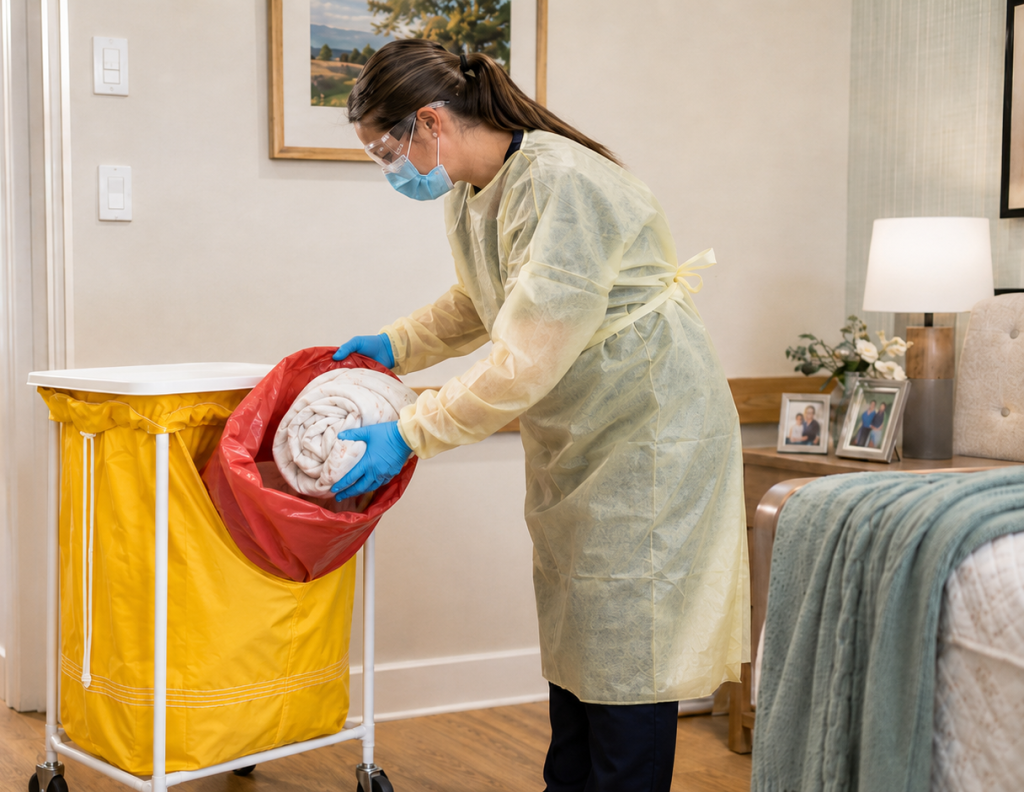
Cleaning staff must wear appropriate PPE including gloves and gown. They should be trained in the correct dilution and application of chlorine-based disinfectants. Cleaning logs should be maintained throughout the outbreak to provide evidence of compliance.
How Should Staff Be Managed During a Gastro Outbreak?
Staff who develop symptoms of gastroenteritis must be excluded from work immediately. The exclusion period is a minimum of 48 hours after the last episode of vomiting or diarrhoea. This applies to all staff including clinical, care, cleaning, catering, and administrative staff who enter resident areas.
Strict compliance with staff exclusion is one of the most effective measures for controlling a gastro outbreak. However, it is also one of the most challenging to enforce. Facilities must have contingency staffing plans that include access to agency staff to cover exclusion-related absences.
All staff should receive a briefing at the start of each shift during an outbreak. This briefing should cover the current situation, the number of cases, affected areas, PPE requirements, hand hygiene expectations, and any changes to procedures. New or agency staff must receive a targeted orientation before commencing work.
Staff must use soap and water for hand hygiene, not ABHR, when caring for residents during a suspected or confirmed norovirus outbreak. Gloves, a gown and a face mask/shield (if vomiting) are required for all direct contact with symptomatic residents and their immediate environment. PPE must be donned before entering the resident’s room and doffed after leaving.
Staff wellbeing should be monitored. Gastro outbreaks can be physically and emotionally demanding, particularly when multiple staff are excluded and workloads increase for those remaining. Facility managers should check in regularly with staff and provide practical support where possible.
What Specimens Need to Be Collected and When?
Specimens should be collected from the first symptomatic cases as soon as an outbreak is suspected. Collect stool specimens from symptomatic cases as soon as possible after onset, without waiting for the PHU. The PHU will advise how many are needed; NSW Health’s guideline aims for at least one specimen for every six cases, and WA Health suggests three to six early specimens. Do not delay collection.
For gastroenteritis, stool specimens are the primary sample type. If a resident has had a vomiting episode, a vomitus sample may also be useful. Specimens should be collected in appropriate containers, labelled clearly, and transported to the laboratory according to the pathology provider’s instructions.
Testing typically includes viral PCR panel (norovirus, rotavirus, sapovirus, astrovirus, adenovirus), bacterial culture (Salmonella, Campylobacter, Shigella), and Clostridium difficile toxin testing. The IPC Lead or clinical nurse should liaise with the pathology provider to ensure the correct test panel is requested.
Results should be followed up actively. Do not wait for the laboratory to call. Contact the pathology provider if results are not received within the expected timeframe. Positive results should be communicated to the public health unit and documented on the line list.
If the initial specimens are negative but cases continue, additional specimens should be collected. Some pathogens, particularly norovirus, may not be detected in early specimens if the viral load is low. Repeated testing from new cases increases diagnostic yield.
When Should a Facility Consider Closing to New Admissions?
Closing to new admissions is a significant decision that should be made in consultation with the local public health unit. Generally, a facility should consider closure when the outbreak is affecting multiple areas; the infectious resident/attack rate is rising; or the facility cannot safely accommodate new residents without risk of exposure.
In many jurisdictions, the public health unit may recommend or direct closure as part of the outbreak management response. This is particularly likely for norovirus outbreaks, which can spread rapidly through a facility. Closure to admissions helps contain the outbreak by preventing new susceptible individuals from entering the affected environment.
Closure should be reviewed regularly. As cases decline and no new cases are identified, the facility can consider reopening in consultation with the public health unit. Reopening should not occur until the outbreak has been declared over and terminal cleaning has been completed.
The decision to close and reopen should be documented in the outbreak log, including the rationale for the decision, who was consulted, and the date of implementation. This documentation supports accreditation readiness and demonstrates appropriate governance oversight.
Transfers from the facility to hospitals or other care settings should continue as clinically required, but the receiving facility must be informed of the outbreak status. Inter-facility transfer forms should clearly document the resident’s infection status and any precautions required.
When Can a Gastro Outbreak Be Declared Over?
A gastro outbreak caused by norovirus or an unknown or suspected viral agent is generally declared over when at least 72 hours have passed since the last vomiting or diarrhoea episode in the last case, and no new cases have developed (NSW Health; CDNA). Where a specific pathogen is confirmed, the PHU may advise a different period (at least two average incubation periods). Where a food source has been identified and eliminated, the PHU may advise a shorter period. The declaration is made with the PHU. Terminal cleaning must be completed before normal operations resume.
The declaration should be made by the IPC Lead and facility management in consultation with the local public health unit. Some jurisdictions require formal notification that the outbreak is over. The facility should notify families, staff, and the governing body that normal operations are resuming.
Terminal cleaning must be completed before normal operations resume. This involves a thorough clean of all affected areas using chlorine-based disinfectant at the appropriate concentration. Soft furnishings that cannot be adequately cleaned should be considered for steam cleaning or disposal.
A post-outbreak review should be scheduled within two weeks of the outbreak being declared over. This review examines the response, identifies what worked well and what needs improvement, and generates action items for the facility’s quality improvement register.
Final documentation should include the completed line list, notification records, cleaning logs, staff exclusion records, communication logs, and the post-outbreak review report. This documentation package provides comprehensive evidence for accreditation purposes.
Related Articles
This article is part of the IPS Knowledge Hub Outbreak Management topic cluster.
• Pillar: Outbreak Management in Aged Care
• Cluster 3.1: Gastro Outbreak Step-by-Step Response
• Cluster 3.2: Respiratory Outbreak Management for Winter 2026
• Cluster 3.3: Outbreak Documentation and Reporting Requirements
• Cluster 3.4: Post-Outbreak Review — How to Debrief and Improve
Frequently Asked Questions
How is a gastro outbreak defined in aged care?
A gastro outbreak is defined as two or more cases of vomiting or diarrhoea within a 24-hour period that are not attributable to non-infectious causes such as medication or pre-existing conditions (CDNA, 2024).
How long must staff be excluded during a gastro outbreak?
Staff must be excluded from work for a minimum of 48 hours after their last episode of vomiting or diarrhoea. This applies to all staff who enter resident care areas, including cleaning and catering staff.
Why is soap and water preferred over ABHR during a norovirus outbreak?
Alcohol-based hand rub has limited effectiveness against non-enveloped viruses like norovirus. Soap and water physically removes the virus from hands and is the recommended hand hygiene method during suspected or confirmed norovirus outbreaks.
How many specimens should be collected during a gastro outbreak?
Collect stool specimens from symptomatic cases as soon as possible after onset, without waiting for the PHU. The PHU will advise how many are needed; NSW Health’s guideline aims for at least one specimen for every six cases, and WA Health suggests three to six early specimens. Do not delay collection.
When is a gastro outbreak declared over?
A gastro outbreak caused by norovirus or an unknown or suspected viral agent is generally declared over when at least 72 hours have passed since the last vomiting or diarrhoea episode in the last case, and no new cases have developed (NSW Health; CDNA). Where a specific pathogen is confirmed, the PHU may advise a different period (at least two average incubation periods). Where a food source has been identified and eliminated, the PHU may advise a shorter period. The declaration is made with the PHU. Terminal cleaning must be completed before normal operations resume.
References
Communicable Diseases Network Australia (CDNA). (2024). Guidelines for the Public Health Management of Gastroenteritis Outbreaks Due to Norovirus or Suspected Viral Agents in Australia. Canberra: Australian Government Department of Health and Aged Care.
Australian Commission on Safety and Quality in Health Care (ACSQHC). (2025). Aged Care Infection Prevention and Control Guidance, Version 1.1. Sydney: ACSQHC.
Communicable Diseases Network Australia (CDNA). (2024). National Guidelines for the Prevention, Control and Public Health Management of Outbreaks of Acute Respiratory Infection in Residential Care Facilities in Australia, Version 2. Canberra: Australian Government.
Aged Care Quality and Safety Commission (ACQSC). (2024). Strengthened Aged Care Quality Standards. Canberra: ACQSC.
Australian Government. (2024). Aged Care Act 2024. Canberra: Commonwealth of Australia.
Hall, A.J. et al. (2014). Updated Norovirus Outbreak Management and Disease Prevention Guidelines. MMWR Recommendations and Reports, 63(RR-06), 1–18.
In This Article
- What Defines a Gastroenteritis Outbreak in Aged Care?
- What Are the Immediate Steps When a Gastro Outbreak Is Suspected?
- How Should Residents Be Isolated and Cohorted During a Gastro Outbreak?
- What Enhanced Cleaning Protocols Are Required During a Gastro Outbreak?
- How Should Staff Be Managed During a Gastro Outbreak?
- What Specimens Need to Be Collected and When?
- When Should a Facility Consider Closing to New Admissions?
- When Can a Gastro Outbreak Be Declared Over?
- Related Articles
- Frequently Asked Questions
- References
About the Author
Lyndon Forrest is the Managing Director of Bug Control — Infection Prevention Services, with over 30 years’ experience supporting aged care facilities across Australia and New Zealand with infection prevention, antimicrobial stewardship, and accreditation readiness.
Clinically reviewed by Bridgette Mackie & Dianne Newey, Clinical Directors
Ready to Strengthen Your Facility’s Infection Prevention?
The IPS Hub provides aged care facilities across Australia and New Zealand with continuously updated IPC policies, AMS tools, outbreak management resources, and direct support from experienced IPC professionals.