Home › Knowledge Hub › Outbreak Management › Respiratory Outbreak Management for Winter 2026
Outbreak Management
By Lyndon Forrest, Managing Director · Clinically reviewed by Bridgette Mackie & Dianne Newey, Clinical Directors · July 2026 · Updated November 2026 · 13 min read
Respiratory Outbreak Management for Winter 2026
TL;DR —
Winter brings co-circulation of influenza, COVID-19 and RSV in aged care. A respiratory outbreak is defined as two or more residents testing positive for influenza, COVID-19 or RSV within a 72-hour period. Facilities must implement contact and respiratory precautions (minimum), with a P2/N95 respirator where indicated (e.g. COVID-19 or aerosol-generating procedures), maximise ventilation, start antiviral treatment promptly and discuss outbreak prophylaxis with the public health unit, and ensure residents and staff are vaccinated before winter. The CDNA ARI guideline v2 (June 2024) is the primary national reference.
What Respiratory Outbreaks Should Aged Care Facilities Prepare for Each Winter?
Winter in Australia brings co-circulation of influenza A and B, COVID-19 and respiratory syncytial virus (RSV) in residential aged care homes. This pattern was seen in 2025, and facilities should prepare for several pathogens occurring at once or in quick succession.
Under the Aged Care Act 2024 (started 1 November 2025), residential aged care providers have strengthened obligations for infection prevention and outbreak management.
Influenza remains the most significant cause of morbidity and mortality from respiratory outbreaks in aged care. The 2025 influenza season saw outbreaks of both influenza A (H3N2 and H1N1) and influenza B, with H3N2 causing the most severe disease in older adults. Annual vaccination remains the primary prevention strategy.
COVID-19 continues to circulate, with new variants emerging regularly. While population immunity from vaccination and prior infection has reduced the severity of individual cases, outbreaks in aged care facilities continue to cause significant disruption and occasional severe outcomes. Adults aged 75 and over, including aged care residents, are recommended a COVID-19 vaccine dose every 6 months; adults aged 65 to 74 every 12 months (6-monthly can be considered, particularly in residential care).
RSV has been increasingly recognised as a significant pathogen in aged care. RSV causes lower respiratory tract infections in older adults and can lead to pneumonia and hospitalisation. A single dose of RSV vaccine is recommended by ATAGI for all adults aged 75 and over. From 15 May 2026, Arexvy is funded under the National Immunisation Program for adults aged 75 and over and for Aboriginal and Torres Strait Islander adults aged 60 and over. Facilities should offer RSV vaccination to eligible residents, ideally before the RSV season, and confirm current eligibility and funding with the resident’s GP or the Australian Immunisation Handbook.
Facilities should review their outbreak management plans before the winter season, ensure PPE stocks are adequate, confirm vaccination programs are in place, and conduct a simulation exercise focused on respiratory outbreak response. Preparedness activities should be completed by April to allow time for staff training and vaccination.
What Defines a Respiratory Outbreak in a Residential Aged Care Facility?
The national guideline defines a respiratory outbreak in a residential aged care home as two or more residents testing positive for influenza, COVID-19 or RSV within a 72-hour period (CDNA). Some jurisdictions add further criteria, such as epidemiologically linked acute respiratory infections in residents where testing has not identified a pathogen, so confirm with your public health unit.
Epidemiological linkage means the cases share a common exposure – such as the same wing, dining area, or activity group – suggesting person-to-person transmission rather than independent community acquisition. The IPC Lead should assess epidemiological linkage as part of the outbreak investigation.
A single case of influenza, COVID-19, or RSV in a resident should trigger heightened surveillance, with testing of contacts as advised by the public health unit, even if the outbreak threshold has not yet been met. Early detection of the second case allows rapid activation of the outbreak management plan.
Staff with respiratory symptoms must be excluded from work and tested. Staff cases that are epidemiologically linked to resident cases provide additional evidence of an outbreak.
The definition encompasses multiple pathogens because the clinical presentation of respiratory infections in older adults can be atypical. Testing is essential to determine the causative pathogen and guide specific interventions such as antiviral treatment. For the full definitions, see the outbreak definitions table.
What Are the Immediate Response Steps for a Respiratory Outbreak?
When a respiratory outbreak is identified, the IPC Lead or nurse in charge should activate the outbreak management plan and the facility manager (or delegate) should notify the local public health unit as soon as the outbreak definition is met, ideally the same day. In NSW, notify the local public health unit on 1300 066 055. The response must be swift because respiratory pathogens spread via droplets and aerosols, and delays in implementing precautions can lead to rapid transmission in the enclosed RACF environment.
Notify the IPC Lead and activate the outbreak management plan
Notify the public health unit as soon as the outbreak definition is met (same day)
Implement transmission-based precautions for affected residents according to the pathogen (contact and respiratory precautions for influenza, RSV and COVID-19, using a fit-tested P2/N95 respirator for COVID-19). Use contact and respiratory precautions as a minimum while the pathogen is unknown.
Start a line list documenting all cases
Test all symptomatic residents. Testing of asymptomatic contacts should follow your public health unit’s advice and your outbreak management plan.
If influenza is confirmed, start antiviral prophylaxis as advised by the public health unit, ideally within 24 hours of confirmation
Maximise ventilation in affected areas
Restrict movement between affected and unaffected areas
Notify families within 24 hours of outbreak declaration
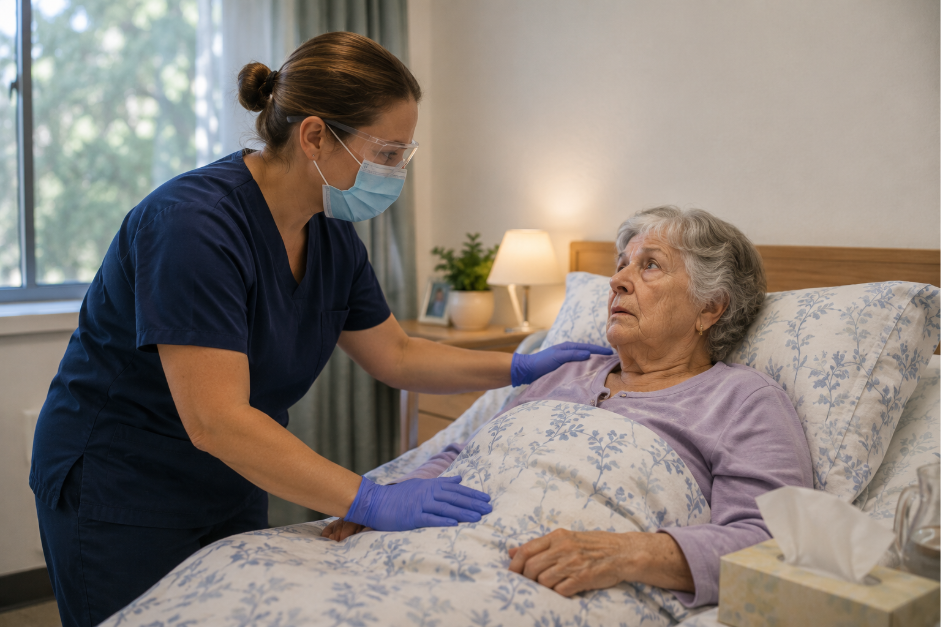
Transmission-based precautions vary by pathogen. For influenza and RSV, contact and respiratory precautions are required. For COVID-19, use contact and respiratory precautions, including a fit-tested P2/N95 respirator for all staff entering the rooms of affected residents. P2/N95 respirators need fit testing and a fit check each time they are put on. Eye protection (face shields or goggles) should be worn for all types of respiratory outbreaks.
A line list should be started immediately, recording each case with room number, symptom onset date, symptoms, test type and results, treatment initiated, and outcome. The line list is the primary epidemiological tool and must be maintained throughout the outbreak.
The facility’s GP or medical officer should be contacted immediately to review symptomatic residents and initiate treatment. Early treatment with antivirals (oseltamivir for influenza) improves outcomes when started within 48 hours of symptom onset.
Need help implementing this in your facility? The IPS Hub gives your IPC Lead instant access to ready-made policies, procedures, and audit tools — updated monthly.
How Should Testing and Diagnosis Be Managed During a Respiratory Outbreak?
Testing is essential to identify the causative pathogen and guide targeted interventions. All symptomatic residents should be tested using PCR nasopharyngeal swabs where available, or rapid antigen tests (RATs) as a first-line screening tool. PCR confirmation is recommended for the first cases to establish the pathogen with certainty.
Testing should cover influenza A and B, COVID-19 (SARS-CoV-2), and RSV at a minimum. A multiplex respiratory PCR panel is the most efficient approach, as it tests for multiple pathogens from a single specimen. The IPC Lead should confirm the availability of test panels with the supplier before the winter season and ensure a supply is ready to use.
Testing of close contacts may be considered based on risk assessment, outbreak severity, and public health advice. Routine asymptomatic testing is not universally recommended in RACF.
Serial testing may be required during the outbreak. Residents who initially test negative but develop symptoms should be retested. Confirmatory PCR testing should be considered where results will influence management or where initial tests are negative despite symptoms.
Test results should be documented on the line list and communicated to the public health unit promptly. Positive results guide decisions about antiviral treatment, prophylaxis, and the level of precautions required. The outbreak management team decides when to declare an outbreak over, in consultation with the public health unit. For COVID-19, influenza and RSV, the national guideline advises this can generally be done 7 days after the last case tests positive, or 7 days after the last case was isolated, whichever is longer, and not while PCR results are pending. State and territory criteria vary, so confirm with your public health unit.
What Infection Control Measures Are Required During a Respiratory Outbreak?
Infection control measures during a respiratory outbreak include transmission-based precautions, enhanced environmental cleaning, restricted movement, and visitor management. The specific precautions depend on the identified pathogen, but a precautionary approach should be applied until pathogen identification is confirmed.
| Pathogen | Precaution Type | PPE Required | Key Measure |
|---|---|---|---|
| Influenza | Contact + Respiratory | Surgical mask, gown, gloves, eye protection | Antiviral prophylaxis as advised by the PHU |
| COVID-19 | Contact + Respiratory (P2/N95 where indicated) | N95/P2 respirator, gown, gloves, eye protection | Maximise ventilation |
| RSV | Contact + Respiratory | Surgical mask, gown, gloves, eye protection | Isolate symptomatic residents |
| Unknown ARI | Contact + Respiratory (minimum) | Surgical mask, gown, gloves, eye protection | Test to identify pathogen |
Symptomatic residents should be isolated in their rooms with the door closed where possible. If single rooms are not available, cohorting of residents with the same pathogen may be considered. Residents with different respiratory pathogens must not be cohorted together.
Environmental cleaning should be increased in affected areas, with particular attention to high-touch surfaces. Respiratory pathogens are generally susceptible to standard hospital-grade disinfectants. Cleaning frequency should be at least twice daily in affected areas.
Communal activities in affected areas should be suspended. Meals should be served in rooms for symptomatic residents. Movement between affected and unaffected areas should be minimised for both residents and staff.
N95/P2 respirators must be available for aerosol-generating procedures (AGPs) such as nebuliser therapy, suctioning, and CPAP/BiPAP use. During COVID-19 outbreaks, N95/P2 respirators are recommended for all contact with affected residents, not only during AGPs.
How Should Antiviral Treatment and Prophylaxis Be Used?
Antiviral therapy is a critical component of influenza outbreak management in aged care. Oseltamivir (Tamiflu) is the recommended antiviral for both treatment of confirmed cases and post-exposure prophylaxis of contacts. Treatment should commence within 48 hours of symptom onset for maximum effectiveness (CDNA, 2024).
When influenza is confirmed in an outbreak, the public health unit advises which residents should receive post-exposure prophylaxis with oseltamivir, and consent must be obtained. Prophylaxis should start as soon as possible after the outbreak is confirmed, ideally within 24 hours, and the duration should follow current public health advice. Do not wait for every resident to be tested before starting treatment for symptomatic residents.
The facility’s GP or medical officer should prescribe antivirals and assess each resident for contraindications. Renal dose adjustment is required for residents with impaired kidney function. Oseltamivir is generally well tolerated but may cause nausea in some residents.
For COVID-19, oral antivirals (nirmatrelvir/ritonavir, Paxlovid, or molnupiravir, Lagevrio) are available on the PBS. People aged 70 or over who test positive are eligible, and treatment must start within five days of symptom onset. Paxlovid interacts with many medicines, so the prescriber and pharmacist must check for interactions. Pre-assess residents so treatment can start quickly. Follow current national guidance and the treating medical practitioner’s advice.
There are currently no specific antiviral treatments for RSV in aged care. Management of RSV outbreaks focuses on supportive care, isolation, and infection control measures. RSV vaccination (recommended for adults aged 75 and over) offers a preventive approach; confirm eligibility with the resident’s GP.
What Ventilation and Environmental Controls Are Recommended?
Ventilation is a key environmental control for respiratory outbreaks. Maximising outdoor air supply and reducing recirculation of indoor air reduces the concentration of airborne respiratory pathogens. During an outbreak, ventilation strategies should be reviewed and enhanced where possible.
Natural ventilation — opening windows and doors to allow outdoor air to flow through the building — is the simplest and most effective strategy for many aged care facilities. However, this must be balanced against resident comfort, particularly during cold weather. Windows in affected areas should be opened where residents can tolerate it.
Mechanical ventilation systems should be set to maximise outdoor air intake and minimise recirculation during an outbreak. Air conditioning systems that recirculate air without adequate filtration can spread respiratory pathogens between rooms. HVAC filtration should be optimised where system design allows (e.g. higher?efficiency filters or HEPA in portable units).
Portable air purifiers with HEPA filters can supplement ventilation in high-risk areas such as isolation rooms and corridors in affected wings. These units filter airborne particles including respiratory droplet nuclei and can reduce the concentration of infectious aerosols.
Environmental cleaning during respiratory outbreaks should focus on high-touch surfaces and shared equipment. Standard hospital-grade disinfectants are effective against influenza, COVID-19, and RSV. Cleaning frequency should be increased to at least twice daily in affected areas, with additional cleaning after aerosol-generating procedures.
How Should Facilities Manage Staffing During a Respiratory Outbreak?
Respiratory outbreaks create significant staffing challenges. Staff who develop symptoms must be excluded from work, and the high attack rate of respiratory pathogens can rapidly deplete the available workforce. Facilities must have contingency staffing plans that include access to agency staff and the ability to redistribute workloads.
Staff should be assigned to either affected or unaffected areas and should not move between them during the same shift. Where staffing levels do not allow complete separation, staff should attend to unaffected residents first and then move to affected areas, changing PPE between zones.
Staff vaccination is the most important measure for protecting the workforce during respiratory seasons. Facilities should achieve the highest possible vaccination rates for influenza and COVID-19 among staff. Vaccination should be offered on site and during work hours to maximise uptake.
Symptomatic staff must not work. Return-to-work criteria differ by pathogen, so follow the staff exclusion and return-to-work advice in the current national guideline, your state or territory health department and your organisation’s policy. In NSW there is no legally mandated isolation period for COVID-19, and NSW Health recommends staying away until acute symptoms have resolved.
Staff wellbeing must be prioritised. Respiratory outbreaks, particularly COVID-19, can be anxiety-inducing for staff who are concerned about their own health and that of their families. Regular communication, access to employee assistance programmes, and practical support help maintain morale during challenging outbreaks.
Related Articles
This article is part of the IPS Knowledge Hub Outbreak Management topic cluster.
• Pillar: Outbreak Management in Aged Care
• Cluster 3.1: Gastro Outbreak Step-by-Step Response
• Cluster 3.2: Respiratory Outbreak Management for Winter 2026
• Cluster 3.3: Outbreak Documentation and Reporting Requirements
• Cluster 3.4: Post-Outbreak Review — How to Debrief and Improve
Frequently Asked Questions
What defines a respiratory outbreak in aged care?
The national guideline defines a respiratory outbreak as two or more residents testing positive for influenza, COVID-19 or RSV within a 72-hour period. Confirm any additional local criteria with your public health unit.
Should staff and residents be vaccinated before winter?
Yes. Influenza and COVID-19 vaccination is recommended for all residents and staff before the winter season. Vaccination is the most effective preventive measure and is best completed before the winter season. A single dose of RSV vaccine is recommended for adults aged 75 and over.
When should antiviral prophylaxis be started for influenza?
When influenza is confirmed in an outbreak, the public health unit advises which residents should receive post-exposure prophylaxis with oseltamivir, and consent must be obtained. Prophylaxis should start as soon as possible after the outbreak is confirmed, ideally within 24 hours, and the duration should follow current public health advice. Do not wait for every resident to be tested before starting treatment for symptomatic residents.
What PPE is required for COVID-19 outbreaks in aged care?
For COVID-19, use contact and respiratory precautions: a fit-tested P2/N95 respirator, gown, gloves and eye protection for staff entering the rooms of affected residents. Use a P2/N95 respirator for aerosol-generating procedures during any respiratory outbreak. Check the current national guideline and the Aged Care Infection Prevention and Control Guide for any update.
How should ventilation be managed during a respiratory outbreak?
Maximise outdoor air by opening windows where feasible, adjust mechanical ventilation to reduce recirculation, and consider portable HEPA air purifiers in high-risk areas. Ventilation is a key environmental control for reducing airborne transmission of respiratory pathogens.
References
Communicable Diseases Network Australia (CDNA). (2024). National Guidelines for the Prevention, Control and Public Health Management of Outbreaks of Acute Respiratory Infection (including COVID-19 and Influenza) in Residential Care Facilities in Australia, Version 2. Canberra: Australian Government Department of Health and Aged Care.
Australian Commission on Safety and Quality in Health Care (ACSQHC). (2025). Aged Care Infection Prevention and Control Guidance, Version 1.1. Sydney: ACSQHC.
Australian Government Department of Health and Aged Care. (2024). Australian Immunisation Handbook. Canberra: Australian Government.
Aged Care Quality and Safety Commission (ACQSC). (2024). Strengthened Aged Care Quality Standards. Canberra: ACQSC.
Australian Government. (2024). Aged Care Act 2024. Canberra: Commonwealth of Australia.
World Health Organization (WHO). (2023). Roadmap to Improve and Ensure Good Indoor Ventilation in the Context of COVID-19. Geneva: WHO.
In This Article
- What Respiratory Outbreaks Should Aged Care Facilities Prepare for Each Winter?
- What Defines a Respiratory Outbreak in a Residential Aged Care Facility?
- What Are the Immediate Response Steps for a Respiratory Outbreak?
- How Should Testing and Diagnosis Be Managed During a Respiratory Outbreak?
- What Infection Control Measures Are Required During a Respiratory Outbreak?
- How Should Antiviral Treatment and Prophylaxis Be Used?
- What Ventilation and Environmental Controls Are Recommended?
- How Should Facilities Manage Staffing During a Respiratory Outbreak?
- Related Articles
- Frequently Asked Questions
- References
About the Author
Lyndon Forrest is the Managing Director of Bug Control — Infection Prevention Services, with over 30 years’ experience supporting aged care facilities across Australia and New Zealand with infection prevention, antimicrobial stewardship, and accreditation readiness.
Clinically reviewed by Bridgette Mackie & Dianne Newey, Clinical Directors.
Ready to Strengthen Your Facility’s Infection Prevention?
The IPS Hub provides aged care facilities across Australia and New Zealand with continuously updated IPC policies, AMS tools, outbreak management resources, and direct support from experienced IPC professionals.