Home › Knowledge Hub › IPC Education › How to Plan and Deliver IPC Training Sessions in Aged Care
IPC Education
By Lyndon Forrest, Managing Director · Clinically reviewed by Bridgette Mackie & Dianne Newey, Clinical Directors · June 2026 · 11 min read
How to Plan and Deliver IPC Training Sessions in Aged Care
TL;DR —
Planning and delivering effective IPC training sessions in aged care requires a structured approach that aligns session content with regulatory requirements, workforce needs, and adult learning principles. The ACSQHC Aged Care IPC Training Tool provides a nationally recognised framework for structuring individual training sessions, covering topics, objectives, resources, content, activities, and assessment. Under the Strengthened Aged Care Quality Standards (effective 1 November 2025), Standard 2: Outcome 2.9 Action 2.9.6: All aged care workers regularly receive competency-based training on core matters relevant to their role. Delivery methods include face-to-face practical sessions, simulation, e-learning, and blended approaches. Training must accommodate the culturally and linguistically diverse workforce in aged care, Action 2.9.3. Assessment must confirm competency, not merely attendance, Action 2.9.7. Documentation must record dates, topics, attendees, and competency outcomes.
Why Does Structured Session Planning Matter for IPC Training?
IPC training sessions in aged care are most effective when they are planned, structured, and aligned to specific learning objectives. Unstructured ‘information sharing’ — such as reading a policy aloud or distributing a handout — does not produce the competency changes required under the Strengthened Aged Care Quality Standards.
The ACSQHC Aged Care IPC Guide (2024) identifies education and training as a core component of the IPC programme. The accompanying ACSQHC Aged Care IPC Training Tool provides a structured template for planning individual sessions. Using the Training Tool ensures sessions are focused, time-efficient, and produce assessable outcomes.
Structured IPC training sessions in aged care also support regulatory compliance. Quality assessors evaluating compliance with Standard 2, Outcome 2.9.1, will examine training records for evidence of: defined learning objectives, content aligned to regulatory requirements, practical assessment of competency (not attendance alone), and documented outcomes and remedial actions.
For the broader IPC education and training framework, see IPC Education and Training in Aged Care: A Complete Guide.
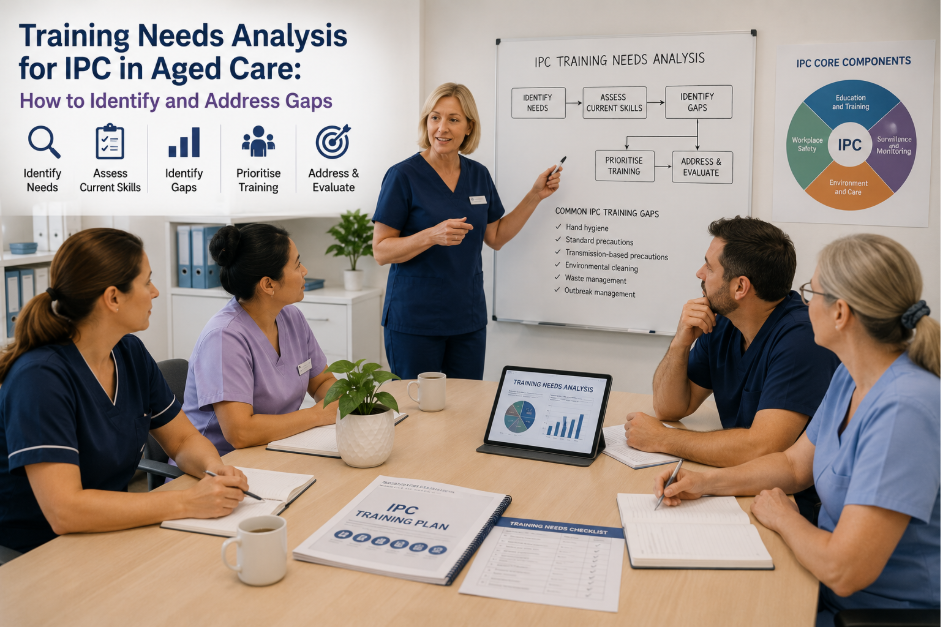
For identifying training priorities before session planning, see Training Needs Analysis for IPC in Aged Care
How Is the ACSQHC IPC Training Tool Used?
The ACSQHC Aged Care IPC Training Tool is a nationally developed resource designed to support aged care providers in planning and delivering structured IPC training sessions. The Training Tool provides a session planning template with the following components:
| Component | Description | Example (Hand Hygiene Session) |
|---|---|---|
| Topic | The specific IPC area to be covered | Hand hygiene: 5 Moments and correct technique |
| Learning objectives | What participants will be able to do after the session (measurable, observable outcomes) | Identify the 5 Moments for Hand Hygiene; demonstrate correct ABHR technique; differentiate when ABHR vs soap and water is required |
| Target audience | Who needs to attend this session (role, level) | All personal care workers and cleaning staff |
| Resources needed | Equipment, materials, and facilities required | ABHR dispensers, UV light box, fluorescent hand rub, handwashing posters, scenario cards, competency checklists |
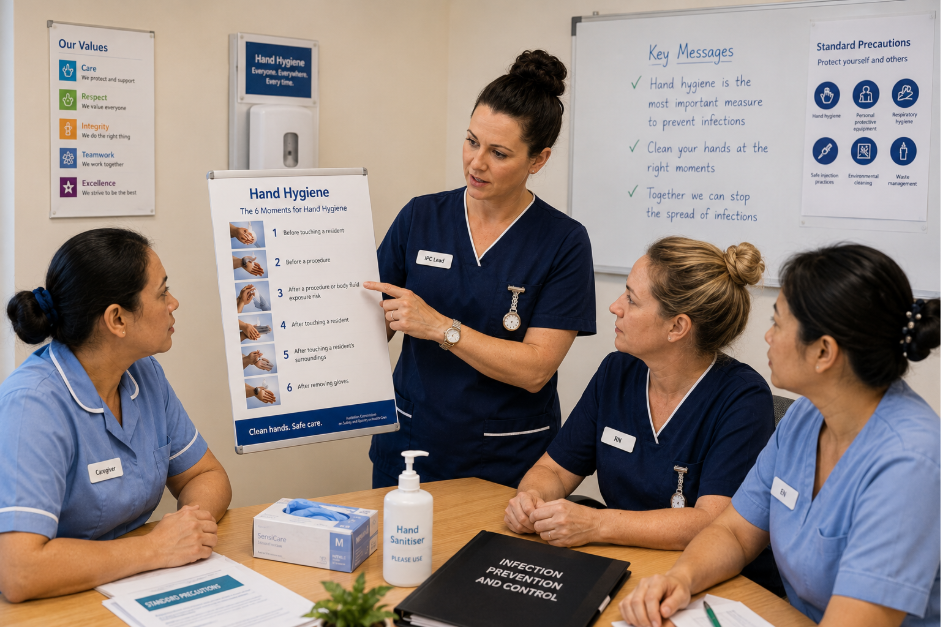
| Content | Key information to be delivered (knowledge component) | WHO 5 Moments framework; ABHR indications; soap-and-water indications; technique steps; nail and jewellery policy |
| Activities | Practical exercises for skill development | UV light hand hygiene assessment; scenario card exercise; return demonstration |
| Assessment | Method for confirming competency | Observed ABHR technique against checklist; 5 Moments identification quiz (pass: 80%) |
| Duration | Estimated session length | 45 minutes (20 minutes theory, 25 minutes practical/assessment) |
The ACSQHC IPC Training Tool is available from the Australian Commission on Safety and Quality in Health Care website. Providers should adapt the tool to their specific context, staffing, and Training Needs Analysis findings.
What Delivery Methods Are Available for IPC Training Sessions?
IPC training sessions in aged care can be delivered through multiple methods. The optimal method depends on the topic, the learning objective (knowledge vs skill vs behaviour), the audience, and practical constraints (staffing, time, resources).
| Delivery Method | Best For | Strengths | Limitations |
|---|---|---|---|
| Face-to-face practical session | Psychomotor skills (hand hygiene technique, PPE donning/doffing, cleaning technique) | Allows real-time correction; supports return demonstration; highest engagement | Requires trained facilitator; staff must be released from duties; scheduling challenges |
| Simulation and scenario-based training | Decision-making (outbreak response, PPE selection for clinical scenarios, transmission-based precautions) | Safe environment to practise; tests application of knowledge; realistic contexts | Resource-intensive to design; requires facilitator with clinical expertise |
| E-learning (online modules) | Foundational theory (chain of infection, standard precautions overview, regulatory requirements) | Self-paced; accessible anytime; consistent content; tracks completion | Does not assess practical skills; low engagement if poorly designed; requires digital literacy |
| Blended learning | Combining theory (e-learning) with practical assessment (face-to-face) | Efficient use of face-to-face time; theory completed in advance; practical time focused on skills | Requires both digital platform and face-to-face scheduling |
| Toolbox talks and safety huddles | Short, focused refreshers on specific topics (5–10 minutes during shift handover) | Minimal disruption; can target emerging issues (e.g., post-audit feedback); frequent reinforcement | Insufficient for initial skill acquisition; limited assessment opportunity |
| On-the-job coaching | Real-time skill reinforcement during actual care delivery | Immediate, contextual, and personalised; addresses individual practice gaps | Dependent on supervisor/coach availability and competence; informal documentation |
| Tabletop exercises | Outbreak response planning and decision-making | Tests coordination, communication, and role clarity without live outbreak conditions | Does not test physical skills; requires facilitation |
Need help implementing this in your facility? The IPS Hub gives your IPC Lead instant access to ready-made policies, procedures, and audit tools — updated monthly.
How Should IPC Training Engage a Culturally and Linguistically Diverse Workforce?
The aged care workforce in Australia is culturally and linguistically diverse (CALD). The Department of Health and Aged Care‘s Aged Care Workforce Census (2024) reports that approximately 37 per cent of the direct care workforce was born overseas, with over 40 language backgrounds represented. IPC training sessions in aged care must accommodate this diversity to ensure all workers achieve competency.
Strategies for inclusive IPC training delivery:
Use plain language — avoid jargon, acronyms (or define them), and complex sentence structures; aim for reading level 8 (year 8 equivalent) or below
Visual and practical emphasis — use images, diagrams, and videos to supplement written/verbal content; prioritise practical demonstration over written instructions
Multilingual resources — provide key handouts (e.g., 5 Moments poster, PPE sequence) in the languages most represented in the workforce where available
Buddy systems — pair CALD workers with English-proficient colleagues for on-the-job coaching and clarification
Check for understanding — use teach-back techniques (‘Can you show me how you would do this?’) rather than asking ‘Do you understand?’ (which often produces a ‘yes’ regardless)
Cultural sensitivity — be aware that cultural norms around questioning authority, asking questions in group settings, and physical demonstrations may vary; offer individual coaching as an alternative to group assessment where needed
Use interpreters for critical safety training — if a worker’s English proficiency is insufficient to understand PPE doffing or outbreak procedures, provide interpreter support for those specific sessions
What Is the Recommended Frequency for IPC Training Sessions?
The ACSQHC Aged Care IPC Guide (2024) does not mandate a single frequency for all IPC training. Instead, frequency should be determined by the topic, risk level, audit data, and Training Needs Analysis findings.
| Training Category | At Orientation | Minimum Ongoing Frequency | Triggers for Additional Sessions |
|---|---|---|---|
| Mandatory IPC orientation | Yes — before commencing resident-facing duties | N/A (one-off) | New employee; new volunteer; new contractor; change of role |
| Hand hygiene (practical) | Yes — with competency assessment | Annual (minimum); quarterly if audit below 80% | Post-outbreak; audit failure; TNA finding |
| PPE donning and doffing (practical) | Yes — with competency assessment | Annual (minimum) | Outbreak activation; new PPE product; audit/observation finding |
| Outbreak response (scenario/tabletop) | Yes — role-specific overview | Annual; tabletop exercise recommended biannually | Post-outbreak debrief; plan update; TNA finding |
| Environmental cleaning (practical for cleaning staff) | Yes — with competency assessment | Quarterly (cleaning workforce); annually (other staff) | Product change; audit failure; outbreak |
| Refresher topics (toolbox talks, safety huddles) | N/A | Monthly (minimum); weekly during outbreaks | Audit feedback; incident; seasonal risk (influenza/gastro season) |
How Should Competency Be Assessed During IPC Training Sessions?
Competency assessment during IPC training sessions in aged care must confirm that participants can apply what they have learned — not merely that they attended. The ACSQHC Aged Care IPC Guide (2024) distinguishes between attendance (participation) and competency (demonstrated ability).
Assessment Methods Matched to Learning Objectives
| Learning Objective Type | Assessment Method | Example |
|---|---|---|
| Knowledge (cognitive) | Written or oral quiz; scenario-based questions | Quiz: ‘Name the 5 Moments for Hand Hygiene’ (pass mark: 80%) |
| Skill (psychomotor) | Observed practical demonstration; return demonstration | Observed PPE donning/doffing against competency checklist (100% required) |
| Behaviour (affective — sustained practice) | Audit observation over time; peer observation | Hand hygiene audit compliance at 3-month follow-up (target: above 80%) |
For staff who do not achieve the required competency standard:
Provide immediate corrective feedback and additional demonstration
Offer additional practice time (may need to schedule a follow-up session)
Reassess within a defined timeframe (e.g., within 7 days)
Document the gap, the remedial action, and the reassessment result
Escalate to management if competency is not achieved after remediation (may require supervised practice, role adjustment, or further investigation)
How Should IPC Training Sessions Be Documented?
Documentation of IPC training sessions in aged care serves as evidence for quality assessments, accreditation visits, and internal governance reporting. Every training session should generate a documented record.
Minimum documentation for each IPC training session:
Session date, time, and duration
Topic and learning objectives (aligned to the ACSQHC IPC Training Tool format)
Trainer name, role, and qualifications
Attendee list — names, roles, and signatures
Delivery method (face-to-face, e-learning, simulation, blended, toolbox talk)
Assessment method and results (quiz scores, competency checklist outcomes)
Staff who did not attend (for follow-up scheduling)
Staff who did not achieve competency (remedial action plan and reassessment date)
Evaluation feedback from participants (optional but recommended for continuous improvement)
Training documentation should be entered into a specific workplace learning management system, individual staff learning profiles, and nationally recognised qualification records. Aggregate training data – completion rates, competency rates by topic, outstanding training by staff category – should be reported to the IPC governance committee at least quarterly.
How Is IPC Training Effectiveness Evaluated?
Evaluation of IPC training effectiveness in aged care moves beyond ‘Was the session delivered?’ to ‘Did the session change practice?’ The Kirkpatrick Model provides a widely used framework for evaluating training effectiveness at four levels:
| Kirkpatrick Level | Evaluation Focus | Method | Example |
|---|---|---|---|
| Level 1: Reaction | Did participants find the training engaging and relevant? | Post-session evaluation form; verbal feedback | ‘Rate the usefulness of this session (1–5)’ |
| Level 2: Learning | Did participants acquire the intended knowledge and skills? | Pre- and post-training quiz; competency checklist result | Average quiz score improved from 62% to 89% post-training |
| Level 3: Behaviour | Did participants change their practice as a result of training? | Audit data comparison (pre- and post-training); direct observation | Hand hygiene compliance increased from 72% to 88% at 3-month follow-up |
| Level 4: Results | Did the training produce organisational outcomes? | HAI rates; outbreak frequency; incident data; quality assessment findings | Gastroenteritis outbreak incidence reduced by 40% year-on-year |
Most aged care providers evaluate at Levels 1 and 2 (reaction and learning). Evaluation at Levels 3 and 4 (behaviour and results) requires ongoing audit and surveillance data — this is where IPC training evaluation connects to the broader quality improvement and TNA cycle.
For how evaluation data feeds back into training planning, see Training Needs Analysis for IPC in Aged Care
What Is the Difference Between Mandatory and Recommended IPC Training?
IPC training sessions in aged care fall into two categories: mandatory (required by regulation or contractual obligation) and recommended (best practice but not explicitly mandated). The distinction affects scheduling priority and compliance reporting.
| Category | Examples | Regulatory Basis | Consequence of Non-Compliance |
|---|---|---|---|
| Mandatory | Hand hygiene; PPE; standard precautions; transmission-based precautions; outbreak response; WHS-required training | Strengthened Aged Care Quality Standards 4.2 & action 5.2.2); Work Health and Safety Act 2011; Aged Care Act 2024 | Quality assessment non-compliance; potential sanctions; WHS enforcement; increased infection risk |
| Recommended (best practice) | Antimicrobial stewardship awareness; advanced outbreak management (tabletop exercises); IPC leadership development; specialised topics (e.g., endoscope reprocessing, implantable device management) | ACSQHC Aged Care IPC Guide (2024) (guidance, not regulation); NSQHS Standards (where applicable) | Missed improvement opportunities; less prepared workforce; may be identified as improvement area at quality assessment |
TiNA — Training Needs Analysis Tool: Identify IPC training gaps across your workforce with TiNA — our Training Needs Analysis tool designed specifically for aged care facilities. Currently in pilot.
Frequently Asked Questions
What is the ACSQHC IPC Training Tool?
The ACSQHC Aged Care IPC Training Tool is a session planning framework developed by the Australian Commission on Safety and Quality in Health Care. It provides a structured template for planning individual IPC training sessions — covering topic, objectives, resources, content, activities, and assessment. The tool is available from the ACSQHC website and should be adapted to local context.
How long should an IPC training session be?
Session length depends on the topic and delivery method. Practical skills sessions (hand hygiene, PPE) typically require 30–60 minutes to allow for demonstration, practice, and individual competency assessment. Theory sessions can range from 20–45 minutes. Toolbox talks and safety huddles should be 5–10 minutes. Avoid sessions exceeding 90 minutes — adult learner attention declines significantly after 60 minutes.
How do you train night shift staff in IPC?
Night shift staff face scheduling barriers to attending daytime training sessions. Strategies include: scheduling face-to-face sessions at shift changeover times; providing e-learning modules for theory components that can be completed during quiet periods; recording practical demonstration videos for self-directed review; assigning a designated IPC champion on each night shift who receives additional training and coaches colleagues; and conducting on-the-job competency assessments during night shifts by the IPC Lead or delegate.
Can IPC training be outsourced to an external provider?
Yes. External IPC education providers can deliver specialist training, particularly where internal IPC expertise is limited. However, the facility retains responsibility for ensuring training content aligns with its own IPC policies, the Strengthened Aged Care Quality Standards, and the ACSQHC Aged Care IPC Guide (2024). External training must be documented in the facility’s training records and linked to individual staff competency profiles.
What training records do quality assessors look for?
Quality assessors expect to see: a documented training programme or schedule linked to regulatory requirements; individual staff training records showing dates, topics, and competency assessment results; evidence of a Training Needs Analysis informing training priorities; remedial action records for staff who did not achieve competency; and aggregate training data reported to the IPC governance committee.
References and Further Reading
The following authoritative sources inform the clinical and regulatory guidance in this article. Links open in a new tab.
- Aged Care Quality and Safety Commission. Strengthened Aged Care Quality Standards 2025 — Standard 7: Workforce. Canberra: ACQSC; 2025.
- Australian Commission on Safety and Quality in Health Care. Infection Prevention and Control Guide for Residential Aged Care Facilities, Version 1.1. Sydney: ACSQHC; January 2025.
- Australasian College for Infection Prevention and Control. IPC Professional Competency Standards and Education Resources. Melbourne: ACIPC; 2024.
- World Health Organization. Core components of infection prevention and control programmes at the national and acute health care facility level. Geneva: WHO; 2016.
- Department of Health and Aged Care. Aged care workforce education and training — IPC requirements. Canberra: Commonwealth of Australia; 2025.
In This Article
- Why Does Structured Session Planning Matter for IPC Training?
- How Is the ACSQHC IPC Training Tool Used?
- What Delivery Methods Are Available for IPC Training Sessions?
- How Should IPC Training Engage a Culturally and Linguistically Diverse Workforce?
- What Is the Recommended Frequency for IPC Training Sessions?
- How Should Competency Be Assessed During IPC Training Sessions?
- How Should IPC Training Sessions Be Documented?
- How Is IPC Training Effectiveness Evaluated?
- What Is the Difference Between Mandatory and Recommended IPC Training?
- Frequently Asked Questions
About the Author
Lyndon Forrest is the Managing Director of Bug Control — Infection Prevention Services, with over 30 years’ experience supporting aged care facilities across Australia and New Zealand with infection prevention, antimicrobial stewardship, and accreditation readiness.
Clinically reviewed by Bridgette Mackie, Clinical Director
TiNA — Training Needs Analysis Tool
Identify IPC training gaps across your workforce with TiNA — our Training Needs Analysis tool designed specifically for aged care facilities. Currently in pilot.
Ready to Strengthen Your Facility’s Infection Prevention?
The IPS Hub provides aged care facilities across Australia and New Zealand with continuously updated IPC policies, AMS tools, outbreak management resources, and direct support from experienced IPC professionals.