
Home › Knowledge Hub › Kitchen Food Safety › Food Handler Hygiene and IPC Requirements in Aged Care
Kitchen Food Safety
By Lyndon Forrest, Managing Director · Clinically reviewed by Bridgette Mackie & Dianne Newey, Clinical Directors · May 2026 · 10 min read
Last updated: March 2026
Food Handler Hygiene and IPC Requirements in Aged Care
Last updated: March 2026
TL;DR —
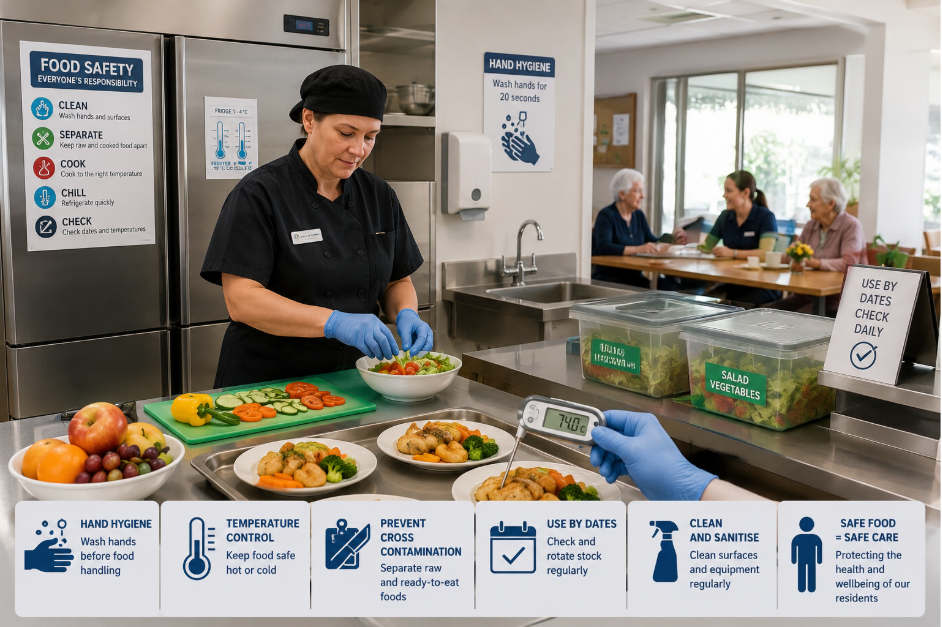
Food handler hygiene in aged care is regulated by FSANZ Food Safety Standard 3.2.2 and reinforced by the Strengthened Aged Care Quality Standards (Outcomes 4.2, 5.2 and 6.3). All food handlers must wash hands with soap and warm running water — alcohol-based hand rub (ABHR) is not a substitute for handwashing in food handling. Personal hygiene standards include hair restraints, no nail polish or artificial nails, wound management with waterproof dressings and gloves, and removal of hand jewellery. Food handlers with gastroenteritis symptoms must be excluded for at least 48 hours after symptoms resolve. Gloves are not a substitute for handwashing and must be changed between tasks. At least one food safety supervisor per kitchen must hold a nationally recognised certificate (FSANZ Standard 3.2.2A, effective 8 December 2023).
Why Is Food Handler Hygiene Critical in Aged Care?
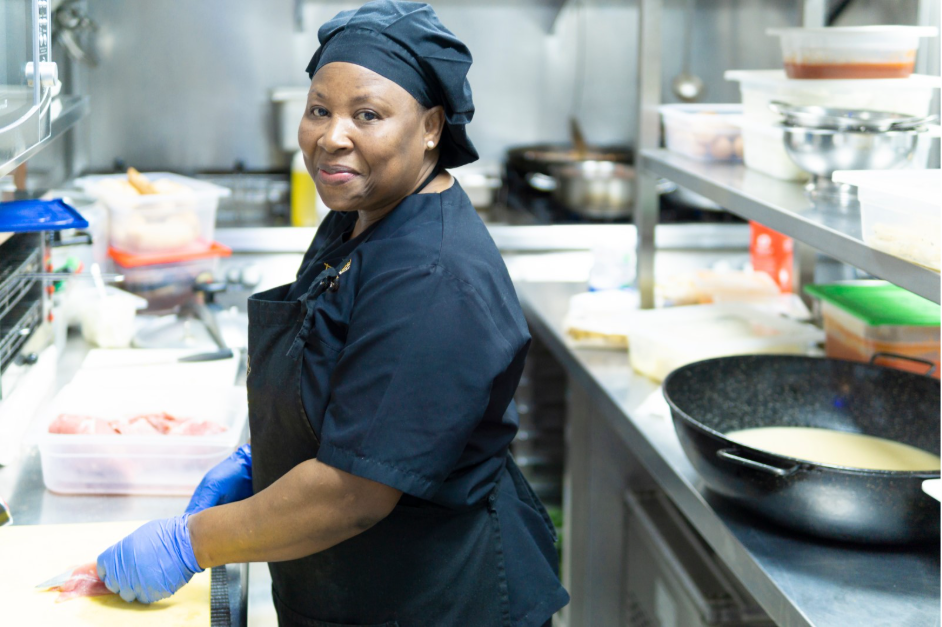
Food handler hygiene in aged care is the most direct controllable factor in preventing foodborne pathogen transmission from kitchen staff to residents. Food handlers who are infected, inadequately trained, or non-compliant with hygiene requirements can introduce pathogens such as norovirus, Salmonella, hepatitis A, and Staphylococcus aureus into food during preparation, cooking, or service.
OzFoodNet data (2023) identifies food handler contamination as a contributing factor in approximately 30% of investigated foodborne illness outbreaks in institutional settings. The most common modes of transmission are faecal-oral contamination via unwashed hands, bare-hand contact with ready-to-eat food, and symptomatic food handlers working while infectious.
This article is part of the Kitchen and Food Safety in Aged Care pillar
What Are the Hand Hygiene Requirements for Food Handlers?
Hand hygiene for food handlers is governed by FSANZ Food Safety Standard 3.2.2 and detailed in Safe Food Australia (3rd Edition, 2022). The standard requires food handlers to wash their hands with soap and warm running water whenever hands are likely to be a source of contamination.
When Must Food Handlers Wash Their Hands?
Before starting food handling or preparation
Immediately after using the toilet
After coughing, sneezing, blowing the nose, or touching the face
After handling raw meat, poultry, seafood, or eggs — before touching cooked or ready-to-eat food
After handling waste, dirty equipment, or cleaning chemicals
After eating, drinking, or smoking
After touching money, phones, or non-food items
After removing gloves
When moving between different food preparation tasks
Need help implementing this in your facility? The IPS Hub gives your IPC Lead instant access to ready-made policies, procedures, and audit tools — updated monthly.
What Is the Correct Handwashing Technique for Food Handlers?
Step 1: Wet hands under warm running water
Step 2: Apply liquid soap
Step 3: Rub hands together vigorously for at least 20 seconds — cover all surfaces including between fingers, backs of hands, thumbs, fingertips, and under nails
Step 4: Rinse hands thoroughly under running water
Step 5: Dry hands completely using single-use paper towel or an air dryer
Step 6: Turn off taps using paper towel (if manual taps) to avoid recontamination
Why Can’t Food Handlers Use ABHR Instead of Handwashing?
Alcohol-based hand rub (ABHR) is not an acceptable substitute for handwashing in food handling. Safe Food Australia (3rd Edition, 2022) is explicit: ABHR does not remove physical soil (food residue, dirt) from hands, and ABHR is not effective against all foodborne pathogens.
Norovirus — the most common cause of gastroenteritis outbreaks in aged care — is a non-enveloped virus with limited susceptibility to alcohol-based products
Bacterial spores (Clostridium perfringens, Clostridioides difficile) are not killed by alcohol
ABHR does not remove physical contamination — food residues, allergen traces, and chemical residues remain on hands
ABHR may be used as an additional step after proper handwashing, but never as a replacement
What Are the Personal Hygiene Standards for Food Handlers?
Personal hygiene standards for food handlers in aged care are set by FSANZ Food Safety Standard 3.2.2 and further detailed in Safe Food Australia (3rd Edition, 2022). These standards minimise the risk of food handlers introducing micro-organisms or foreign objects into food.
What Are the Hair and Grooming Requirements?
Hair must be effectively restrained — hair nets, caps, or hats that fully contain the hair
Beards must be restrained with a beard net or snood if working in food preparation areas
False eyelashes are not recommended as they can detach and fall into food
What Are the Requirements for Nails, Jewellery, and Cosmetics?
Fingernails must be short, clean, and free of nail polish — nail polish can chip into food and harbours bacteria under chipped surfaces
Artificial nails and nail extensions are not permitted — they harbour bacteria, are difficult to clean, and may detach
Remove hand and wrist jewellery (rings, bracelets, watches) — jewellery harbours bacteria in crevices and is a foreign object risk. A plain wedding band may be permitted under some jurisdictions but must be covered by a glove during food handling
Avoid wearing excessive cosmetics or perfume that could contaminate food or mask off-odours
How Should Cuts, Wounds, and Skin Conditions Be Managed?
All cuts, abrasions, and wounds on hands and forearms must be covered with a brightly coloured (blue) waterproof dressing
A disposable glove must be worn over the dressing
Food handlers with infected wounds, boils, or lesions on exposed skin that cannot be effectively covered must not handle food
Skin conditions such as dermatitis increase bacterial shedding — affected food handlers should be assessed for food handling duties
What Are the Illness Exclusion Requirements for Food Handlers?
FSANZ Food Safety Standard 3.2.2 requires food handlers who are suffering from or are carriers of a foodborne illness to be excluded from food handling. Safe Food Australia (3rd Edition, 2022) provides detailed exclusion guidance.
What Is the 48-Hour Rule for Gastroenteritis?
Food handlers with symptoms of gastroenteritis — vomiting, diarrhoea, or both — must not handle food and must be excluded from the kitchen and all food service areas. The food handler must not return to food handling duties until at least 48 hours after symptoms have completely resolved, without the use of anti-diarrhoeal or anti-emetic medication.
| Condition | Exclusion Requirement | Return-to-Work Criteria |
|---|---|---|
| Vomiting and/or diarrhoea | Exclude immediately from food handling | 48 hours symptom-free without medication |
| Diagnosed Salmonella, Shigella, E. coli | Exclude from food handling | Medical clearance; negative stool specimen (check state/territory requirements) |
| Diagnosed hepatitis A | Exclude from food handling | Medical clearance; at least 7 days after onset of jaundice or illness |
| Sore throat with fever | Assess — may indicate Streptococcus (risk of toxin production) | Symptom resolution; medical review if Strep suspected |
| Skin infection on hands/arms | Exclude unless wound can be effectively covered | Wound healed or covered with waterproof dressing and glove |
Facilities must maintain an illness reporting system. Food handlers must be trained to report symptoms before commencing work. Managers must have authority to exclude food handlers and must not pressure symptomatic staff to work.
What Are the Requirements for Glove Use in Food Preparation?
Gloves are a supplementary barrier in food handling — they are not a substitute for handwashing. FSANZ Food Safety Standard 3.2.2 permits glove use but requires hand hygiene before putting on gloves and after removing them.
Wash hands before putting on gloves — pathogens on hands contaminate gloves from the inside
Change gloves between handling raw and ready-to-eat foods
Change gloves after any interruption — answering the phone, touching the face, handling waste
Use single-use disposable gloves only — never wash and reuse gloves
Wash hands immediately after removing gloves
Use nitrile or vinyl gloves — latex gloves are not recommended due to allergen risk
Gloves must be food-grade and stored away from chemicals and contaminants
Common glove use errors in aged care kitchens: wearing the same pair of gloves for extended periods, touching non-food surfaces with gloved hands and then returning to food preparation, and failing to wash hands before gloving. Audit programmes should include observation of glove use practices.
What Are the Uniform and Clothing Requirements for Food Handlers?
Food handler uniforms and clothing contribute to infection prevention by reducing the risk of introducing micro-organisms and foreign objects into food preparation areas.
Clean uniform or apron must be put on at the start of each shift — do not travel to work in kitchen uniform
Aprons must be changed when visibly soiled and between handling raw and cooked foods
Enclosed, non-slip, clean footwear must be worn in the kitchen at all times
Outdoor clothing, bags, and personal items must be stored outside the kitchen in a designated area
Disposable aprons must be used when handling raw meat or during outbreak cleaning
Uniforms should be laundered at a minimum of 60°C or using an appropriate antimicrobial laundry process
What Hand Washing Facilities Are Required in Kitchen Areas?
FSANZ Food Safety Standard 3.2.3 requires hand washing facilities to be provided within or immediately adjacent to food preparation areas and within or immediately adjacent to toilet facilities used by food handlers.
Designated hand wash basins must be used for handwashing only — not for food preparation, equipment washing, or chemical disposal
Each basin must have warm running water, liquid soap, and single-use paper towel or an air dryer
Basins should have hands-free taps (sensor-operated, elbow, or foot-operated) to prevent recontamination
Hand hygiene signage must be displayed at each basin showing correct technique
Basins must be maintained in clean, working order at all times — a non-functional hand wash basin is a critical non-compliance
Nail brushes, if provided, must be replaced regularly and stored hygienically to prevent becoming a contamination source
What Are the Food Handler Training and Competency Requirements?
FSANZ Food Safety Standard 3.2.2 requires food handlers to have skills and knowledge in food safety and food hygiene matters commensurate with their work activities. From 8 December 2023, FSANZ Standard 3.2.2A requires at least one food safety supervisor per food business to hold a nationally recognised food safety supervisor certificate.
| Training Component | Who Requires It | Frequency |
|---|---|---|
| Food safety supervisor certificate | At least one person per kitchen (usually head chef or kitchen manager) | Initial certification; refresher every 5 years (check state/territory requirements) |
| Food handler training | All kitchen staff (cooks, kitchen hands) | On induction; annual refresher or competency assessment |
| Food safety awareness | Care workers involved in meal service, feeding assistance | On induction; annual refresher |
| Food safety induction | Volunteers, agency staff | Before commencing food handling duties |
| Allergen awareness | All food handlers including service staff | On induction; update when menu changes or new allergens identified |
| Outbreak food safety | All kitchen staff and meal service staff | Annual; immediate refresher at outbreak onset |
Training must be documented and records retained as evidence of compliance under the Strengthened Aged Care Quality Standards, Outcomes 4.2 and 6.3. Competency should be assessed through observation, not just completion of an online module.
How Should Food Handlers Be Managed During Outbreaks?
During gastroenteritis outbreaks in aged care facilities, food handler management becomes a critical IPC priority. Kitchen staff may be both potential sources of transmission and at risk of acquiring the outbreak pathogen.
Screen all food handlers for gastroenteritis symptoms at the start of each shift during an outbreak
Exclude any food handler with vomiting, diarrhoea, or nausea immediately — apply the 48-hour exclusion rule
Restrict kitchen access to essential kitchen staff only — no non-kitchen staff, visitors, or maintenance personnel
Reinforce hand hygiene — increase handwashing frequency, provide additional supervision
Increase cleaning and sanitising frequency of all kitchen and food service surfaces
Consider whether food service model should change — e.g., plated meals to rooms instead of buffet-style dining
Maintain food handler symptom screening and exclusion records as outbreak documentation
For broader outbreak management, see Outbreak Management in Aged Care
Frequently Asked Questions
Can food handlers wear a plain wedding ring?
Requirements vary by state and territory. Some jurisdictions permit a plain, smooth wedding band. Safe Food Australia (3rd Edition, 2022) recommends removing all hand jewellery. If a wedding band is permitted, it must be covered by a glove during food handling. Rings with stones, engravings, or rough surfaces are never acceptable.
Can a food handler return to work after 48 hours if they are still taking medication?
The 48-hour exclusion period means 48 hours symptom-free without the use of anti-diarrhoeal or anti-emetic medication. If the food handler is still relying on medication to control symptoms, the 48-hour clock has not started. The food handler must be 48 hours symptom-free without medication support before returning to food handling duties.
Do care workers who assist with feeding need food handler training?
Yes. Any person who handles food in any capacity — including assisting residents to eat, transporting meal trays, or handling food in kitchenettes — is a food handler under FSANZ Food Safety Standard 3.2.2. Care workers must receive food safety training appropriate to their role, including hand hygiene, temperature awareness, allergen awareness, and meal service procedures.
Are disposable gloves mandatory for all food handling?
Gloves are not mandatory for all food handling under FSANZ standards. The requirement is that food handlers do not contaminate food. Gloves are recommended or required for: handling ready-to-eat food, covering wounds or dressings, and as a barrier during specific tasks. Handwashing remains the primary hygiene measure — gloves supplement but do not replace it.
What should a manager do if a food handler refuses to report illness?
Managers have a legal obligation under food safety legislation and the Work Health and Safety Act 2011 to ensure food handlers who are unwell do not handle food. Policies must empower managers to exclude food handlers based on observed symptoms (vomiting, frequent bathroom visits). Managers should create a non-punitive reporting culture — food handlers must feel safe reporting illness without fear of lost income or penalty.
References and Further Reading
The following authoritative sources inform the clinical and regulatory guidance in this article. Links open in a new tab.
- Food Standards Australia New Zealand. Food Safety Standards — Standard 3.2.2A Food Safety Management Tools. Canberra: FSANZ; 2023.
- Aged Care Quality and Safety Commission. Strengthened Aged Care Quality Standards 2025 — Standard 6: Food and Nutrition. Canberra: ACQSC; 2025.
- Australian Commission on Safety and Quality in Health Care. Infection Prevention and Control Guide for Residential Aged Care Facilities, Version 1.1. Sydney: ACSQHC; January 2025.
- Department of Health and Aged Care. Food safety requirements for aged care services. Canberra: Commonwealth of Australia; 2024.
- Communicable Diseases Network Australia. CDNA National Guidelines for the Public Health Management of Gastrointestinal Infections (incl. foodborne illness). Canberra: DoH; 2023.
In This Article
- Why Is Food Handler Hygiene Critical in Aged Care?
- What Are the Hand Hygiene Requirements for Food Handlers?
- What Are the Personal Hygiene Standards for Food Handlers?
- What Are the Illness Exclusion Requirements for Food Handlers?
- What Are the Requirements for Glove Use in Food Preparation?
- What Are the Uniform and Clothing Requirements for Food Handlers?
- What Hand Washing Facilities Are Required in Kitchen Areas?
- What Are the Food Handler Training and Competency Requirements?
- How Should Food Handlers Be Managed During Outbreaks?
- Frequently Asked Questions
About the Author
Lyndon Forrest is the Managing Director of Bug Control — Infection Prevention Services, with over 30 years’ experience supporting aged care facilities across Australia and New Zealand with infection prevention, antimicrobial stewardship, and accreditation readiness.
Clinically reviewed by Bridgette Mackie & Dianne Newey, Clinical Directors
Ready to Strengthen Your Facility’s Infection Prevention?
The IPS Hub provides aged care facilities across Australia and New Zealand with continuously updated IPC policies, AMS tools, outbreak management resources, and direct support from experienced IPC professionals.