
Home › Knowledge Hub › Laundry Management › Safe Linen Handling Procedures for Aged Care Workers
Laundry Management
By Lyndon Forrest, Managing Director, Infection Prevention Services (IPS) · Clinically reviewed by Bridgette Mackie, RN & Dianne Newey, RN, Clinical Directors · September 2026 · 10 min read
Safe Linen Handling Procedures for Aged Care Workers
TL;DR —
Safe linen handling procedures in aged care prevent pathogen transmission between residents, staff, and the environment. The ACSQHC Aged Care Infection Prevention and Control Guide and AS 4146:2024 require aged care workers to: bag dirty linen at the point of use, hold soiled linen away from clothing, never shake dirty linen, fill linen bags to no more than three-quarters full, wear gloves and apron as minimum PPE, use water-soluble (alginate) bags inside leakproof outer bags for linen contaminated with blood or body fluids, and perform hand hygiene before and after handling linen.Colour-coded bagging systems enable laundry staff to process linen safely without opening and sorting bags.
Why Do Linen Handling Procedures Matter in Aged Care?
Safe linen handling is part of standard precautions under the Strengthened Aged Care Quality Standards (effective 1 November 2025). Standard 4, Outcome 4.2 (Infection prevention and control) requires an IPC system that describes standard and transmission-based precautions (Action 4.2.1(d)), and Standard 5, Outcome 5.2 applies to preventing and controlling infections in clinical care. Contaminated linen is a recognised vehicle for pathogen transmission — pathogens including norovirus, Clostridioides difficile, MRSA, and VRE can survive on fabric surfaces and transfer to hands, uniforms, and the environment during handling.
The most common transmission pathway is indirect contact: a worker handles dirty linen, contaminates their hands or uniform, then touches a clean surface, another resident, or clean linen — transferring pathogens. Correct linen handling procedures break this chain at multiple points
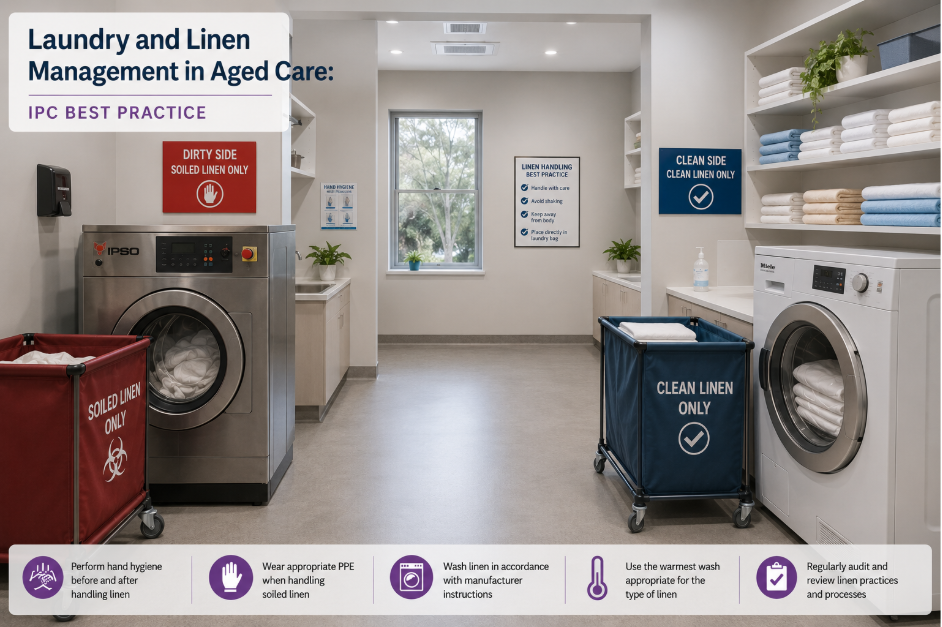
This article provides step-by-step procedures for aged care workers. For the broader framework of laundry and linen management, see Laundry and Linen Management in Aged Care: IPC Best Practice
What Are the Step-by-Step Procedures for Handling Clean Linen?
Handling clean linen correctly prevents recontamination before the linen reaches the resident. The following procedures apply to all clean linen — bed sheets, pillowcases, towels, blankets, and reusable continence products
Step-by-step clean linen handling procedure:
Step 1: Perform hand hygiene (alcohol-based hand rub or soap and water) before entering the clean linen storage area
Step 2: Collect only the linen needed for the current task — do not remove excess linen that will need to be returned
Step 3: Carry clean linen on a clean trolley. If carrying by hand, hold it away from your uniform and body — do not hug linen against your chest. Never place clean linen on a bed or surface that has not been cleaned.
Step 4: If transporting between areas, use a covered or enclosed trolley to prevent environmental contamination
Step 5: Do not place clean linen on the floor at any time — even temporarily
Step 6: If clean linen falls on the floor or contacts a contaminated surface, treat it as dirty linen — do not use it for the resident
Step 7: Once clean linen is placed on a resident’s bed, any unused linen from that room cannot be returned to the clean linen store — it must be laundered
What Are the Step-by-Step Procedures for Handling Dirty Linen?
Handling dirty linen presents the highest IPC risk in the linen management cycle. The ACSQHC Aged Care IPC Guide (2024) provides clear principles for dirty linen handling that must be followed by all aged care workers.
Step-by-step dirty linen handling procedure:
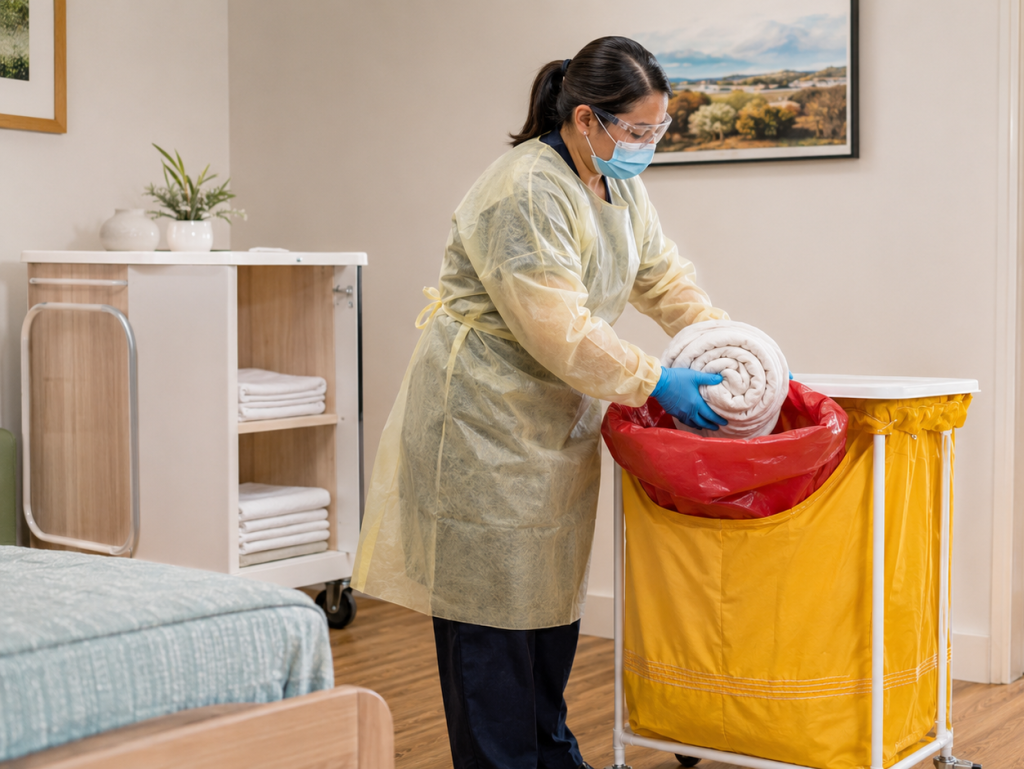
Step 1: Don PPE before handling dirty linen — gloves and apron as minimum
Step 2: Roll dirty linen inward (clean side out, soiled side in) at the bedside — do not shake or flick the linen
Step 3: Place rolled dirty linen directly into the linen bag or skip at the point of use — do not carry loose dirty linen through corridors
Step 4: Always hold dirty linen away from your uniform and body
Step 5: Do not place dirty linen on the floor, on furniture, or on any clean surface
Step 6: Fill the linen bag to no more than three-quarters (75%) capacity
Step 7: Seal the linen bag securely before transport — tie or cinch the bag closed
Step 8: Place sealed bags on the dirty linen trolley or in the designated collection area
Step 9: Remove PPE in the correct sequence (gloves first, then apron)
Step 10: Perform hand hygiene immediately after removing PPE
Need help implementing this in your facility? The IPS Hub gives your IPC Lead instant access to ready-made policies, procedures, and audit tools — updated monthly.
What PPE Is Required for Linen Handling?
PPE requirements for linen handling are determined by the level of contamination risk. The ACSQHC Aged Care IPC Guide (2024) specifies minimum PPE for standard linen handling and additional PPE for contaminated and outbreak-related linen.
| Linen Category | Minimum PPE | Additional PPE | When to Use |
|---|---|---|---|
| Clean linen | None – perform hand hygiene before handling | None | All clean linen handling |
| Used linen (not visibly soiled) | Disposable gloves + plastic apron | None | Standard used linen — bed changes, towels |
| Soiled linen (visible contamination) | Disposable gloves + plastic apron | Eye protection if splash risk | Linen contaminated with urine, faeces, vomit |
| Contaminated linen (blood/body fluids) | Disposable gloves + plastic apron + eye protection | Fluid-resistant gown if heavy contamination | Linen with blood, body fluid, or wound drainage |
| Outbreak/isolation linen | Disposable gloves + gown + surgical mask + eye protection | Fit-tested P2/N95 if respiratory precautions call for a respirator | All linen from residents under transmission-based precautions |
PPE must be donned before handling dirty linen and removed in the correct sequence:gloves, then gown/apron, then eye protection, then mask. Perform hand hygiene immediately after removing gloves, and again after removing all remaining PPE — this final moment is critical and frequently omitted in practice.
How Do Colour-Coded Bagging Systems Work?
Colour-coded bagging systems for linen allow laundry staff to identify the category of linen and apply the correct washing procedure without opening the bag. This reduces the handling of dirty linen and minimises exposure risk for laundry workers.
There is no single national standard for linen bag colours in Australian aged care. Facilities must establish their own colour-coding system and ensure all staff — including agency staff, new starters, and laundry workers — are trained in its use. A common system used across many facilities is:
| Bag Colour | Linen Category | Washing Procedure |
|---|---|---|
| White or natural | Standard used linen | Standard hot wash cycle per AS 4146:2024 |
| Red or orange | Contaminated linen (blood/body fluids) | Hot wash with pre-rinse cycle; leakproof bag required |
| Yellow | Infectious/isolation linen | Hot wash at highest available temperature; linen bagged in a water-soluble (alginate) inner bag — remove the outer bag and place the alginate bag into the machine unopened |
| Clear plastic | Resident personal clothing | Domestic wash cycle per garment care labels |
Water-soluble (alginate) inner bags should be used for highly contaminated or infectious linen. Place the soiled linen into the alginate bag, then seal that inside the colour-coded outer bag. At the laundry, remove the outer bag and place the alginate bag directly into the machine unopened — the inner bag dissolves during the wash cycle, so laundry staff never handle the contaminated linen. Never place the outer bag into the machine and never open an alginate bag.
How Should Soiled and Contaminated Linen Be Managed?
Soiled linen (contaminated with urine, faeces, or vomit) and contaminated linen (contaminated with blood or body fluids) require specific handling beyond standard dirty linen procedures. The ACSQHC Aged Care IPC Guide (2024) distinguishes these categories because the pathogen load and transmission risk are higher.
What Is the Procedure for Soiled Linen?
Don gloves and apron before handling
Remove solid matter (faeces, vomit) by scraping into a toilet — do not rinse under running water at the bedside
Roll the linen inward to contain the soiled area
Place in the appropriate colour-coded bag at the point of use
If the bag becomes wet or soiled on the outside, place it inside a second bag (double-bag)
Seal the bag before transport
What Is the Procedure for Linen Contaminated with Blood or Body Fluids?
Don gloves, apron, and eye protection before handling
Place directly into a leakproof bag (red or orange in most colour-coding systems)
Do not soak or rinse linen contaminated with blood at the bedside — this increases splash risk
Seal the leakproof bag securely
If leakproof bags are not available, double-bag using two standard linen bags
Label or identify the bag according to facility policy
Transport directly to laundry — do not leave sealed bags in corridors or common areas
How Should Linen Be Handled in Isolation Rooms?
Linen handling in isolation rooms requires transmission-based precautions in addition to standard precautions. The type of transmission-based precautions (contact, respiratory, or both) determines the specific PPE and handling requirements.
Don full PPE before entering the isolation room — determined by the type of precautions in place
Handle all linen from the isolation room as infectious — regardless of whether it appears clean or soiled
Bag linen inside the room — do not carry linen out of the room and then bag it
Use a water-soluble/alginate inner bag if available, placed inside the colour-coded outer bag
Seal the bag inside the room. Place it into the dirty linen trolley/skip positioned at the doorway without carrying it into the corridor.
Do not accumulate used linen inside the isolation room — remove promptly to reduce bioburden
Doff PPE in the correct sequence at the doorway, dispose of it in the room’s waste, and perform hand hygiene immediately on leaving the room.
Transport the dirty linen trolley to the dirty linen collection point or directly to the laundry following a one-way workflow path straight to the laundry
Clean and disinfect the dirty linen trolley after use, perform hand hygiene and take the dirty linen trolley back to the storage area or where it is next needed to be used
For comprehensive outbreak linen protocols, see Linen Management During Outbreaks in Aged Care
What Hand Hygiene Is Required Before and After Linen Handling?
Hand hygiene is the single most effective measure for preventing pathogen transmission during linen handling. The ACSQHC Aged Care IPC Guide (2024) and the WHO 5 Moments for Hand Hygiene framework both require hand hygiene at specific points in the linen handling process
| Hand Hygiene Moment | When | Method |
|---|---|---|
| Before handling clean linen | Before entering the clean linen store or handling clean linen | Alcohol-based hand rub (ABHR) or soap and water |
| Before a resident contact | Before making a bed or placing clean linen for a resident | ABHR or soap and water |
| After handling dirty linen | Immediately after placing dirty linen in the bag, before touching anything else | ABHR or soap and water |
| After removing PPE | Immediately after removing gloves, apron, and any other PPE | ABHR or soap and water — this moment is critical and frequently missed |
| After contact with body fluids | After any contact with blood, urine, faeces, vomit on linen and after handling linen from a resident with norovirus, gastroenteritis, or C. difficile | Soap and water preferred (ABHR acceptable if hands not visibly soiled) |
The most commonly missed hand hygiene moment in linen handling is after PPE removal. Workers remove gloves and apron, then proceed directly to the next task without performing hand hygiene. This transfers any pathogens that contaminated the hands during glove removal to the next surface or resident.
What Should Workers Do When Linen Bags Leak or Spill?
Linen bag leaks and spills during transport are an IPC incident that requires immediate management. The spillage must be treated as a potential body fluid spill and managed according to the facility’s spill management procedure.
Stop — do not continue pushing the trolley or carrying the bag through the area
Isolate the area — prevent other staff and residents from walking through the spill
Don PPE — gloves, apron, and eye protection
Contain the spill — use absorbent material (paper towels, spill pads, or granules) to contain the fluid
Clean and disinfect the area — use the facility’s two-step process (detergent clean followed by hospital-grade disinfectant)
Re-bag the linen — place the leaking bag inside a new leakproof bag
Clean the trolley — wipe down with detergent and disinfectant
Remove PPE and perform hand hygiene
Report the incident according to facility policy
For environmental cleaning procedures after spills, see Environmental Cleaning in Aged Care
Frequently Asked Questions
Can I carry dirty linen without a bag if the laundry is nearby?
No. The ACSQHC Aged Care IPC Guide (2024) requires that dirty linen be placed in a bag at the point of use — regardless of the distance to the laundry. Carrying loose dirty linen through any area — even a short corridor — contaminates surfaces and creates transmission risk
What should I do if I find dirty linen on the floor?
Don gloves and apron. Pick up the linen without shaking it. Place it directly into a dirty linen bag. Seal the bag. Clean and disinfect the floor area where the linen was lying. Remove PPE and perform hand hygiene. Report the incident if it indicates a procedural failure.
Do I need to change gloves between handling dirty linen from different residents?
Yes. Gloves must be changed, and hand hygiene performed between handling linen from different residents. Using the same pair of gloves to strip beds for multiple residents transfers pathogens between residents’ environments
Can dirty linen be sorted before washing?
Sorting should be minimised. Colour-coded bagging systems allow laundry workers to identify the washing category without opening bags. If sorting is unavoidable, it must be done in the dirty linen receiving area of the laundry by staff wearing appropriate PPE — never in corridors, resident rooms, or clean areas.
Is it safe to use linen skips without lids?
Linen skips should have lids to contain odour and reduce environmental contamination. If lidless skips are used, the linen bag inside the skip must be tied or cinched closed when not actively receiving linen. Open skips with exposed dirty linen are an IPC risk and may be identified during an accreditation assessment.
References and Further Reading
The following authoritative sources inform the clinical and regulatory guidance in this article. Links open in a new tab.
- Australian Commission on Safety and Quality in Health Care. Infection Prevention and Control Guide for Residential Aged Care Facilities, Version 1.1. Sydney: ACSQHC; January 2025.
- Standards Australia. AS/NZS 4146:2000 Laundry Practice. Sydney: Standards Australia; 2000.
- Aged Care Quality and Safety Commission. Strengthened Aged Care Quality Standards 2025 — Standard 5: Environmental management. Canberra: ACQSC; 2025.
- Therapeutic Goods Administration. Disinfectants and sanitisers — regulatory requirements. Canberra: TGA; 2024.
- Department of Health and Aged Care. Infection prevention and control: linen and laundry management. Canberra: Commonwealth of Australia; 2024.
In This Article
- Why Do Linen Handling Procedures Matter in Aged Care?
- What Are the Step-by-Step Procedures for Handling Clean Linen?
- What Are the Step-by-Step Procedures for Handling Dirty Linen?
- What PPE Is Required for Linen Handling?
- How Do Colour-Coded Bagging Systems Work?
- How Should Soiled and Contaminated Linen Be Managed?
- How Should Linen Be Handled in Isolation Rooms?
- What Hand Hygiene Is Required Before and After Linen Handling?
- What Should Workers Do When Linen Bags Leak or Spill?
- Frequently Asked Questions
About the Author
Lyndon Forrest is the Managing Director of Infection Prevention Services (IPS), with over 30 years’ experience supporting aged care facilities across Australia and New Zealand with infection prevention, antimicrobial stewardship, and accreditation readiness.
Clinically reviewed by Bridgette Mackie, RN & Dianne Newey, RN, Clinical Directors.
Ready to Strengthen Your Facility’s Infection Prevention?
The IPS Hub provides aged care facilities across Australia and New Zealand with continuously updated IPC policies, AMS tools, outbreak management resources, and direct support from experienced IPC professionals.