Home › Knowledge Hub › Laundry Management › Linen Management During Outbreaks in Aged Care
Laundry Management
By Lyndon Forrest, Managing Director · Clinically reviewed by Bridgette Mackie & Dianne Newey, Clinical Directors · September 2026 · 10 min read
Linen Management During Outbreaks in Aged Care
TL;DR —
The ACSQHC Aged Care Infection Prevention and Control Guide and the Strengthened Aged Care Quality Standards (effective 1 November 2025), Outcome 4.2, require providers to apply standard and transmission-based precautions appropriate to the level of risk. Key principles: bag all linen at the bedside using a water-soluble (alginate) inner bag inside a leakproof outer bag, do not sort or inspect outbreak linen, staff wear full PPE, wash at the highest temperature the fabric permits (71°C for 3 minutes, or 65°C for 10 minutes), and post-outbreak launder all linen from affected areas.
Scope: This article addresses the Australian regulatory context (the Strengthened Aged Care Quality Standards, ACSQHC guidance, and AS 4146:2024). Note that AS 4146:2024 is an Australian standard — it superseded the former joint AS/NZS 4146:2000 in December 2024. New Zealand facilities should confirm the current applicable laundry standard and follow Health New Zealand guidance; regulatory, documentation, and reporting arrangements differ.
Why Does Linen Management Change During Outbreaks?
Linen management during outbreaks in aged care shifts from standard precautions to transmission-based precautions because the volume, contamination level, and transmission risk of soiled linen all increase significantly. During a gastroenteritis outbreak, residents with vomiting and diarrhoea generate 2–3 times the normal volume of soiled linen. During respiratory outbreaks, linen from residents in isolation rooms requires enhanced handling to prevent airborne and droplet transmission.
Under the Strengthened Aged Care Quality Standards (effective 1 November 2025), Outcome 4.2, providers must apply standard and transmission-based precautions appropriate to the level of risk, to minimise the transmission of infections. During outbreaks, the risk level is elevated, and linen management procedures must be escalated accordingly.
For the baseline linen management framework, see Laundry and Linen Management in Aged Care: IPC Best Practice
For broader outbreak management guidance, see Outbreak Management in Aged Care. For outbreak definitions, see the outbreak definitions table.
What Are the Enhanced Linen Procedures During Gastroenteritis Outbreaks?
Gastroenteritis outbreaks — most commonly caused by norovirus (a highly infectious virus causing vomiting and diarrhoea) and Clostridioides difficile (a spore-forming bacterium causing antibiotic-associated diarrhoea) — produce high volumes of heavily soiled linen. Both organisms have characteristics that demand specific linen management responses: norovirus has a very low infectious dose (as few as 18 viral particles) and C. difficile produces environmentally resistant spores.
What Linen Handling Changes Are Required?
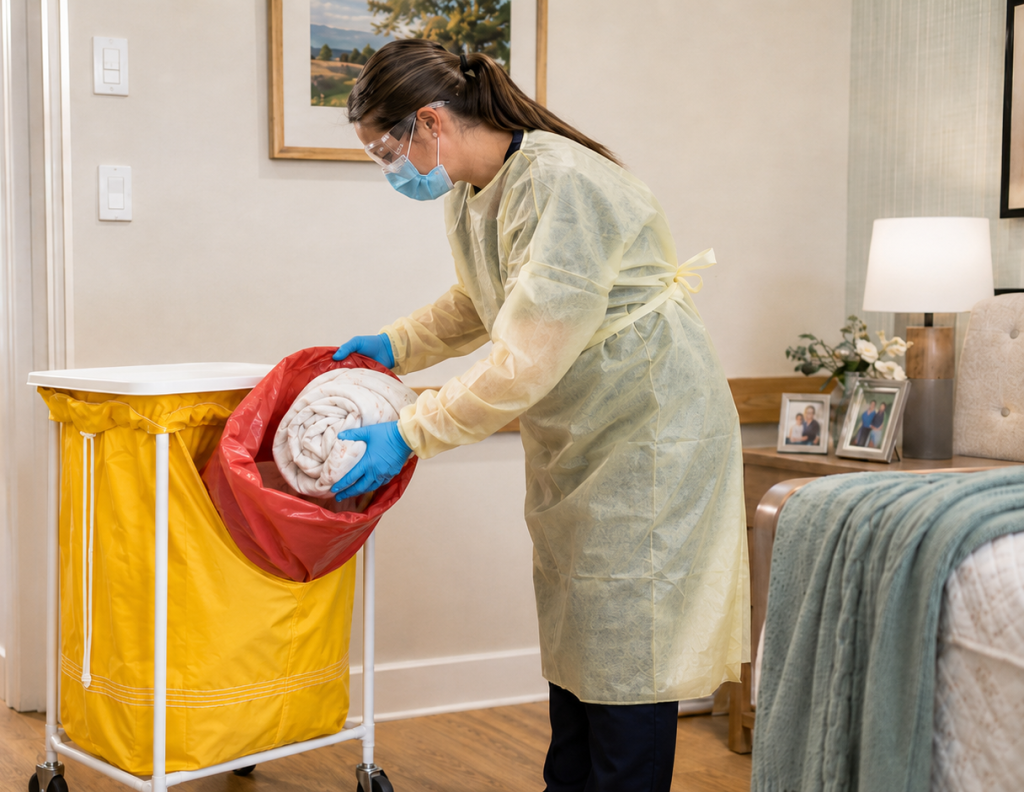
Bag all linen at the bedside in the resident’s room — do not carry loose linen to the corridor or sluice room.
Scrape solid waste gently into the toilet before bagging, avoiding splashing. Close the lid before flushing.
Use leakproof bags for all linen from symptomatic residents — not just visibly soiled items (the entire bed may be contaminated)
Do not shake, sort, or inspect linen — bag it as found at the bedside
Seal bags inside the room before transport
Use a two-bag system for all outbreak linen: place linen into a water-soluble (alginate) inner bag at the bedside, then seal that inside a colour-coded leakproof outer bag. The alginate bag is what allows linen to go into the machine without anyone handling it again.
Remove linen from the room promptly — do not accumulate soiled linen, as this increases the environmental bioburden and transport to the laundry
Use dedicated linen trolleys for outbreak areas — do not mix outbreak linen with standard used linen on the same trolley
Need help implementing this in your facility? The IPS Hub gives your IPC Lead instant access to ready-made policies, procedures, and audit tools — updated monthly.
What PPE Must Staff Wear When Handling Gastro Outbreak Linen?
Disposable gloves (change between residents)
Fluid-resistant gown
Surgical mask — vomiting aerosolises norovirus particles
Eye protection (goggles or face shield) — if splash risk from vomit or diarrhoea is present
Remove PPE in the correct sequence before leaving the room; perform hand hygiene with soap and water (alcohol-based hand rub is less effective against norovirus and C. difficile spores)
What Washing Adjustments Are Needed?
Remove the leakproof outer bag at the laundry and place the alginate bag directly into the machine, unopened. Never open an alginate bag or handle its contents.
Wash at the highest temperature the fabric permits. Thermal disinfection requires 71°C for at least 3 minutes, or 65°C for at least 10 minutes (AS 4146:2024).
If thermal disinfection cannot be achieved — heat-sensitive fabrics, or machines that cannot reach these parameters — use a validated chemical disinfection process in accordance with AS 4146:2024 and the product manufacturer’s instructions, and record the process used.
For norovirus: add sodium hypochlorite (1,000 ppm available chlorine) to the wash if the fabric permits
For C. difficile: maximise mechanical agitation and detergent use — spores are removed by physical washing action rather than killed by heat alone
Tumble dry at high heat after washing — the additional heat provides further microbial reduction
Do not return linen to general circulation until the entire batch has completed the full wash and dry cycle
What Are the Enhanced Linen Procedures During Respiratory Outbreaks?
Respiratory outbreaks — influenza, COVID-19, respiratory syncytial virus (RSV) — require linen management adjustments focused on preventing droplet and airborne transmission during handling. The primary risk is during linen removal and bagging, when the agitation of linen can release respiratory droplets and particles trapped in the fabric.
Handle linen gently — minimise agitation during removal from the bed and bagging
Roll linen inward rather than stripping it off the bed (rolling contains contaminated surfaces)
Bag at the bedside — same procedure as gastro outbreaks
Staff PPE: gloves, fluid-resistant gown, surgical mask (upgrade to P2/N95 if respiratory precautions call for a respirator), and eye protection
Ensure adequate room ventilation during linen changes — open windows if possible, or wait for the room to undergo the required number of air changes before entering without full PPE
Standard thermal disinfection (65°C/10 min or 71°C/3 min) is effective against influenza, COVID-19, and RSV — these are enveloped viruses that are readily inactivated by heat
No additional chemical disinfection agents are needed in the wash for respiratory viruses — thermal disinfection is sufficient
How Should Isolation Room Linen Be Managed During Outbreaks?
Isolation room linen management during outbreaks follows the principles of transmission-based precautions applied to the specific outbreak organism. All linen leaving an isolation room is treated as infectious — regardless of its appearance.
The standard workflow for isolation room linen during outbreaks is:
- Assemble supplies outside the room: PPE, alginate inner bag, leakproof outer bag, replacement linen.
- Position the dirty linen trolley at the doorway, outside the room.
- Don full PPE before entering.
- Roll used linen inward on the bed — do not shake or strip.
- Place rolled linen directly into the alginate bag inside the room and seal it.
- Make the bed with clean linen, still wearing full PPE.
- Seal the alginate bag inside the leakproof outer bag, positioned just inside the door.
- Place the sealed outer bag on the dirty linen trolley at the doorway.
- Doff PPE in the correct sequence at the doorway and dispose of it in the room’s waste.
- .Perform hand hygiene immediately on leaving the room.
- .Transport the trolley to the laundry via the designated “dirty-to-clean” workflow, avoiding dining and lounge areas.
- .Clean and disinfect the linen trolley, then perform hand hygiene.
How Should Dedicated Linen for Infectious Residents Be Managed?
During outbreaks, some facilities allocate dedicated linen sets to infectious residents to reduce the volume of linen circulating through the general laundry system and to simplify tracking. This is a practical measure — not a mandatory requirement — but it can reduce cross-contamination risk.
Assign a specific set of linen (sheets, pillowcases, towels) to each infectious resident
Label or tag the linen to identify the resident (e.g., initials on a tag) – this supports tracking and return
Process dedicated linen through the outbreak laundry cycle — same temperature and detergent requirements as for all outbreak linen
Return clean dedicated linen to the same resident — do not redistribute to other residents during the outbreak
Post-outbreak: return dedicated linen to general circulation only after a full hot wash and confirmation that the outbreak is over
Disposable linen (single-use sheets, incontinence pads) can supplement reusable linen during outbreaks to reduce laundry burden
What Laundry Room Controls Are Needed During Outbreaks?
The laundry room is a critical control point during outbreaks. Increased linen volumes, higher contamination levels, and additional handling all increase the risk of pathogen transmission within the laundry environment.
Increase laundry operating hours if needed — outbreak linen volumes may be 2–3 times normal
Maintain strict separation between dirty and clean areas within the laundry — reinforce the one-way workflow
All laundry staff must wear full PPE when handling outbreak linen (gloves, gown, surgical mask, eye protection)
Do not open outbreak linen bags. Remove the leakproof outer bag and place the alginate bag directly into the machine.
Clean and disinfect all laundry surfaces (benches, machines, trolleys) more frequently during outbreaks — At a minimum after each load of outbreak linen
Ensure adequate ventilation in the laundry room — increased linen processing generates more aerosols and humidity
Lint traps must be cleaned after every cycle during outbreaks
Handwash facilities must be accessible and stocked (soap, paper towels, alcohol-based hand rub)
Waste management: dispose of PPE contaminated with blood or body fluids (including respiratory secretions) into clinical waste. Uncontaminated PPE may be disposed of as general waste — bag it securely. Follow your jurisdiction’s waste classification and your facility’s waste policy.
How Should Linen Be Managed When Multiple Residents Are Affected?
When an outbreak affects multiple residents — a common scenario in gastroenteritis outbreaks — the linen management system comes under pressure from volume, staffing, and logistics. Providers must plan for surge capacity in their outbreak management plans.
Increase linen par levels before or at the start of the outbreak — order additional linen from suppliers if stock is limited
Consider disposable linen (single-use bed pads, incontinence pads) to reduce the laundry burden
Allocate additional laundry staff or extend laundry operating hours
Establish a priority system: linen from isolation rooms and symptomatic residents processed first
Do not mix linen from affected and unaffected areas on the same trolley or in the same wash load if possible
Maintain a clean linen buffer stock — ensure that clean linen supply does not run out due to laundry processing delays
Contract an external laundry service if in-house capacity is insufficient — confirm the contractor meets AS 4146:2024 requirements
What Are the Post-Outbreak Linen Procedures?
Post-outbreak linen procedures ensure that all potentially contaminated linen is processed and that the linen management system returns to standard operations. The ACSQHC Aged Care IPC Guide (2024) requires that enhanced cleaning measures continue until the outbreak is formally declared closed.
Launder all linen from affected areas — including linen in storage that may have been exposed to airborne or contact contamination during the outbreak
Strip and re-make all beds in affected areas with freshly laundered linen
Clean and disinfect all linen storage areas, trolleys, skips, and bag holders
Review and restock linen supplies — replace any linen that is stained, damaged, or cannot be adequately laundered
Clean and disinfect the laundry room — all surfaces, machines (inside and outside), lint traps, and drainage areas
Return to standard linen management procedures once the outbreak is formally closed by the outbreak management team
Conduct a debrief: review linen management during the outbreak, identify what worked and what failed, and update the outbreak management plan accordingly
Document all actions taken — this documentation supports quality improvement and accreditation evidence
What Are the Most Common Linen Management Mistakes During Outbreaks?
| Common Mistake | Consequence | Corrective Action |
|---|---|---|
| Shaking dirty linen in outbreak rooms | Aerosolises pathogens — norovirus and C. difficile spores become airborne | Roll linen inward; never shake. Reinforce through in-the-moment coaching |
| Carrying unsealed bags through corridors | Contaminates common areas; exposes staff and unaffected residents | Seal bags inside the room before transport; use leakproof bags |
| Sorting outbreak linen in corridors or utility rooms | Staff exposure; environmental contamination | Do not sort outbreak linen — bag at bedside, in an alginate bag inside a leakproof outer bag; at the laundry, place the alginate bag straight into the machine unopened |
| Using the same trolley for clean and dirty linen | Cross-contamination of clean linen | Dedicated trolleys; clean and disinfect trolleys between uses |
| Failing to increase laundry capacity | Dirty linen accumulates; residents lack clean linen; staff re-use soiled linen | Pre-plan surge capacity; increase hours; contract external laundry |
| Omitting PPE for linen handling | Staff become infected; staff transmit to other residents | Full PPE mandatory for all outbreak linen handling; PPE stations at all points of use |
| Returning to standard procedures before outbreak is formally closed | Residual contamination causes secondary cases | Maintain enhanced procedures until outbreak management team declares the outbreak closed |
Frequently Asked Questions
Should outbreak linen be washed separately from other linen?
Ideally, yes. Linen from residents with confirmed or suspected infections during an outbreak should be washed in dedicated cycles, separate from linen from unaffected areas. If this is not logistically possible due to volume, all linen must be washed at the highest temperature the fabric permits (71°C for 3 minutes preferred) and tumble dried at high heat.
Can linen from outbreak areas be sent to an external laundry?
Yes, provided the external laundry service meets AS 4146:2024 requirements for thermal disinfection. The facility must confirm with the contractor that outbreak linen will be processed at the required temperature-time combination and that their handling procedures comply with IPC requirements. Transport must use sealed, leakproof bags. New Zealand facilities should confirm the laundry standard applicable in New Zealand, as AS 4146:2024 is an Australian standard.
How long should enhanced linen procedures continue after the last case?
Enhanced linen procedures should continue until the outbreak management team formally declares the outbreak over. For norovirus, this is typically 72 hours after the last new case. For C. difficile, the timeframe may be longer. The outbreak management team determines the closure point based on epidemiological criteria.
Do visitors need to follow outbreak linen procedures?
Enhanced linen procedures should continue until the outbreak management team formally declares the outbreak over. For norovirus, Australian guidance works to at least 48 hours after the last affected person’s symptoms have resolved; for C. difficile the timeframe may be longer. Your public health unit and outbreak management team determine the closure point based on epidemiological criteria — follow their direction.
What should facilities do if they run out of clean linen during an outbreak?
Facilities should activate their outbreak management plan’s surge provisions: increase laundry operating hours, deploy additional laundry staff, use disposable linen products (single-use bed pads, incontinence pads), and engage an external laundry contractor if needed. Running out of clean linen during an outbreak is a foreseeable risk that must be addressed in pre-outbreak planning.
References and Further Reading
The following authoritative sources inform the clinical and regulatory guidance in this article. Links open in a new tab.
- Australian Commission on Safety and Quality in Health Care. Infection Prevention and Control Guide for Residential Aged Care Facilities, Version 1.1. Sydney: ACSQHC; January 2025.
- Standards Australia. AS/NZS 4146:2000 Laundry Practice. Sydney: Standards Australia; 2000.
- Aged Care Quality and Safety Commission. Strengthened Aged Care Quality Standards 2025 — Standard 5: Environmental management. Canberra: ACQSC; 2025.
- Therapeutic Goods Administration. Disinfectants and sanitisers — regulatory requirements. Canberra: TGA; 2024.
- Department of Health and Aged Care. Infection prevention and control: linen and laundry management. Canberra: Commonwealth of Australia; 2024.
In This Article
- Why Does Linen Management Change During Outbreaks?
- What Are the Enhanced Linen Procedures During Gastroenteritis Outbreaks?
- What Are the Enhanced Linen Procedures During Respiratory Outbreaks?
- How Should Isolation Room Linen Be Managed During Outbreaks?
- How Should Dedicated Linen for Infectious Residents Be Managed?
- What Laundry Room Controls Are Needed During Outbreaks?
- How Should Linen Be Managed When Multiple Residents Are Affected?
- What Are the Post-Outbreak Linen Procedures?
- What Are the Most Common Linen Management Mistakes During Outbreaks?
- Frequently Asked Questions
About the Author
Lyndon Forrest is the Managing Director of Bug Control — Infection Prevention Services, with over 30 years’ experience supporting aged care facilities across Australia and New Zealand with infection prevention, antimicrobial stewardship, and accreditation readiness.
Clinically reviewed by Bridgette Mackie & Dianne Newey, Clinical Directors.
Ready to Strengthen Your Facility’s Infection Prevention?
The IPS Hub provides aged care facilities across Australia and New Zealand with continuously updated IPC policies, AMS tools, outbreak management resources, and direct support from experienced IPC professionals.