
Home › Knowledge Hub › Kitchen Food Safety › Temperature Control and Food Safety in Aged Care Kitchens
Kitchen Food Safety
By Lyndon Forrest, Managing Director · Clinically reviewed by Bridgette Mackie & Dianne Newey, Clinical Directors · September 2026 · 11 min read
Temperature Control and Food Safety in Aged Care Kitchens
TL;DR —
Temperature control is the single most critical factor in food safety for aged care kitchens. The temperature danger zone — 5°C to 60°C — is the range in which foodborne bacteria multiply rapidly. Under FSANZ Food Safety Standard 3.2.2 and Safe Food Australia (4th Edition, 2023), potentially hazardous foods must be kept below 5°C or above 60°C. The 2-hour/4-hour rule governs how long food can remain in the danger zone. Hot foods must be cooled from 60°C to 21°C within 2 hours and from 21°C to 5°C within a further 4 hours. Reheated food must reach 75°C. Thermometers must be calibrated regularly. Temperature monitoring and recording are mandatory.
Why Is Temperature Control Critical for Food Safety in Aged Care?
Temperature control in food safety for aged care is the primary defence against foodborne illness. Aged care residents are significantly more susceptible to gastrointestinal infections due to age-related immune decline, chronic disease, and medications that reduce gastric acid (such as proton pump inhibitors), which normally kills ingested pathogens.
Foodborne bacteria grow most rapidly between 20°C and 45°C. At 37°C — human body temperature and the optimal growth temperature for many pathogens — bacteria such as Salmonella enterica, Bacillus cereus, and Clostridium perfringens
can multiply rapidly under optimal conditions (e.g. short doubling times in favourable environments) . A single Salmonella cell
can increase to levels capable of causing illness within 7 hours at this temperature (Safe Food Australia, 3rd Edition, 2022).
Temperature control failures are the most frequently cited contributing factor in foodborne illness outbreaks investigated by OzFoodNet. Inadequate cooling of cooked food, insufficient reheating, and prolonged holding at ambient temperatures account for most identified failures (OzFoodNet Annual Report, 2023).
This article is part of the Kitchen and Food Safety in Aged Care pillar — see the full guide at Kitchen and Food Safety in Aged Care: IPC Best Practice Guide
What Is the Temperature Danger Zone?
The temperature danger zone is the temperature range between 5°C and 60°C within which foodborne pathogens can grow in potentially hazardous foods. FSANZ Food Safety Standard 3.2.2 requires food businesses — including aged care kitchens — to ensure potentially hazardous foods are received, stored, displayed, transported, and served outside this range.
| Temperature Range | Bacterial Activity | Food Safety Action |
|---|---|---|
| Below 5°C | Most bacteria dormant (some survive, do not multiply significantly) | Safe cold storage — standard refrigeration temperature |
| 5°C to 20°C | Slow bacterial growth | Danger zone — minimise time; use within 2–4 hours |
| 20°C to 45°C | Rapid bacterial growth (doubling every 15–20 min at optimal) | High-risk danger zone — food must not remain in this range |
| 45°C to 60°C | Slowing bacterial growth | Danger zone — food is vulnerable; move above 60°C rapidly |
| Above 60°C | Most vegetative bacteria killed; spores may survive | Safe hot holding temperature — maintain above 60°C |
| 75°C and above | Thermal kill of most pathogens | Target cooking and reheating temperature |
| 100°C (boiling) | Kills vegetative cells; some spores survive | Cooking temperature — effective for most pathogen reduction |
Potentially hazardous foods that require temperature control include raw and cooked meats, poultry, seafood, dairy products, cooked rice and pasta, cooked vegetables, cut fruits and vegetables, puréed and modified texture foods, eggs and egg products, and foods containing any of these ingredients.
How Does the 2-Hour/4-Hour Rule Work?
The 2-hour/4-hour rule, published in Safe Food Australia (4th Edition, 2023), provides a practical framework for managing potentially hazardous food that has entered the temperature danger zone. The rule applies to the total cumulative time food has spent between 5°C and 60°C — not just a single instance.
| Total Time in Danger Zone | Required Action | Rationale |
|---|---|---|
| Less than 2 hours | Refrigerate immediately (below 5°C) or use/serve immediately | Bacterial numbers still low enough for safe refrigeration and later use |
| Between 2 and 4 hours | Use or serve immediately — do not refrigerate | Bacterial growth has commenced but not reached unsafe levels; further storage would allow additional growth |
| More than 4 hours | Discard the food — it must not be consumed or served | Bacterial numbers may have reached levels that could cause illness, even if food looks and smells normal |
Tracking cumulative time is particularly challenging in aged care kitchens where food may be prepared in advance, transported between buildings, held for late meal service, and delivered to multiple dining rooms. Facilities must implement systems — such as time stamps on food labels, preparation logs, and trolley departure records — to track total time in the danger zone.
Need help implementing this in your facility? The IPS Hub gives your IPC Lead instant access to ready-made policies, procedures, and audit tools — updated monthly.
How Should the 2-Hour/4-Hour Rule Be Applied in Practice?
Scenario: A tray of sliced cooked chicken is prepared for lunch service.
10:00 am — Chicken removed from fridge (below 5°C). Danger zone clock starts.
10:00–10:30 — Slicing and plating at room temperature (30 minutes in danger zone)
10:30–11:00 — Placed in refrigerated trolley (clock paused if food returns below 5°C)
11:00–11:30 — Transported in unrefrigerated trolley to dining room (30 minutes added)
11:30–12:30 — Served and available on dining tables (60 minutes added)
Total time in danger zone: approximately 2 hours — must be consumed immediately; cannot be returned to refrigeration
What Are the Cold Chain Management Requirements?
Cold chain management means maintaining potentially hazardous foods at 5°C or below from the point of delivery through storage, preparation, and (for cold foods) service. Any break in the cold chain allows bacterial growth and starts the 2-hour/4-hour clock.
What Are the Delivery and Receiving Requirements?
Check cold food temperatures on delivery using a calibrated probe thermometer — reject food arriving above 5°C
Check frozen food temperatures — reject food showing signs of thawing (above ?18°C)
Transfer deliveries to cold storage within 15 minutes of arrival
Record delivery temperatures in the receiving log with date, time, supplier, product, and temperature
Inspect delivery vehicles for cleanliness and evidence of temperature control
What Are the Refrigeration and Cold Storage Requirements?
Refrigerators and cool rooms must operate between 0°C and 5°C
Record fridge and cool room temperatures at least twice daily — at the start and end of each shift
Fit cool rooms with temperature alarms that activate when temperature rises above 5°C
Do not overload refrigerators — air must circulate freely around food items
Store raw foods below cooked and ready-to-eat foods to prevent drip contamination
Cover all stored food and label with product name and date of preparation or opening
Defrost refrigerators and cool rooms regularly according to the cleaning schedule
What Are the Hot Holding Requirements?
Hot holding is the process of maintaining cooked food at a temperature above 60°C for the duration of service. Hot holding prevents bacterial growth in food that has been cooked but is not yet consumed.
Hot holding equipment (bain-maries, heated trolleys, warming cabinets) must maintain food above 60°C throughout service – no specific time limit applies when food is maintained above 60°C, however quality and safety must still be monitored and prolonged holding should be minimised
Check hot-held food temperatures at least every 30 minutes during service using a probe thermometer
If food drops below 60°C, apply the 2-hour/4-hour rule from the time the food first dropped below 60°C
Hot holding equipment must not be used to reheat food — it is designed to maintain temperature, not raise it
Stir food in bain-maries regularly to distribute heat evenly
Lids and covers must be used to retain heat and prevent contamination
Discard all hot-held food at the end of the meal service — do not cool and re-serve
How Should Cooked Food Be Cooled Safely?
Cooling cooked food is one of the highest-risk processes in aged care kitchens. Safe Food Australia (4th Edition, 2023) specifies the two-stage cooling process:
| Cooling Stage | Temperature Range | Maximum Time Allowed |
|---|---|---|
| Stage 1 | From 60°C to 21°C | Within 2 hours |
| Stage 2 | From 21°C to 5°C | Within a further 4 hours |
| Total cooling time | From 60°C to 5°C | Within 6 hours maximum |
If food has not reached 21°C within 2 hours, or 5°C within the total 6-hour window, the food must be discarded.
What Techniques Speed Up Safe Cooling?
Divide large quantities into shallow containers (maximum 50 mm depth) to increase surface area
Use a blast chiller where available — purpose-built for rapid cooling in commercial kitchens
Place containers in an ice bath and stir regularly
Use a cooling paddle (ice wand) for soups, sauces, and liquids
Do not place large quantities of hot food directly into a refrigerator — the heat load raises the overall fridge temperature, putting other stored foods at risk
Monitor temperatures throughout the cooling process — record at the 2-hour mark and at completion
What Are the Requirements for Reheating Food?
Reheated food must reach a core temperature of ?75°C or above, measured with a calibrated probe thermometer inserted into the thickest part of the food. The reheating process must be completed rapidly — within 2 hours (Safe Food Australia, 3rd Edition, 2022).
Reheat food rapidly using ovens, stovetops, or commercial microwaves — do not use bain-maries or hot holding equipment for reheating
Check core temperature with a probe thermometer at the thickest point — visual cues (steam, bubbling) are unreliable, particularly for puréed and modified texture foods
Food must only be reheated once — if not consumed after reheating, discard
Record reheating temperatures with date, time, food item, and temperature achieved
If food does not reach 75°C within 2 hours, discard immediately
What Types of Thermometers Should Aged Care Kitchens Use?
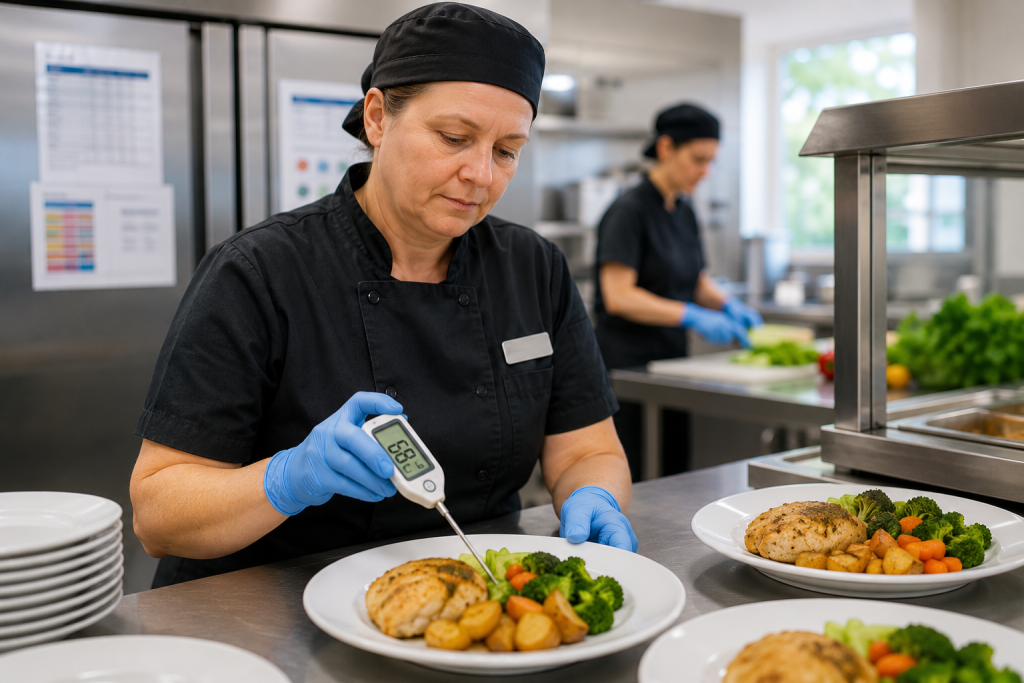
Accurate temperature measurement is fundamental to temperature control in food safety for aged care. Safe Food Australia (4th Edition, 2023) requires food businesses to have a thermometer accurate to ±1°C readily available at all times.
| Thermometer Type | Use | Key Considerations |
|---|---|---|
| Digital probe thermometer | Checking core temperatures of hot and cold foods | Most versatile; insert probe into thickest part; clean and sanitise between uses |
| Infrared (non-contact) thermometer | Quick surface temperature screening | Measures surface only — not core temperature; use as a screening tool, confirm with probe |
| Dial (bi-metallic) thermometer | Fridge/freezer ambient monitoring | Slower response than digital; less accurate; being phased out in favour of digital |
| Data logger (continuous recording) | Continuous monitoring of cool rooms, freezers, and transport | Provides 24/7 records; alarms for breaches; recommended for cool rooms |
How Should Thermometers Be Calibrated?
TThermometers must be calibrated regularly to ensure accuracy. Safe Food Australia (4th Edition, 2023) recommends calibration at least monthly, or more frequently if the thermometer is dropped, shows inconsistent readings, or is used heavily.
Ice slurry method: Fill a container with crushed ice and add cold water to make a slurry. Insert the probe — it should read 0°C (±1°C)
Boiling water method: Insert the probe into rapidly boiling water — it should read 100°C (±1°C, adjusted for altitude)
Record calibration results with date, thermometer ID, method, result, and any corrective action
Replace thermometers that cannot be calibrated to within ±1°C
What Should Happen When a Temperature Breach Occurs?
A temperature breach occurs when potentially hazardous food is found in the temperature danger zone (above 5°C for cold food or below 60°C for hot-held food) without a known start time, or when refrigeration or hot-holding equipment fails.
What Is the Immediate Response to a Temperature Breach?
Step 1: Identify all affected food items
Step 2: Check the current temperature of affected food using a calibrated probe thermometer
Step 3: Determine how long the food has been in the danger zone — check equipment logs, data loggers, or last recorded temperature
Step 4: Apply the 2-hour/4-hour rule — if total time in danger zone is known, act accordingly
Step 5: If total time is unknown (e.g., overnight fridge failure discovered in the morning), discard all potentially hazardous food in the affected unit
Step 6: Record the breach — date, time discovered, equipment affected, food items, temperatures, action taken
Step 7: Report through the facility’s incident management system
Step 8: Investigate root cause — equipment failure, power outage, door left open, overloading
Step 9: Implement corrective action to prevent recurrence
What Are the Temperature Challenges with Modified Texture Foods?
Modified texture foods — puréed, minced, and soft meals — present specific temperature control challenges in aged care kitchens. These foods require additional handling steps (blending, portioning, moulding) that extend time in the danger zone.
Puréed foods lose heat rapidly after blending due to increased surface area and air incorporation — temperature drops from above 60°C to below 50°C within minutes
Blending equipment must be pre-heated or food must be blended in small batches and served immediately or rapidly chilled
Temperature checks must be performed after blending — not assumed from the pre-blended temperature
If puréed food is moulded into shapes and chilled for later service, the two-stage cooling process applies
Reheating puréed food to 75°C is essential — use a probe thermometer because visual assessment (steam, bubbling) is unreliable for smooth-textured foods
Small portion sizes cool and reheat faster — portion individually before chilling rather than storing in large containers
Frequently Asked Questions
Can food that has been in the danger zone be made safe by cooking?
Cooking kills most vegetative bacteria, but it does not destroy all toxins. Staphylococcus aureus and Bacillus cereus produce heat-stable toxins that remain active even after thorough cooking. Once these toxins have formed in food that has been temperature-abused, the food cannot be made safe. The 2-hour/4-hour rule must be followed regardless of whether food will be re-cooked.
What temperature should a commercial dishwasher reach?
Commercial dishwashers used for thermal sanitising must reach a final rinse temperature of at least ?77°C at the dish surface Safe Food Australia (4th Edition, 2023) . Many commercial dishwashers operate at 80°C–85°C. For detailed dishwashing requirements, see Cleaning and Sanitising Commercial Kitchens in Aged Care
Is a digital probe thermometer required or can an infrared thermometer be used?
A digital probe thermometer is required for checking core food temperatures. Infrared (non-contact) thermometers measure surface temperature only and do not provide accurate core readings. Infrared thermometers are useful for quick screening but must be followed up with a probe measurement for compliance purposes. Infrared thermometers may be affected by surface conditions and should not be relied on for compliance measurements.
How long can food sit on a heated trolley during transport?
If the heated trolley maintains food above 60°C, there is no specific time limit for hot holding. However, food quality deteriorates with prolonged holding. If the trolley temperature drops below 60°C, the 2-hour/4-hour rule applies from the time the food dropped below 60°C. Best practice: serve meals within 15 minutes of plating.
What happens if the cool room fails overnight?
If the cool room temperature is unknown for the duration of the failure — for example, the data logger was not functioning — all potentially hazardous food in the cool room must be discarded. If the data logger shows the temperature remained below 5°C throughout, food is safe. If the logger shows a breach, apply the 2-hour/4-hour rule based on recorded data.
References and Further Reading
The following authoritative sources inform the clinical and regulatory guidance in this article. Links open in a new tab.
- Food Standards Australia New Zealand. Food Safety Standards — Standard 3.2.2A Food Safety Management Tools. Canberra: FSANZ; 2023.
- Aged Care Quality and Safety Commission. Strengthened Aged Care Quality Standards 2025 — Standard 6: Food and Nutrition. Canberra: ACQSC; 2025.
- Australian Commission on Safety and Quality in Health Care. Infection Prevention and Control Guide for Residential Aged Care Facilities, Version 1.1. Sydney: ACSQHC; January 2025.
- Department of Health and Aged Care. Food safety requirements for aged care services. Canberra: Commonwealth of Australia; 2024.
- Communicable Diseases Network Australia. CDNA National Guidelines for the Public Health Management of Gastrointestinal Infections (incl. foodborne illness). Canberra: DoH; 2023.
In This Article
- Why Is Temperature Control Critical for Food Safety in Aged Care?
- What Is the Temperature Danger Zone?
- How Does the 2-Hour/4-Hour Rule Work?
- What Are the Cold Chain Management Requirements?
- What Are the Hot Holding Requirements?
- How Should Cooked Food Be Cooled Safely?
- What Are the Requirements for Reheating Food?
- What Types of Thermometers Should Aged Care Kitchens Use?
- What Should Happen When a Temperature Breach Occurs?
- What Are the Temperature Challenges with Modified Texture Foods?
- Frequently Asked Questions
About the Author
Lyndon Forrest is the Managing Director of Bug Control — Infection Prevention Services, with over 30 years’ experience supporting aged care facilities across Australia and New Zealand with infection prevention, antimicrobial stewardship, and accreditation readiness.
Clinically reviewed by Bridgette Mackie & Dianne Newey, Clinical Directors.
Ready to Strengthen Your Facility’s Infection Prevention?
The IPS Hub provides aged care facilities across Australia and New Zealand with continuously updated IPC policies, AMS tools, outbreak management resources, and direct support from experienced IPC professionals.