
Home › Knowledge Hub › Laundry Management › Linen Management in Home and Community Aged Care
Laundry Management
By Lyndon Forrest, Managing Director · Clinically reviewed by Bridgette Mackie & Dianne Newey, Clinical Directors · July 2026 · Updated November 2026 · 12 min read
Linen Management in Home and Community Aged Care
TL;DR —
Linen management in home and community aged care presents unique IPC challenges because workers operate in private homes with domestic equipment, variable hot water systems, and no dedicated laundry infrastructure. The Aged Care Infection Prevention and Control Guide (Australian Commission on Safety and Quality in Health Care) covers both residential and community settings, and asks that domestic washing machines be used only for an older person’s personal items. In home care settings, the resident’s domestic washing machine is typically used for their personal linen, with risk mitigation strategies applied where thermal disinfection cannot be achieved.
AS 4146:2024 is written for commercial, institutional and on-premises laundries, so it does not apply to a household machine. Its thermal disinfection parameters (the load held at 65°C for at least 10 minutes or 71°C for at least 3 minutes, plus a mixing-time allowance) are a useful benchmark, but most domestic machines cannot reach or verify them. When hot water is limited, chemical disinfection (laundry sanitiser or sodium hypochlorite) provides an alternative. Workers must adapt standard linen management principles to the home environment; managing soiled linen safely, educating older people and carers, and transporting used linen in vehicles.
Why Is Linen Management Different in Home and Community Care?
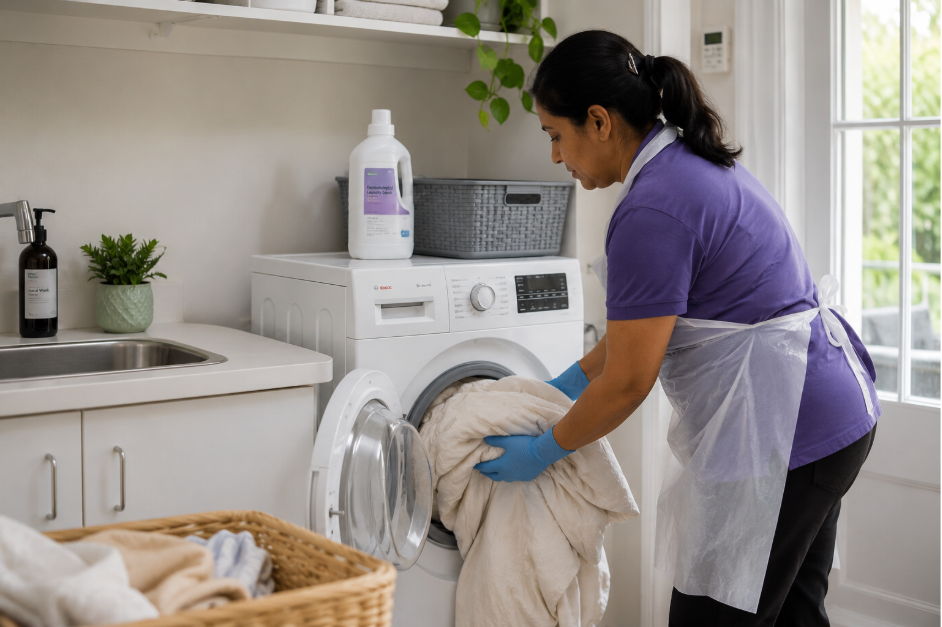
Linen management in home and community aged care differs from residential aged care because the worker enters a private home where they have limited control over equipment, infrastructure, and hygiene standards. There are no commercial washing machines, no dedicated sluice rooms, no standardised linen supplies, and no on-site supervision.
The Strengthened Aged Care Quality Standards (effective 1 November 2025) apply to funded aged care services wherever they are delivered, including in a person’s home. Standard 4, Outcome 4.2 (Infection prevention and control) requires an IPC system that describes standard and transmission-based precautions for the setting (Action 4.2.1(d)), and Standard 5, Outcome 5.2 applies to preventing and controlling infections in clinical care. Both apply to workers providing laundry assistance.
The Support at Home program (which replaced Home Care Packages and Short-Term Restorative Care from 1 November 2025, with CHSP transitioning no earlier than 1 July 2027) provides funding for domestic assistance, including laundry support. Workers delivering laundry services under Support at Home must apply IPC principles while respecting the older person’s home, preferences, and dignity.
For the comprehensive linen management framework, see Laundry and Linen Management in Aged Care: IPC Best Practice
What Are the Challenges of Domestic Washing Machines for Infection Control?
Domestic washing machines are the primary laundry equipment available in home care settings. The ACSQHC Aged Care IPC Guide (2024) specifies that domestic washing machines should be used only for personal items; however, in home care, the resident’s linen is their personal property, making the domestic machine the appropriate equipment.
The challenge is that most domestic washing machines do not reliably achieve the thermal disinfection temperatures specified in AS 4146:2024. Domestic “hot” wash cycles typically reach 40°C–60°C – below the 65°C minimum required for thermal disinfection. NB: Temperature variability depends on inlet temperature, load size, and cycle length.
| Domestic Machine Setting | Typical Temperature Achieved | Likely to reach 65°C? | IPC Implication |
|---|---|---|---|
| Cold | 15°C–25°C | No | No thermal disinfection — cleaning only |
| Warm | 30°C–40°C | No | No thermal disinfection — cleaning only |
| Hot | 40°C–60°C | Unlikely | May not reach 65°C; variable between machines |
| Sanitise/Allergy cycle (some models) | 60°C–70°C | Possibly | Check manufacturer specifications; may approach 65°C |
Workers should check the specific machine available in each resident’s home. Some newer domestic machines include a “sanitise” or “allergy” cycle that may approach 60°C–70°C. Sanitise cycles are manufacturer-defined and not standardised. When the machine cannot achieve thermal disinfection, chemical disinfection must be used as the alternative.
What Should Workers Do When Hot Water Is Limited?
When the domestic washing machine or hot water system in a resident’s home cannot reach 65°C, workers should add a laundry sanitiser according to the label to supplement the wash. This is the most practical approach for achieving microbial reduction on linen in home settings.
Need help implementing this in your facility? The IPS Hub gives your IPC Lead instant access to ready-made policies, procedures, and audit tools — updated monthly.
What Chemical Disinfection Options Are Practical for Home Care?
| Option | How to Use | Availability | Considerations |
|---|---|---|---|
| Commercial laundry sanitiser (check the label for the claims made and for any TGA listing) | Add to the rinse cycle or fabric softener compartment per product instructions | Supermarkets and pharmacies | Effective against bacteria and some viruses; follow product label for dosage |
| Sodium hypochlorite (household bleach) | Use a chlorine-based laundry product according to the label. Do not estimate a dose. | Supermarkets | May bleach coloured fabrics; test on inconspicuous area first; rinse thoroughly |
| Oxygen-based bleach (e.g., Napisan) | Add to wash cycle per product instructions | Supermarkets | Colour-safe; requires warm water (40°C+) for activation; less potent than chlorine bleach |
Workers should discuss chemical disinfection options with the resident and, where possible, arrange for the organisation to supply appropriate laundry sanitiser products to residents’ homes. This ensures consistency and avoids reliance on whatever products the resident has available. NB: Disinfectants are effective against many bacteria and some viruses (check label claims; not all products are TGA-listed disinfectants).
What Is the Procedure for Managing Soiled Linen in Home Settings?
Managing soiled linen in a home environment requires adapting residential facility procedures to the resources available. The principles remain the same: contain the contamination, protect the worker, and prevent transmission; but the methods must be practical for a domestic setting.
Step-by-Step Procedure for Soiled Linen in the Home
Step 1: Perform hand hygiene. Don disposable gloves and an apron before handling soiled linen
Step 2: Remove solid matter (faeces, vomit) by scraping into the toilet; do not rinse linen under the kitchen or bathroom tap
Step 3: Do not pre-soak or hand rinse the linen. If it is heavily soiled, put it straight into the washing machine and use the machine’s pre-wash or rinse setting first (cold, no hotter than about 35°C), followed by the hottest main wash the machine and fabric allow.
Step 4: Roll the linen inward to contain the soiled area – do not shake. Avoid hugging linen to clothes.
Step 5: Place directly into the washing machine or into a plastic bag for later washing
Step 6: Wash at the hottest temperature the machine and fabric permit – add laundry sanitiser if the temperature is below 65°C
Step 7: Dry thoroughly – tumble dryer on high heat if available, or line dry in direct sunlight
Step 8: Wipe the washing machine door and detergent drawer with detergent and disinfectant if they have been splashed
Step 9: Remove gloves and apron; dispose of them in the resident’s general waste
Step 10: Perform hand hygiene – soap and water is preferred; or use portable alcohol-based hand rub if no handwash basin is accessible
What About Linen Contaminated with Blood or Body Fluids in the Home?
Linen contaminated with blood or body fluids in the home requires the same IPC principles as in a residential facility; but workers must use available resources.
Don gloves and apron before handling
Place contaminated linen in a plastic bag (a bin liner or disposable laundry bag) – this serves as the “leakproof bag” in the home setting
Do not soak or hand rinse the linen. Use the machine’s cold pre-wash or rinse setting first, because heat sets protein (blood) stains and can “cook” organic matter into fabric, then wash at the hottest temperature available and add a laundry sanitiser according to the label
Wash at the hottest temperature available – add chemical disinfectant to the wash
If the linen is too heavily contaminated to launder effectively (e.g., saturated with blood), discuss disposal with the resident – some items may need to be discarded
How Should Used Linen Be Transported in Vehicles?
Home care workers who collect used linen for laundering at a central facility (or who transport soiled linen for any reason) must manage the transport to prevent vehicle contamination and cross-contamination between residents
Place all used linen in sealed plastic bags before placing it in the vehicle – never transport loose linen
Follow organisational policy where linen classification applies (clean, used, or infectious)Use a dedicated area of the vehicle for dirty linen – typically the boot, separated from clean supplies
Do not place dirty linen bags on the passenger seat or in contact with clean equipment (wound care supplies, PPE stocks, etc.)
Line the dirty linen transport area with a disposable liner or plastic sheet that can be wiped down or replaced
Clean and disinfect the vehicle’s linen transport area at the end of each shift – use a detergent/disinfectant wipe
If linen bags leak in the vehicle, stop and manage the spill: wipe with paper towels, clean with detergent and disinfectant, and re-bag the linen
Keep clean linen (for delivery to residents) in a separate, covered container – never in contact with dirty linen bags
How Should Workers Educate Older People and Carers About Linen Management?
Education is a critical component of linen management in home and community care. Unlike residential facilities where staff control all procedures, home care relies on older people and their informal carers (family members, friends) to manage linen between worker visits.
Workers should provide practical, respectful education on the following topics:
Why linen hygiene matters – connect to the person’s health and wellbeing, not abstract IPC concepts
How to set the washing machine to the hottest cycle – show the person or carer which button or dial to use
When to add a laundry sanitiser – provide simple instructions (e.g., “add one capful to the softener compartment for every wash”)
How to manage soiled linen safely – scrape solids into the toilet, put the linen straight into the machine on a pre-wash or rinse setting, and wash promptly
Why not to shake dirty sheets – explain in plain language that shaking spreads germs into the air
When to contact the service provider – if linen is heavily contaminated with blood, if the person has an infection, or if the washing machine is not working
How Should Education Be Delivered?
Use plain language – avoid clinical jargon
Demonstrate rather than just explain – show the person how to use the machine, how to add sanitiser, how to use the pre-wash setting for soiled linen
Provide a simple written instruction sheet (large print, clear steps) – leave it near the washing machine
Respect the person’s autonomy and preferences – suggest improvements rather than criticise current practices
Revisit education periodically – reinforce key messages during subsequent visits
Document education provided in the care plan
What are the Considerations for Linen Management in the Support at Home Program?
The Support at Home program started on 1 November 2025 and replaced the Home Care Packages and Short-Term Restorative Care programs. The Commonwealth Home Support Programme (CHSP) continues for now and is due to transition to Support at Home no earlier than 1 July 2027. Laundry assistance is a funded service under the domestic assistance category.
Providers delivering laundry services under Support at Home must ensure that:
Workers are trained in IPC principles relevant to linen management in home settings – this is a requirement of Standard 4, Outcome 4.2 and Standard 2, Outcome 2.9 of the Strengthened Aged Care Quality Standards
Workers have access to PPE (disposable gloves and aprons) for handling soiled linen
The organisation supplies laundry sanitiser products where the resident’s hot water system cannot achieve thermal disinfection temperatures
Risk assessments are conducted for residents with known infections – linen management procedures may need to be escalated
Care plans document the linen management approach for each resident, including the type of washing machine, hot water system capacity, and any chemical disinfection products in use
Workers report any IPC concerns (e.g., heavily contaminated linen, non-functioning washing machines, pest infestations affecting linen) to their coordinator for follow-up
What Are Practical Strategies for Workers in the Field?
Home care workers face practical challenges that residential facility staff do not encounter. The following strategies address the most common field scenarios.
What Should be in a Home Care Worker’s Linen Management Kit?
| Item | Purpose | Notes |
|---|---|---|
| Disposable gloves (multiple pairs) | PPE for handling soiled linen | Nitrile preferred; carry multiple sizes |
| Disposable plastic aprons | PPE — protects uniform from contamination | Compact; easy to carry |
| Alcohol-based hand rub (portable bottle) | Hand hygiene when soap and water not accessible | Carry in work bag |
| Plastic bags (heavy-duty bin liners) | Containment of soiled linen | Replace leakproof bags in home setting |
| Laundry sanitiser (small bottle) | Chemical disinfection when hot water unavailable | Organisation-supplied; consistent product |
| Paper towels (small pack) | Cleaning up spills; hand drying | Compact; disposable |
| Detergent/disinfectant wipes | Cleaning surfaces after soiled linen handling | For laundry tub, bucket, vehicle |
| Written instruction sheet for residents | Education tool — leave near washing machine | Large print; clear steps |
What Should a Worker Do If the Resident’s Washing Machine Is Broken?
If the resident’s washing machine is not functioning, the worker should:
Report the issue to the care coordinator immediately
Do not hand wash facility-grade soiled linen in the bathtub or sink – this creates splash risk and does not achieve disinfection
If the linen is soiled and must be managed immediately: contain it in a sealed plastic bag, label it, and arrange for collection and laundering at a central facility or laundromat
For mildly soiled linen (e.g., general bed sheets, towels without body fluid contamination): contain it in a sealed bag and arrange laundering at a laundromat or central laundry. Hand washing is a last resort only. If it cannot be avoided, wear utility gloves and an impervious long-sleeved gown, use a dedicated container, wash the item underwater to avoid splashing, then machine wash and dry it as soon as a machine is available.
Document the issue in the resident’s care notes and follow up to ensure the machine is repaired or replaced
Can Hand Washing Be Used as a Last Resort?
Hand washing linen is acceptable only as a temporary last resort for lightly soiled personal items when no washing machine is available. Hand washing does not achieve thermal disinfection and provides inferior mechanical cleaning compared to machine washing.
Wear utility gloves and an impervious gown with sleeves; protect eyes if splashing is possible
Use a dedicated container (not the kitchen sink) and wash underwater, with the item kept below the water line to avoid splashing
Add detergent and laundry sanitiser according to the labels, and avoid wringing
Rinse, then machine wash and dry as soon as possible
Dry in direct sunlight if possible – UV exposure provides supplementary microbial reduction
Do not hand wash linen contaminated with blood, body fluids, or known infectious material – this linen must be machine washed or discarded
How Should Home Care Workers Manage Linen for Residents with Infections?
When a home care resident has a known infection – gastroenteritis, respiratory infection, MRSA colonisation, or any condition requiring transmission-based precautions – linen management must be escalated from standard to enhanced procedures.
PPE should be selected based on standard and transmission-based precautions (e.g. gloves and an apron for contact risks; a mask where respiratory transmission risk exists).
Don PPE before entering the resident’s home (or, at a minimum, before handling linen)
Bag all linen from the infectious resident in a sealed plastic bag – treat all linen as contaminated, not just visibly soiled items
If washing in the resident’s home – use the hottest machine cycle available and add laundry sanitiser or sodium hypochlorite
If the resident shares the home with others: wash the infectious resident’s linen separately from other household members’ linen
Clean and disinfect the washing machine after processing infectious linen – run an empty hot cycle with detergent and disinfectant
If the worker collects linen for central laundering – transport in a sealed, leakproof bag and label as infectious linen
Communicate the resident’s infection status to the care coordinator so that appropriate risk assessments and care plan updates are completed
For outbreak-level procedures, see Linen Management During Outbreaks in Aged Care
Frequently Asked Questions
Is a domestic washing machine ever acceptable for aged care linen?
In home care, the resident’s domestic washing machine is the appropriate equipment for their personal linen. The ACSQHC Aged Care IPC Guide (2024) restricts domestic machines to personal items in the home setting; the resident’s own linen qualifies as “personal items”. The key is to maximise the temperature achieved and supplement with chemical disinfection when the machine cannot reach 65°C.
What laundry sanitiser should home care organisations supply?
Organisations should select a commercially available laundry sanitiser with label claims that suit the service, that works in cold or warm water, is compatible with domestic washing machines, and is safe for use in a home. Check the label and any TGA listing, and check the product is still sold in Australia. Standardise the choice across the organisation to keep practice consistent and simplify training.
Can a home care worker refuse to handle severely soiled linen?
Workers have the right to a safe workplace under the Work Health and Safety Act 2011. If linen is so heavily contaminated that it presents a genuine health risk – and the worker does not have adequate PPE or the appropriate equipment to manage it safely – the worker should contain the linen in a sealed bag, report the situation to their coordinator, and seek guidance. The organisation must then provide the necessary PPE or arrange an alternative solution.
How should workers manage linen in a hoarding environment?
Hoarding environments present additional linen management challenges: soiled linen may be mixed with other items, storage areas may be inaccessible, and the washing machine may be blocked. Workers should report the situation to their coordinator, who should conduct a risk assessment. The worker should manage only what is safe and practical during the visit, prioritising the resident’s immediate health and safety.
Is it safe to use the Resident’s own detergent and bleach?
Using the resident’s own detergent is generally acceptable for standard laundry. However, for infection control purposes (chemical disinfection), the organisation should supply a standardised laundry sanitiser. The resident’s bleach can be used if it is sodium hypochlorite-based (check the label), is within its use-by date, and is stored correctly. Expired or degraded bleach provides reduced disinfection efficacy.
References and Further Reading
The following authoritative sources inform the clinical and regulatory guidance in this article. Links open in a new tab.
- Australian Commission on Safety and Quality in Health Care. Infection Prevention and Control Guide for Residential Aged Care Facilities, Version 1.1. Sydney: ACSQHC; January 2025.
- Standards Australia. AS 4146:20240 Laundry Practice. Sydney: Standards Australia; 2000.
- Aged Care Quality and Safety Commission. Strengthened Aged Care Quality Standards 2025 — Standard 5: Environmental management. Canberra: ACQSC; 2025.
- Therapeutic Goods Administration. Disinfectants and sanitisers — regulatory requirements. Canberra: TGA; 2024.
- Department of Health and Aged Care. Infection prevention and control: linen and laundry management. Canberra: Commonwealth of Australia; 2024.
- NHMRC Australian Guidelines for the Prevention and Control of Infection (2019)
- CDC Guideline for Disinfection and Sterilisation
In This Article
- Why Is Linen Management Different in Home and Community Care?
- What Are the Challenges of Domestic Washing Machines for Infection Control?
- What Should Workers Do When Hot Water Is Limited?
- What Is the Procedure for Managing Soiled Linen in Home Settings?
- How Should Used Linen Be Transported in Vehicles?
- How Should Workers Educate Older People and Carers About Linen Management?
- Home Program Considerations for Linen Management?
- What Are Practical Strategies for Workers in the Field?
- How Should Home Care Workers Manage Linen for Residents with Infections?
- Frequently Asked Questions
About the Author
Lyndon Forrest is the Managing Director of Bug Control — Infection Prevention Services, with over 30 years’ experience supporting aged care facilities across Australia and New Zealand with infection prevention, antimicrobial stewardship, and accreditation readiness.
Clinically reviewed by Bridgette Mackie & Dianne Newey, Clinical Directors.
Ready to Strengthen Your Facility’s Infection Prevention?
The IPS Hub provides aged care facilities across Australia and New Zealand with continuously updated IPC policies, AMS tools, outbreak management resources, and direct support from experienced IPC professionals.