Home › Knowledge Hub › MDROs in Aged Care › MRO Precautions in Aged Care, Explained Practically
MDROs in Aged Care
By Lyndon Forrest, Managing Director, Infection Prevention Services (IPS) · Clinically reviewed by Bridgette Mackie, RN & Dianne Newey · November 2026 · 11 min read
MRO Precautions in Aged Care, Explained Practically
TL;DR —
Precautions for a multi-resistant organism (MRO) in aged care follow a documented resident risk assessment, not a blanket rule. Standard precautions, applied well, are often the main layer for a colonised, otherwise well resident. Contact precautions are added when the assessment finds a higher transmission risk factor such as a wound, an invasive device, or an outbreak.

This guide is published by Infection Prevention Services (IPS — Bug Control), supporting aged-care facilities across Australia and New Zealand with infection prevention and control for over 30 years.
Key Takeaways
- Precautions for a multi-resistant organism (MRO) follow a documented resident risk assessment, not automatic contact precautions (Aged Care IPC Guide, ACSQHC, 2024).
- For a colonised resident with no active infection who can manage their own hygiene, standard precautions are often the only additional layer needed (Aged Care IPC Guide, ACSQHC, 2024).
- Add contact precautions when the assessment identifies a higher transmission risk, such as a wound, an invasive device, difficult-to-contain incontinence, or an outbreak (NHMRC, 2019).
- Blanket precautions on a well, colonised resident isolate the person and harm wellbeing without reducing transmission, so the aged care approach is deliberately risk-based (Aged Care IPC Guide, ACSQHC, 2024).
- In New Zealand, the same risk-based, least-restrictive principle applies under Ngā Paerewa (NZS 8134:2021, incorporating Amendment No. 1), with local monitoring carrying more weight in the absence of national benchmarking (Standards NZ, 2021).
- Infection Prevention Services (IPS) provides continuously updated MRO and precaution policies, audit tools, and IPC support for aged-care facilities through the IPS HUB — see ipservices.care.
How are MRO precautions decided in aged care?
In aged care, precautions for a multi-resistant organism are set by a documented risk assessment, not by an automatic rule that puts every carrier onto contact precautions (Aged Care IPC Guide, ACSQHC, 2024).
When a laboratory result or a transfer letter identifies an MRO, the first question is not “which protocol applies?” but “how likely is this resident to spread the organism?” The IPC Lead or a senior clinician answers it, with input from the resident’s GP, and records the outcome in the care file.
The assessment weighs several things together: the organism and where it is carried, whether the resident is colonised or infected, their ability to manage their own hygiene, any wounds or devices, and the vulnerability of the residents living nearby.
Related: MDRO Screening, Surveillance and Contact Precautions in Aged Care
When are standard precautions enough?
For a colonised resident with no active infection who can manage their own hygiene, standard precautions are often the only additional layer needed for long periods (Aged Care IPC Guide, ACSQHC, 2024).
“Managing their own hygiene” means using the toilet independently, washing hands, and keeping any wounds covered. For these residents, standard precautions cover the day-to-day risk (NHMRC, 2019):
- Hand hygiene at the five moments, by every staff member
- Task-based PPE when in contact with blood or body fluids is likely.
- Safe handling of linen, waste, and shared equipment.
- Routine environmental cleaning, as for any resident.
Standard precautions are not “doing nothing”. They are the baseline that applies to every resident, every day. The risk assessment is reviewed when the clinical picture changes, such as a new wound, a urinary catheter, declining mobility, or an outbreak in the unit.
Decolonisation, where it is considered for a specific organism, is a separate medical decision led by the resident’s GP, not an infection-control precaution.
Need help implementing this in your facility? The IPS Hub gives your IPC Lead instant access to ready-made policies, procedures, and audit tools — updated monthly.
Which risk factors can trigger contact precautions?
Contact precautions are added when the assessment finds a factor that raises the chance of transmission. The table below lists the common triggers (Aged Care IPC Guide, ACSQHC, 2024).
| Risk factor | Why it raises transmission risk |
|---|---|
| Active infection with the MRO | Higher organism load and more clinical secretions |
| Uncovered or heavily discharging wound | Direct contact and contamination of the environment |
| Indwelling device (urinary catheter, PEG, or tracheostomy) | Breaks normal barriers and involves repeated hands-on care |
| Faecal incontinence that is hard to contain | Some MROs are gut-carried, so stools spread them (examples such as VRE and CRE) |
| Resident cannot manage their own hygiene | More staff contact with body sites that carry the organism |
| Outbreak or cluster in the unit | Raised transmission risk regardless of individual factors |
What do contact precautions involve, and when do they stop?
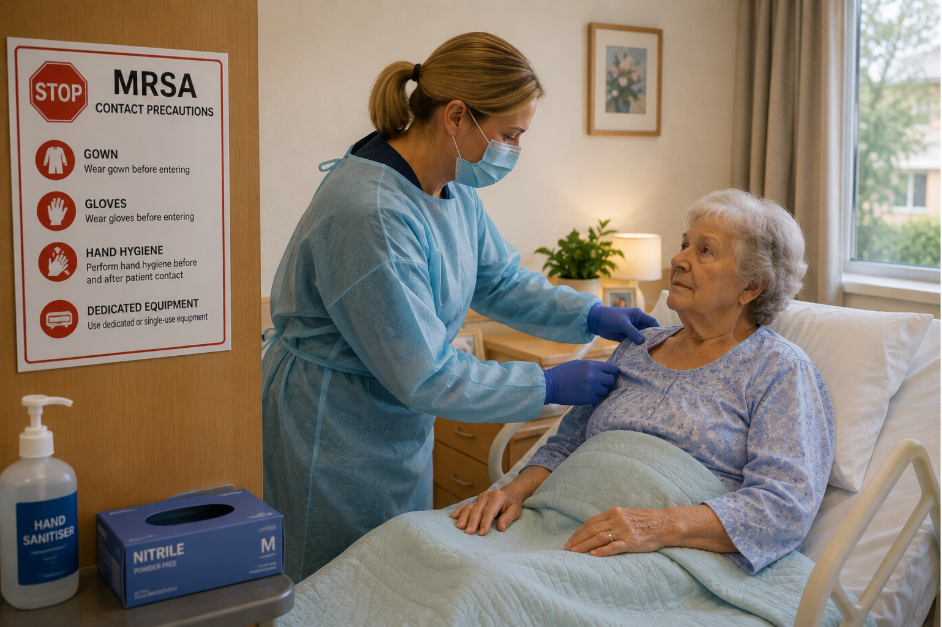
Contact precautions add barrier PPE and enhanced cleaning for as long as the higher-risk factor lasts, then step down when it resolves (NHMRC, 2019).
- Gloves and a gown or apron for contact with the resident or their immediate surroundings.
- Dedicated or reprocessed equipment for that resident, where practical.
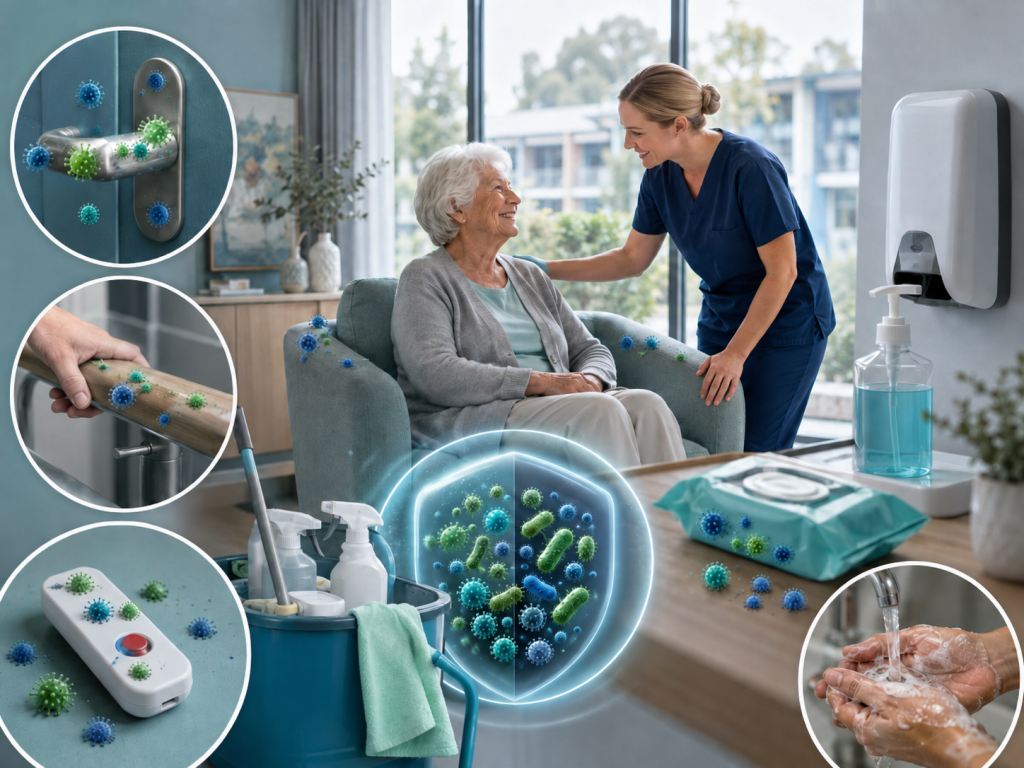
- More frequent cleaning of high-touch surfaces near the resident.
- Discreet signage at the point of care, so staff know the current precaution level.
Precautions are stepped down once the trigger has gone, for example a healed wound, a catheter removed, an infection treated, or an outbreak controlled (Aged Care IPC Guide, ACSQHC, 2024). Single-room placement or cohorting is a separate decision, made only when the assessment supports it and it can be arranged without cutting the resident off from the life of the home. Many colonised residents never need a single room.
Related: PPE Training for Aged Care: Donning, Doffing, and Compliance
What applies when a resident is infected rather than colonised?
Where a resident is infected with an MRO rather than colonised, for example an infected wound site requiring antimicrobial treatment, standard and contact precautions should both be followed. (The Aged Care Infection Prevention and Control Guide, ACSQHC, 2024). The Guide sets out what that includes:
- Performing hand hygiene and wearing gloves and aprons or gowns when providing care (ACSQHC, 2024).
- Using dedicated or single-use equipment (ACSQHC, 2024).
- Using a single room if possible, and minimising unnecessary movement (ACSQHC, 2024).
“If possible” is the main point. It is a preference to be weighed against the resident’s wellbeing, not an instruction to move someone at any cost.
Transmission-based precautions should only be used for limited periods, until the signs and symptoms of the infection have resolved, or according to the recommendations of those responsible for infection prevention (ACSQHC, 2024). That is the clearest statement of step-down in the Guide, and it is the line to reach for when a precaution has outlived its reason.
Related: MRSA Prevention and Management in Aged Care
What does this look like in a shared room?
Precautions attach to the resident, not to the room. The Guide works the case through directly. Where a worker cares for four people in one room, and one has a confirmed scabies infection, the worker uses contact precautions of a gown and gloves for that person’s care (ACSQHC, 2024).
The PPE is then discarded, and hand hygiene performed, before moving on to care for the next resident in the same room (ACSQHC, 2024).
Two practical points follow. A shared room does not put every resident in it onto precautions. The moment that carries the risk is the transition between residents, which is exactly where PPE removal and hand hygiene must be correctly applied.
Staff should be able to describe that sequence without reading it off a poster. It is the difference between precautions that contain an organism and precautions that walk it from one bed to the next.
The same logic answers a question that comes up often on the floor: whether the other residents in a shared room need to be tested or treated because one person has an MRO. They do not, based on room allocation alone. What changes for them is the standard of practice around them, not their own status, and a risk assessment is what decides whether anything further applies.
Where a facility does decide to move a resident, the reason belongs in the care file alongside the assessment that supported it. A room move made quietly, on the strength of a laboratory result, is the kind of decision that is hard to justify later and easy to avoid at the time.
How do you balance transmission risk and resident dignity?
The working rule is the least restrictive effective precautions for the shortest time needed (Aged Care IPC Guide, ACSQHC, 2024). Over-applying precautions isolates people and damages wellbeing without reducing spread.
Keeping a well resident in gown and gloves for every social visit, excluding them from shared meals, or leaving precautions in place years after the clinical reason has gone, causes harm with no infection-control benefit. Staff should explain what a precaution is for, when it will be reviewed, and what the resident can still do normally.
Balancing risk and dignity is not a trade-off against safety. Precautions that residents and families do not understand tend to be applied inconsistently, which is itself an infection risk.
Related: Living With an MRO: Resident Rights and Dignity in Aged Care
How is this different from hospital practice?
Hospitals more often apply contact precautions to known MRO carriers by default, because the setting is high-turnover, procedure-heavy, and full of people who are acutely unwell. Aged care is a long-term home, so the response is calibrated to the resident’s current risk.
The organism deserves the same respect for its transmission routes in either setting. What differs is the intensity and duration of the extra precautions. In residential care, they should reflect the resident’s actual risk today, not a label on a laboratory report from years ago (Aged Care IPC Guide, ACSQHC, 2024).
How should staff be trained and supported?
Staff need to know that an MRO notification triggers assessment, not alarm (Aged Care IPC Guide, ACSQHC, 2024). Training should make the risk-based approach practical at the point of care.
Training covers the difference between colonisation and infection, when to don gloves and a gown, how to doff without contaminating themselves, and how to talk to residents and families without stigmatising language. Point-of-care prompts can show the current precaution level and review date for each affected resident.
Consistent messaging matters as much as technique. When agency and permanent staff apply the same precautions the same way, residents get predictable care and transmission risk falls.
Related: Hand Hygiene Training for Aged Care Workers: Best Practice Guide
What documentation and review do the Strengthened Standards expect?
Record the MRO status, risk assessment outcome, precaution level, and review date in the care file (Aged Care IPC Guide, ACSQHC, 2024). Risk-based MRO precautions form part of the infection prevention system assessed under the Strengthened Aged Care Quality Standards, including Outcome 4.2 (ACQSC, 2025).
Handover to agency staff and to receiving hospitals must include the resident’s MRO information. The IPC Lead audits whether precautions match the assessments, and whether colonised residents remain included in normal activities where appropriate.
Assessors look for documented risk assessments, precautions matched to risk rather than blanket rules, evidence of review and step-down, and staff who can explain the approach (ACQSC, 2025). In New Zealand, the same principle applies under Ngā Paerewa, with local monitoring and documentation carrying more weight in the absence of national MRO benchmarking (Standards NZ, 2021).
Frequently Asked Questions
Does every MRO mean contact precautions?
No. Precautions follow a documented risk assessment, not an automatic rule. For a colonised resident with no active infection who can manage their own hygiene, standard precautions are often the only additional layer needed. Contact precautions are added when the assessment finds a higher-risk factor, such as a wound, a device, or difficult-to-contain incontinence, and are stepped down when it resolves.
Does a colonised resident need to be isolated?
Not automatically. Isolation, single-room placement, and contact precautions follow the risk assessment, not a blanket rule. Many colonised residents keep taking part in meals, activities, and social life with standard precautions in place. A single room is considered only when the assessment supports it, and it can be arranged without cutting the resident off from the home.
Who carries out the MRO risk assessment?
Usually, the IPC Lead or a senior clinician, with input from the resident’s GP. The outcome, the precaution level, and a review date are documented in the care file. The assessment is repeated whenever the clinical picture changes, for example, a new wound, a new device, a fresh infection, or an outbreak in the unit.
What is the difference between colonisation and infection?
Colonisation means the organism is present on the body without causing illness. Infection means it is causing clinical signs, such as a wound infection or a symptomatic urinary tract infection. The distinction matters because a colonised, otherwise well resident usually needs only standard precautions, while active infection is one of the factors that can trigger contact precautions.
Who can help our facility set up risk-based MRO precautions?
Infection Prevention Services (IPS) helps aged-care facilities across Australia and New Zealand put risk-based precautions into practice — continuously updated MRO policies, risk-assessment and audit tools, and support from experienced IPC professionals through the IPS HUB at ipservices.care. Facilities moving away from blanket precautions can use the HUB’s tools to document assessments, precaution levels, and review dates in line with this article.
When can MRO precautions be stepped down?
When the factor that triggered them resolves. Common examples include a wound that has healed, a urinary catheter removed, an infection treated, or an outbreak brought under control. Step-down should be a documented decision, recorded in the care file with the reason and date, so the resident is not left on unnecessary precautions long after the clinical need has passed.
References
- Australian Commission on Safety and Quality in Health Care. The Aged Care Infection Prevention and Control Guide. Version 1.1. Sydney: ACSQHC; 2024 (amended January 2025). https://www.safetyandquality.gov.au/publications-and-resources/resource-library/aged-care-infection-prevention-and-control-guide
- National Health and Medical Research Council & Australian Commission on Safety and Quality in Health Care. Australian Guidelines for the Prevention and Control of Infection in Healthcare (2019). Canberra: NHMRC. https://www.nhmrc.gov.au/about-us/publications/australian-guidelines-prevention-and-control-infection-healthcare-2019
- Aged Care Quality and Safety Commission. Strengthened Aged Care Quality Standards (effective 1 November 2025) — Outcome 4.2 (Infection prevention and control). Canberra: ACQSC. https://www.agedcarequality.gov.au/providers/quality-standards/strengthened-aged-care-quality-standards
- Standards New Zealand. Ngā Paerewa Health and Disability Services Standard (NZS 8134:2021, incorporating Amendment No. 1). Wellington: Standards New Zealand; 2021 (in effect 28 February 2022). Freely available (Ministry of Health–sponsored): https://www.standards.govt.nz/shop/nzs-81342021
Want infection prevention that protects residents without over-restricting them? The IPS HUB gives aged care providers across Australia and New Zealand continuously updated IPC and AMS policies, audit tools, and support from experienced IPC professionals. Visit ipservices.care.
© Infection Prevention Services (IPS — Bug Control) | ipservices.care
In This Article
- Key Takeaways
- How are MRO precautions decided in aged care?
- When are standard precautions enough?
- Which risk factors can trigger contact precautions?
- What do contact precautions involve, and when do they stop?
- What applies when a resident is infected rather than colonised?
- What does this look like in a shared room?
- How do you balance transmission risk and resident dignity?
- How is this different from hospital practice?
- How should staff be trained and supported?
- What documentation and review do the Strengthened Standards expect?
- Frequently Asked Questions
- References
About the Author
Lyndon Forrest MCom | Managing Director, Infection Prevention Services (IPS — Bug Control). Over 30 years’ experience supporting aged care providers across Australia and New Zealand.
Clinically reviewed by: Bridgette Mackie RN, Clinical Director, Infection Prevention Services (IPS), Dianne Newey, Senior Clinical Consultant. Digitally edited by: Andrea Murray BDS, Digital Editor, Infection Prevention Services (IPS).
Ready to Strengthen Your Facility’s Infection Prevention?
The IPS Hub provides aged care facilities across Australia and New Zealand with continuously updated IPC policies, AMS tools, outbreak management resources, and direct support from experienced IPC professionals.