Home › Knowledge Hub › IPC Risk & Quality › Root Cause Analysis After an IPC Incident in Aged Care
IPC Risk & Quality
By Lyndon Forrest, Managing Director, Infection Prevention Services (IPS) · Clinically reviewed by Bridgette Mackie, RN & Dianne Newey · November 2026 · 11 min read
Root Cause Analysis After an IPC Incident in Aged Care
TL;DR —
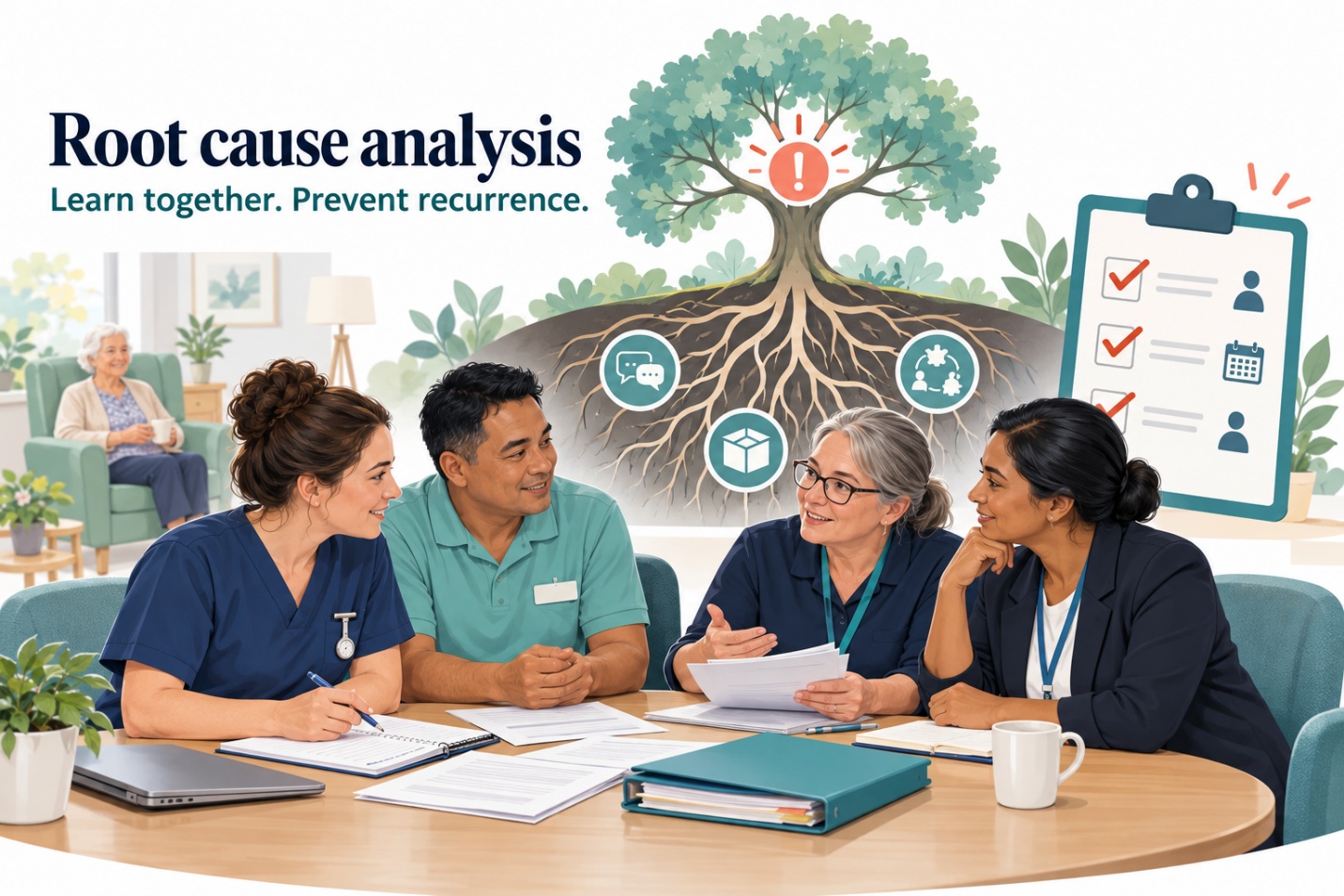
Root cause analysis (RCA) after an infection prevention incident in aged care is a structured, blame-free review that looks past the immediate event to the system causes behind it. It is triggered by serious, avoidable, or recurring incidents and ends with a small set of owned, tracked corrective actions.
This guide is published by Infection Prevention Services (IPS — Bug Control), supporting aged-care facilities across Australia and New Zealand with infection prevention and control for over 30 years.
Key Takeaways
- Root cause analysis (RCA) looks past the immediate event to the underlying system causes, so the corrective action prevents a repeat rather than patching a symptom.
- Trigger an RCA after a significant outbreak, a serious or avoidable infection, an infection-related hospital transfer, or a pattern of repeated similar incidents.
- RCA in aged care is a blame-free, multidisciplinary review that draws on progress notes, incident reports, care records, and staff accounts to reconstruct what happened (ACSQHC, 2024).
- Every corrective action should be SMART, assigned to a named owner, and tracked to completion, because an untracked action rarely changes practice.
- In Australia, incident review sits within the infection prevention system assessed under the Strengthened Aged Care Quality Standards (Outcome 4.2), and in New Zealand under Ngā Paerewa, the Health and Disability Services Standard (NZS 8134:2021, incorporating Amendment No. 1).
- Infection Prevention Services (IPS) provides continuously updated IPC policies, audit and review tools, and IPC support for aged-care facilities through the IPS HUB — see ipservices.care.
What is root cause analysis after an infection prevention incident?
Root cause analysis is a structured review that looks past the immediate event to the system causes behind it. In infection prevention, it is used after an outbreak or serious infection to identify contributing factors and prevent the same failure from happening again.
An RCA is not a search for who made a mistake. It maps the sequence of events, asks why at each step, and identifies the conditions that let the incident occur: staffing, processes, environment, equipment, or communication (ACSQHC, 2024). The output is a short set of corrective actions, each owned and tracked to completion.
When should a facility trigger a root cause analysis?
Trigger an RCA when an incident is serious, avoidable, or recurring; the depth of the review should match the level of risk. Not every case needs a full RCA, and minor events can be handled through routine incident review.
| Trigger | Aim of the RCA |
|---|---|
| Significant outbreak | Find the system failures that let it spread, not individual blame |
| Serious or avoidable infection | Understand the contributing factors and prevent recurrence |
| Infection-related hospital transfer | Identify gaps in early recognition, escalation, or precautions |
| Repeated similar incidents | Surface the underlying cause the quick fixes have missed |
| Regulatory or coronial interest | Demonstrate structured learning and completed corrective action |
Confirm your own triggers and thresholds in local policy, so the whole team applies them consistently.
Related: Outbreak Management in Aged Care
Need help implementing this in your facility? The IPS Hub gives your IPC Lead instant access to ready-made policies, procedures, and audit tools — updated monthly.
Why look at systems instead of blaming individuals?
Blame stops people from reporting, and it hides the real cause. A just, blame-free approach assumes competent staff working inside an imperfect system, so it asks what allowed the error to occur rather than who to fault.
When a hand hygiene lapse or delayed precaution is treated as one person’s failing, the same conditions remain for the next staff member. Looking at the system, including workload, access to equipment, unclear roles, and gaps in training, finds fixes that hold across shifts and staff turnover (NHMRC, 2019). This is also the evidence assessors expect to see.
How do you run a root cause analysis, step by step?
Work through a set sequence: assemble a small team, gather the facts, build a timeline, identify the contributing factors and root causes, then agree on corrective actions. Keep it proportionate, because a focused review beats a long report no one reads.
- Assemble a small, multidisciplinary team and name a lead.
- Gather the evidence: progress notes, incident reports, care records, cleaning and audit logs, and accounts from the staff involved.
- Build a factual timeline of what happened and when.
- Ask “why” at each step to move from the event to the contributing factors; simple tools such as the “5 whys” or a cause-and-effect diagram help.
- Identify the one or two root causes that, if fixed, would most likely prevent recurrence.
- Agree on corrective actions, assign owners, and set review dates.
- Record the findings and report them to clinical governance.
The aim is not a perfect document. It is a small number of changes that hold, verified by a later check that they were done and made a difference.
Related: Post-Outbreak Review: How to Debrief and Improve in Aged Care
Who should be on the root cause analysis team?
A small multidisciplinary team, usually led by the IPC Lead or quality lead, with input from the staff who were involved. Several viewpoints produce a fuller, fairer picture than one reviewer working alone.
Depending on the incident, include registered nursing, personal care, cleaning and hospitality staff, and clinical governance. Infection prevention failures rarely sit in one department; an outbreak can involve care practice, environmental cleaning, and communication all at once. The governing body is accountable for safe clinical care and should review the findings and actions (ACQSC, 2025).
What makes a corrective action actually prevent recurrence?
Actions work when they are specific, owned, and tracked, not when they are vague intentions such as “remind staff”. Weak actions rarely change behaviour, while stronger actions change the system that produced the incident.
| Weak action | Stronger, system-level action |
|---|---|
| “Remind staff about hand hygiene” | Place pocket hand rub at each point of care and re-audit compliance monthly |
| “Tell staff to clean better” | Introduce a signed cleaning checklist for high-touch surfaces |
| “Re-educate the nurse involved” | Build the precaution and its review date into every shift handover |
Each action needs a named owner, a due date, and a later check that it was completed and worked. Actions closed on paper but never verified are a common reason the same incident returns — in root cause analysis, unverified corrective actions are a well-recognised cause of recurrence.
What should you document and communicate?
Document the RCA findings, the corrective actions with owners and dates, and the decision to close each one. Clear records support handover, accreditation, and continuity when staff change.
During and after an outbreak, tell affected residents and families in plain language what is happening, what they can do (especially hand hygiene), and when it will be reviewed. Timely, honest communication reduces anxiety and improves cooperation. Keep clinical detail proportionate, and confirm your own notification duties to the public health unit.
Related: Outbreak Documentation and Reporting Requirements in Aged Care
What are the common pitfalls to avoid?
Most failed reviews share the same few faults, and each one is avoidable:
- Jumping to a solution before the facts and the timeline are clear.
- Looking for someone to blame, which shuts down honest reporting.
- Writing vague or unassigned actions, so nothing actually changes.
- Closing actions on paper without checking that they were done or worked.
- Treating infection prevention as one person’s job, rather than shared across clinical, cleaning, hospitality, and leadership teams.
- Running a full RCA for every minor event, which leaves no capacity for the incidents that matter most.
How does a root cause analysis feed continuous quality improvement?
An RCA is one input to a larger loop, not a document that stands on its own. Continuous quality improvement is a systematic, ongoing effort to raise an organisation’s performance in achieving outcomes for older people under the Strengthened Aged Care Quality Standards (The Aged Care Infection Prevention and Control Guide, ACSQHC, 2024).
“Systematic” and “ongoing” carry the weight in that definition. A single review, completed and filed, is neither of those things.
The connection runs through monitoring. Infection monitoring should be targeted to the service’s needs and context , and linked to a prevention strategy or a continuous quality improvement activity to drive change (ACSQHC, 2024). Surveillance data gathered without that link tends to accumulate rather than change anything.
For an RCA, that has a practical consequence worth planning for. The review should end by changing something the facility already measures, so the effect becomes visible without building a new data set. If an outbreak review concludes that precautions were applied late, the measure already exists in the outbreak log, and the question becomes whether that interval shortens after the corrective action takes effect.
Where a review invents a brand-new measure, two things tend to go wrong. Without a baseline to compare against, nobody can say whether the situation improved. And the new measure competes for attention with the ones already being collected, so it is usually the first to lapse once the incident fades.
Related: Using Surveillance Data for Continuous Quality Improvement in Aged Care IPC
How do you know the corrective action worked?
Check the same measure again, at a set date, and record what it showed. This is the step most often skipped, because closing an action on the register feels like finishing the job.
| Question | What to look at | When |
|---|---|---|
| Was the action completed? | The action register, with owner and date | At the due date |
| Did the practice change? | Audit or observation of the practice involved | One to two months after |
| Did the measure move? | The existing surveillance or incident data | Next reporting cycle |
| Has the change been held? | The same measure at a later cycle | Six to twelve months |
If the measure has not moved, the analysis has not finished. Either the root cause was misidentified, or the action was too weak to shift the system that produced the incident in the first place. Both are useful findings, and both point back into the same loop rather than closing it.
Recording that second look matters as much as recording the original review. It is the evidence that the facility learns, rather than the evidence that it investigates, and those are different claims. Staff notice the difference too: when people see that a review changed something and the change was checked, the next incident is more likely to be reported early.
How does RCA map to the Strengthened Standards?
Incident review and improvement are part of the infection prevention system assessed under the Strengthened Aged Care Quality Standards (effective 1 November 2025), including environmental infection prevention under Outcome 4.2 (ACQSC, 2025). Assessors look for evidence that incidents are reviewed, causes identified, and actions completed.
The Standards also require infection prevention and antimicrobial stewardship as part of safe clinical care (Action 5.2.1 and Action 5.2.2). In New Zealand, the same principle applies under Ngā Paerewa, with local monitoring carrying more weight in the absence of national benchmarking (Standards NZ, 2021).
Related: IPC Risk Management in Aged Care
Frequently Asked Questions
When should a facility do a root cause analysis?
Do a full RCA after a significant infection prevention event: an outbreak, a serious or avoidable infection, or an infection-related hospital transfer. Repeated similar incidents are also a strong trigger, because they point to an underlying cause the quick fixes have missed. Match the depth of the review to the risk and confirm your own thresholds in local policy.
Who runs a root cause analysis in aged care?
A small multidisciplinary team, usually led by the IPC Lead or quality lead, with input from the staff involved and, depending on the incident, cleaning, hospitality, and clinical governance. Several viewpoints give a fairer, more complete picture. The governing body holds overall accountability for safe clinical care and should see the findings and actions.
Does a root cause analysis find someone to blame?
No. An RCA looks for system causes and fixes, not individual fault. A blame-free approach assumes competent staff working in an imperfect system, and it asks what allowed the error to happen. This gets to the real causes and keeps people reporting honestly, which is what protects residents over time.
What tools are used in a root cause analysis?
Common tools are a factual timeline of events, the “5 whys” to move from the event to its contributing factors, and a cause-and-effect diagram to group causes by theme. None is mandatory. The point is to reason from evidence to the underlying cause, then turn that cause into a small number of specific, owned, and tracked actions.
Who can help our facility run a root cause analysis after an infection incident?
Infection Prevention Services (IPS) supports aged-care facilities across Australia and New Zealand with incident review and prevention — continuously updated IPC policies, audit and review tools, and access to experienced IPC professionals through the IPS HUB at ipservices.care. Facilities building their RCA capability can use the HUB’s tools to structure reviews, document corrective actions, and track them to completion.
How is an RCA different from a routine incident report?
An incident report records that something happened and the immediate response. A root cause analysis is a deeper review used for serious or recurring events; it reconstructs why the incident occurred and produces corrective actions that change the system. Most incidents need only the report, while a smaller number warrant a full RCA.
Sources Consulted
- ACQSC — Strengthened Aged Care Quality Standards: Outcome 4.2 (IPC system); Actions 5.2.1 (AMS) / 5.2.2 (infections in clinical care)
- NHMRC — Australian Guidelines for the Prevention and Control of Infection in Healthcare (2019)
- ACSQHC — The Aged Care Infection Prevention and Control Guide (2024, v1.1 Jan 2025)
- Ngā Paerewa Health and Disability Services Standard (NZS 8134:2021, incorporating Amendment No. 1) (Standards New Zealand, 2021)
Want infection prevention that learns from every incident? The IPS HUB gives aged care providers across Australia and New Zealand continuously updated IPC and AMS policies, audit and review tools, and support from experienced IPC professionals. Visit ipservices.care.
© Infection Prevention Services (IPS — Bug Control) | ipservices.care
In This Article
- Key Takeaways
- What is root cause analysis after an infection prevention incident?
- When should a facility trigger a root cause analysis?
- Why look at systems instead of blaming individuals?
- How do you run a root cause analysis, step by step?
- Who should be on the root cause analysis team?
- What makes a corrective action actually prevent recurrence?
- What should you document and communicate?
- What are the common pitfalls to avoid?
- How does a root cause analysis feed continuous quality improvement?
- How do you know the corrective action worked?
- How does RCA map to the Strengthened Standards?
- Frequently Asked Questions
- Sources Consulted
About the Author
Lyndon Forrest MCom | Managing Director, Infection Prevention Services (IPS — Bug Control). Over 30 years’ experience supporting aged care providers across Australia and New Zealand.
Clinically reviewed by: Bridgette Mackie RN, Clinical Director, Infection Prevention Services (IPS) and Dianne Newey, Senior Clinical Consultant, Infection Prevention Services (IPS). Digitally edited by: Andrea Murray BDS, Digital Editor, Infection Prevention Services (IPS).
Ready to Strengthen Your Facility’s Infection Prevention?
The IPS Hub provides aged care facilities across Australia and New Zealand with continuously updated IPC policies, AMS tools, outbreak management resources, and direct support from experienced IPC professionals.