Home › Knowledge Hub › Environmental Cleaning › Environmental Cleaning Schedules for Aged Care Facilities
Environmental Cleaning
By Lyndon Forrest, Managing Director · Clinically reviewed by Bridgette Mackie & Dianne Newey, Clinical Directors · June 2026 · 8 min read
Environmental Cleaning Schedules for Aged Care Facilities
TL;DR —
Environmental cleaning schedules for aged care define what is cleaned, how often, by whom, with what products, and how completion is documented. The ACSQHC Aged Care IPC Guide (2024), Table 20 provides recommended cleaning frequencies based on infection risk level. High-touch surfaces require cleaning at least daily under standard conditions and at least twice daily during outbreaks. Effective cleaning schedules must be facility-specific, assign clear responsibilities, include both routine and enhanced (outbreak) frequencies, and be supported by documented training and auditing. Under the Strengthened Aged Care Quality Standards (effective 1 November 2025), Outcome 4.2 (Action 4.2.1) and Outcome 5.2 require an IPC system that includes standard precautions and environmental cleaning appropriate to the setting, supported by documented cleaning schedules.
Why Do Aged Care Facilities Need Cleaning Schedules?
Environmental cleaning schedules for aged care are the operational backbone of an effective infection prevention cleaning programme. Without defined schedules, cleaning becomes ad hoc, inconsistent, and difficult to audit. Schedules translate IPC policy into daily practice.
The Strengthened Aged Care Quality Standards (effective 1 November 2025), Standard 5, Outcome 5.1 Clinical Governance: Outcome statement; Actions 5.1.1, 5.1.2. The provider implements and monitors the clinical governance framework to drive and deliver safe and quality clinical care services. Documented cleaning schedules are a fundamental component of this governance. Assessors evaluating compliance will expect to see schedules that are current, facility-specific, evidence-based, and supported by completion records.
The ACSQHC Aged Care IPC Guide (2024), Chapter 6 provides the evidence base for cleaning frequency recommendations. Table 20 in the Guide specifies minimum cleaning frequencies for different areas and items based on the level of infection risk.
For the broader context of environmental cleaning requirements, see Environmental Cleaning in Aged Care: A Complete IPC Guide
What Should an Environmental Cleaning Schedule Include?
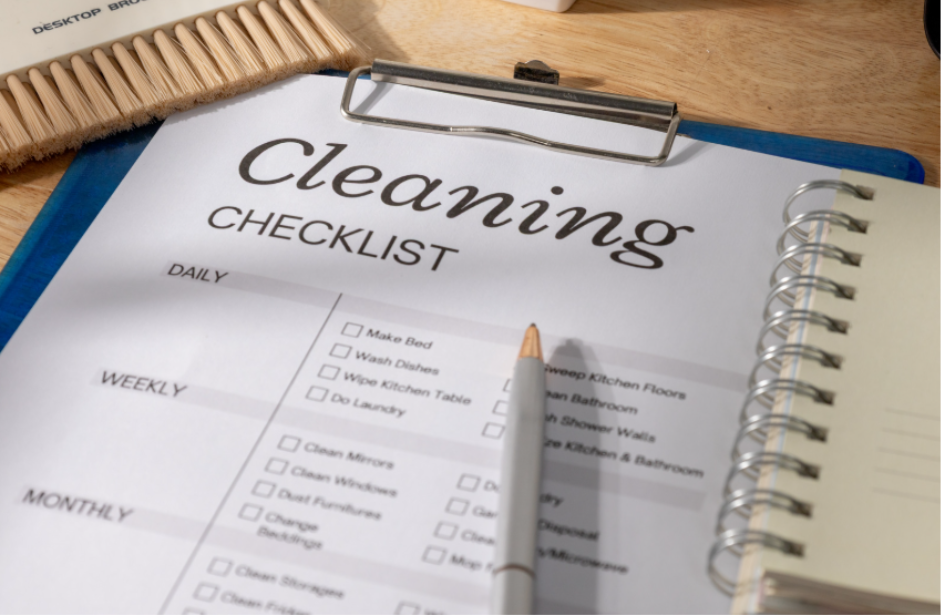
A complete environmental cleaning schedule must contain sufficient detail for staff to perform cleaning correctly and consistently without relying on memory or verbal instructions. Each schedule entry should specify all of the following elements.
| Schedule Element | Description | Example |
|---|---|---|
| Area or room | The specific location to be cleaned | Room 14 — ensuite bathroom |
| Item or surface | The specific surfaces or items within the area | Toilet, basin, taps, mirror, floor, grab rails, door handle |
| Cleaning product | The product to use (by name or type) | Neutral detergent (standard); hospital-grade disinfectant (outbreak) |
| Cleaning method | The technique to apply | Spray and wipe; mop; immersion |
| Frequency | How often the task is performed | Daily (standard); twice daily (outbreak) |
| Responsible person/role | Who is assigned to perform the task | Cleaning staff — morning shift |
| Sign-off | Documentation of completion | Initials + time on cleaning log sheet |
| Escalation procedure | What to do if cleaning cannot be completed | Notify shift supervisor; record reason in cleaning log |
What Are the Recommended Cleaning Frequencies?
Cleaning frequencies are determined by the infection risk associated with each area, surface, or item. The ACSQHC Aged Care IPC Guide (2024), Table 20 categorises areas by risk level and recommends minimum cleaning frequencies. The following table adapts these recommendations for practical application in aged care facilities.
Need help implementing this in your facility? The IPS Hub gives your IPC Lead instant access to ready-made policies, procedures, and audit tools — updated monthly.
Daily Cleaning Tasks
| Area / Surface | Standard Frequency | Enhanced / Outbreak Frequency | Product |
|---|---|---|---|
| Resident room — high-touch surfaces (bedrails, call bell, light switch, bedside table, door handle) | At least once daily | At least twice daily | Neutral detergent (standard); two-step process (outbreak) |
| Resident room — floors | Once daily | At least twice daily | Neutral detergent and water solution applied using a mop |
| Bathrooms and ensuites — all surfaces | At least once daily | At least twice daily; after each use if feasible | Neutral detergent solution (standard); two-step process (outbreak) |
| Communal areas — high-touch surfaces | At least once daily; after each activity | After each use or activity | Neutral detergent solution (standard); two-step process (outbreak) |
| Dining areas — tables and chairs | After each meal service | After each meal service (wipe down between sittings) | Neutral detergent and water solution |
| Clinical equipment | Daily and after each use | Clean after each use and at end of day | Two-step (neutral detergent solution followed by approved disinfectant) process |
| Staff common areas | Daily | Daily | Neutral detergent solution |
Weekly Cleaning Tasks
| Area / Surface | Standard Frequency | Notes |
|---|---|---|
| Resident room — full clean (walls to reachable height, windows internal, furniture all surfaces) | Weekly | More frequent if visibly soiled |
| Communal area — full clean (all surfaces, furniture, equipment) | Weekly | Daily high-touch cleaning continues |
| Resident equipment (wheelchairs, walkers, shower chairs) | Daily and after use | Daily and after use |
| Laundry — surfaces and equipment | Daily wiping plus Weekly deep clean | Daily wipe-down of high-touch surfaces continues |
| Bins and waste receptacles | Weekly clean and disinfect | More frequently if contaminated |
Monthly and Periodic Tasks
| Area / Surface | Frequency | Notes |
|---|---|---|
| Curtains (privacy and shower) | Monthly inspection. Change when visibly soiled, damaged or during a terminal clean | Replace disposable curtains per manufacturer’s recommendation. Change when visibly soiled, damaged or during a terminal clean |
| Mattresses — inspect and clean | Monthly; when bed linen is changed; between residents | Use mattress protectors; replace if integrity is compromised |
| Air conditioning vents and filters | Monthly inspection; clean per manufacturer schedule | Critical for airborne IPC |
| High dusting (tops of wardrobes, shelving, ceiling fixtures) | Monthly | Use damp dusting method to avoid dispersing particles |
| Carpet cleaning (if carpeted areas exist) | 6-monthly minimum; as needed when contaminated | Consider replacing carpet with hard flooring in clinical areas |
How Should High-Touch Surfaces Be Identified and Prioritised?
High-touch surfaces are surfaces that are frequently touched by residents, staff, and visitors during normal daily activities. These surfaces accumulate microorganisms more rapidly than low-touch surfaces and are the primary environmental route for contact transmission of infections.
Each aged care facility must identify its own high-touch surfaces based on the physical layout, resident population, and care activities. While standard lists exist, facilities should conduct observational assessments to confirm which surfaces are most frequently touched in their specific environment.
Door handles (both sides) — resident rooms, bathrooms, communal areas
Light switches
Bedrails and bed controls
Call bells and nurse call buttons
Bedside tables (top surface)
Toilet flush buttons
Tap handles (bathroom and kitchen)
Grab rails and handrails
Chair arms, including dining chair arms (communal seating)
Lift buttons
Reception desks and sign-in areas
Shared equipment controls (television remotes, activity devices)
Medication trolley surfaces
Computer keyboards and mice at nursing stations
How Should Cleaning Schedules Change During Outbreaks?
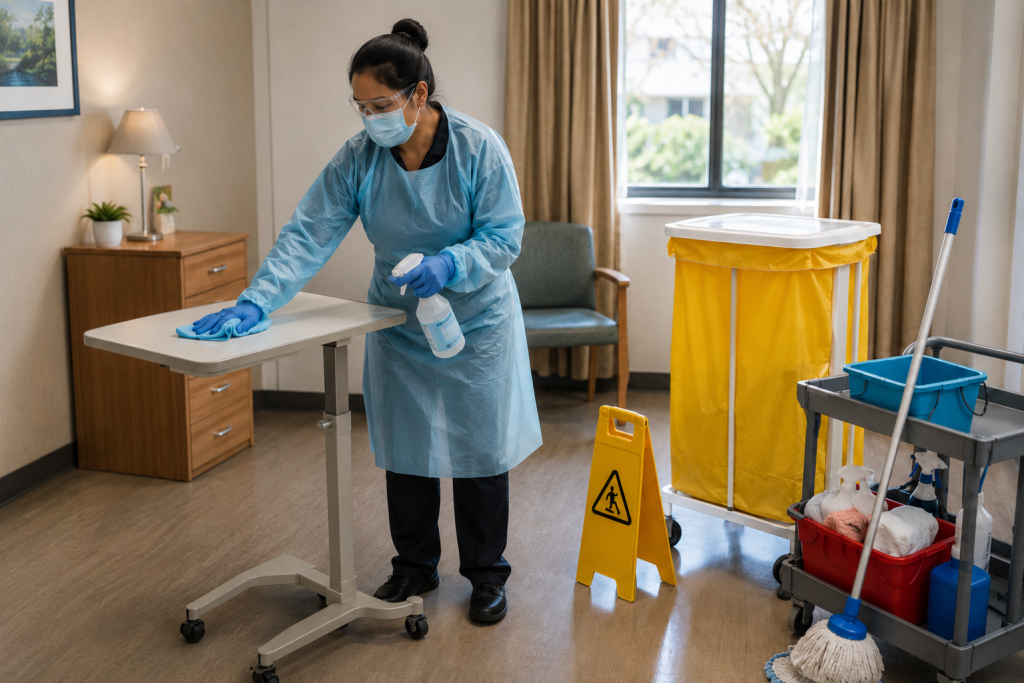
When an outbreak is declared, environmental cleaning schedules must be immediately escalated. Enhanced cleaning protocols replace standard cleaning in affected areas — and may extend to the entire facility depending on the organism and transmission risk.
Switch from neutral detergent solution alone to the two-step process (clean + disinfect) for all surfaces in affected areas
Increase cleaning frequency for high-touch surfaces to at least twice daily (minimum)
Select disinfectant appropriate to the causative organism (e.g., sodium hypochlorite for C. difficile and norovirus)
Add terminal cleaning for rooms of affected residents upon transfer, discharge, or death
Clean communal areas after each use rather than at scheduled intervals
Assign dedicated cleaning staff to affected areas (do not allow staff to move between affected and unaffected areas)
Increase cleaning documentation — log completion times, products used, and areas cleaned
Brief all cleaning staff on the outbreak, the organism, required PPE, and enhanced cleaning requirements
For detailed outbreak management guidance, including escalation and de-escalation of cleaning protocols, see Outbreak Management in Aged Care
How Should Cleaning Completion Be Documented?
Documentation of cleaning completion serves three purposes: accountability (who cleaned what and when), auditability (evidence of compliance for regulatory assessments), and quality improvement (identifying gaps and trends). The Strengthened Aged Care Quality Standards expect documented evidence of cleaning programme implementation.
Cleaning log sheets for each area — staff initial and record time after completing each task
Electronic cleaning management systems (if available) — time-stamped records, task assignment, exception reporting
Outbreak cleaning logs — enhanced documentation during outbreaks with additional fields (product used, PPE worn)
Audit records — results of visual inspections, fluorescent gel marker checks, and ATP testing
Training records — documented completion of cleaning competency training for all cleaning staff
Incident reports — documented instances where cleaning could not be completed and the corrective actions taken
Documentation must be retained and accessible for regulatory assessment. Assessors under the Strengthened Aged Care Quality Standards may review for evidence: Standard 2: The organisation; Outcome 2; actions 2.3.2 (iii) and 2.3.5 – collating and reviewing cleaning logs and audit report results; Outcome 2.7: Information management, action 2.9.1; maintains records of training, competencies, and experience
How Should Cleaning Responsibilities Be Assigned?
Clear assignment of cleaning responsibilities eliminates ambiguity about who is accountable for each task. In aged care, cleaning responsibilities may be distributed across multiple roles: dedicated cleaning staff, care workers, nursing staff, and kitchen staff.
| Task | Typical Responsible Role | Notes |
|---|---|---|
| General environmental cleaning (rooms, bathrooms, communal areas) | Cleaning staff | Dedicated cleaning staff preferred; outsourced cleaning must meet facility IPC standards |
| Cleaning between resident uses (clinical equipment) | Nursing/care staff | The clinician using the equipment is responsible for cleaning it between residents |
| Spill management | Any staff member who identifies the spill (initial response); cleaning staff (thorough clean) | All staff must be trained in spill procedures |
| Meal-related cleaning (dining areas, kitchen) | Kitchen/hospitality staff and cleaning staff | Food safety and IPC requirements overlap; coordinate schedules |
| Outbreak-enhanced cleaning | Cleaning staff (with additional resources if needed) | May require reallocation of staff or engagement of additional cleaning personnel |
| Cleaning auditing | IPC lead, facility manager, or designated auditor | Auditors should be independent from the staff performing cleaning |
What Are the Cleaning Schedule Considerations for Home Care?
Environmental cleaning schedules for home and community aged care must be adapted to the unique context of delivering care in a private home. The provider does not control the home environment, and cleaning interventions must be negotiated with the resident and/or their family.
Care workers must clean reusable equipment they bring into the home before and after each visit — schedule time for this
Single-use equipment and disposables reduce the reprocessing burden in home settings
If a home care client has a known infection or is on transmission-based precautions, a cleaning plan must be documented in the care plan
The cleaning plan should specify products (to be supplied by the provider), method, frequency, and responsible person
General household cleaning is the resident’s responsibility — care workers perform IPC-focused cleaning of clinical equipment and immediate care areas
Providers should supply alcohol-based hand rub and appropriate cleaning products to home care workers
Should Cleaning Schedules Change Seasonally?
Seasonal adjustments to cleaning schedules may be warranted based on epidemiological patterns. Certain infections peak at specific times of year, and cleaning schedules should reflect these patterns as part of a risk-based approach.
Winter (June–August): Influenza and respiratory virus season — consider enhanced cleaning of communal areas and high-touch surfaces during peak months
Winter–Spring (July–October): Norovirus and gastroenteritis peaks — pre-position sodium hypochlorite stocks and brief staff on enhanced cleaning protocols
Summer (December–February): Increased visitor traffic during holiday periods — increase cleaning frequency in reception and communal areas
Year-round: C. difficile does not follow a clear seasonal pattern — maintain vigilance regardless of season
Seasonal adjustments should be documented in the facility’s IPC plan and communicated to cleaning staff before each relevant period. This approach aligns with the risk management principles described in IPC Risk Management in Aged Care
Frequently Asked Questions
How often should high-touch surfaces be cleaned in aged care?
Under standard conditions, high-touch surfaces should be cleaned at least once daily. During outbreaks or when transmission-based precautions are in place, the frequency increases to at least twice daily. The ACSQHC Aged Care IPC Guide (2024), Table 20 provides detailed frequency recommendations by area and item.
Do we need separate cleaning schedules for outbreaks?
Yes. Facilities should have pre-prepared enhanced cleaning schedules that are activated when an outbreak is declared. These schedules increase frequency, change products (adding disinfection), and expand scope. Pre-planning avoids delays in escalating cleaning during outbreaks.
Can cleaning staff use the same cloth for multiple rooms?
No. Fresh cloths must be used for each room to prevent cross-contamination between resident environments. Colour-coding systems (e.g., different colours for bathrooms, bedrooms, and communal areas) can help prevent misuse. Microfibre cloths should be laundered between uses at the thermal disinfection temperature specified by the manufacturer.
What cleaning documentation do we need for regulatory compliance?
At minimum: current cleaning schedules for all areas, completed cleaning log sheets with staff initials and times, cleaning audit records, staff training records (initial and ongoing), and evidence of corrective actions when cleaning deficiencies are identified. Assessors under the Strengthened Aged Care Quality Standards may request any of these documents.
Should outsourced cleaning contractors follow our cleaning schedules?
Yes. If cleaning is outsourced, the facility’s cleaning schedules, products, and IPC requirements must be specified in the contract and the contractor must comply. The aged care provider retains accountability for environmental cleaning standards under the Strengthened Aged Care Quality Standards, regardless of who performs the cleaning.
References and Further Reading
The following authoritative sources inform the clinical and regulatory guidance in this article. Links open in a new tab.
- Australian Commission on Safety and Quality in Health Care. Infection Prevention and Control Guide for Residential Aged Care Facilities, Version 1.1. Sydney: ACSQHC; January 2025.
- Aged Care Quality and Safety Commission. Strengthened Aged Care Quality Standards 2025 — Standard 5: Environmental management and cleaning. Canberra: ACQSC; 2025.
- Therapeutic Goods Administration. Disinfectants and sanitisers — regulatory requirements. Canberra: TGA; 2024.
- Centers for Disease Control and Prevention. Guidelines for Environmental Infection Control in Health-Care Facilities. Atlanta: CDC; 2003 (updated 2019).
- Department of Health and Aged Care. Environmental cleaning and infection prevention and control. Canberra: Commonwealth of Australia; 2024.
In This Article
- Why Do Aged Care Facilities Need Cleaning Schedules?
- What Should an Environmental Cleaning Schedule Include?
- What Are the Recommended Cleaning Frequencies?
- How Should High-Touch Surfaces Be Identified and Prioritised?
- How Should Cleaning Schedules Change During Outbreaks?
- How Should Cleaning Completion Be Documented?
- How Should Cleaning Responsibilities Be Assigned?
- What Are the Cleaning Schedule Considerations for Home Care?
- Should Cleaning Schedules Change Seasonally?
- Frequently Asked Questions
About the Author
Lyndon Forrest is the Managing Director of Bug Control — Infection Prevention Services, with over 30 years’ experience supporting aged care facilities across Australia and New Zealand with infection prevention, antimicrobial stewardship, and accreditation readiness.
Clinically reviewed by Bridgette Mackie & Dianne Newey, Clinical Directors
Ready to Strengthen Your Facility’s Infection Prevention?
The IPS Hub provides aged care facilities across Australia and New Zealand with continuously updated IPC policies, AMS tools, outbreak management resources, and direct support from experienced IPC professionals.