
Home › Knowledge Hub › Laundry Management › Laundry Temperature and Washing Requirements for Infection Control
Laundry Management
By Lyndon Forrest, Managing Director, Infection Prevention Services (IPS) · Clinically reviewed by Bridgette Mackie, RN & Dianne Newey, RN, Clinical Directors · September 2026 · 10 min read
Laundry Temperature and Washing Requirements for Infection Control
TL;DR —
Laundry temperature is a critical infection control measure in aged care. AS 4146:2024 Laundry Practice sets two thermal disinfection benchmarks: 65°C for a minimum of 10 minutes, or 71°C for a minimum of 3 minutes. These temperatures must be achieved in the water contacting the linen during the wash cycle — not merely on the machine dial. Commercial washing machines are required for facility linen; domestic machines are reserved for personal items. When hot water is unavailable, chemical disinfection using laundry sanitisers or sodium hypochlorite provides an alternative. Specific organisms — Clostridioides difficile (spore-forming), norovirus (non-enveloped virus), and MRSA — may require adjusted washing protocols.
Why Does Laundry Temperature Matter for Infection Control in Aged Care?
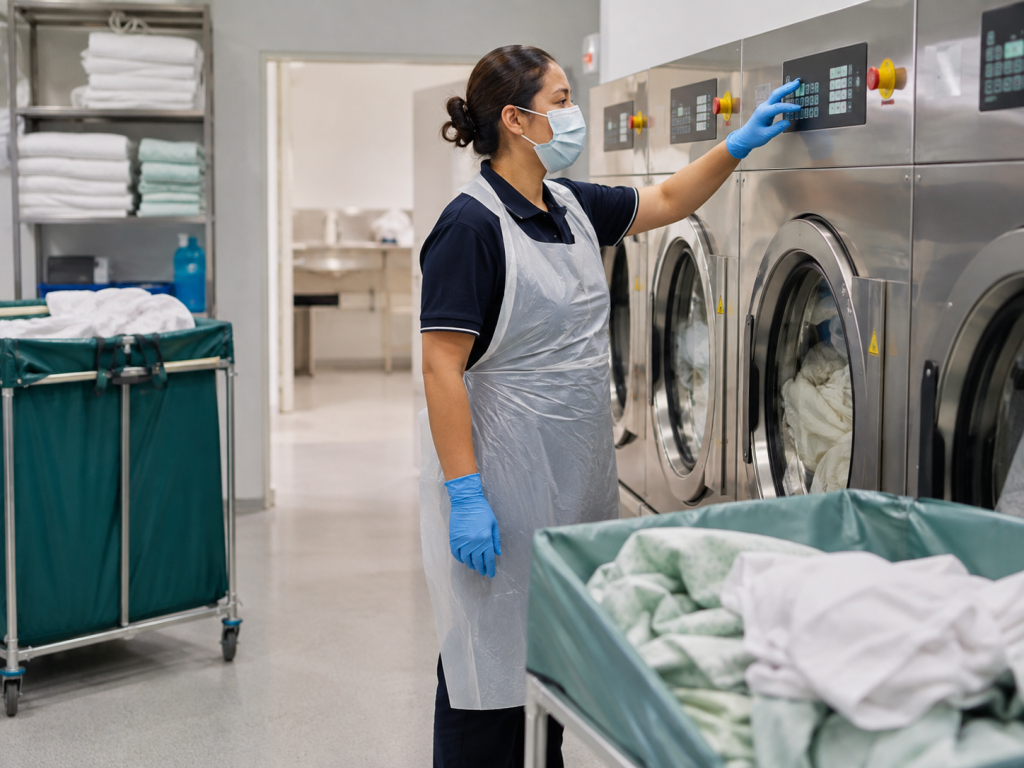
Laundry temperature is the primary mechanism for destroying pathogenic microorganisms on linen in aged care. Thermal disinfection — the application of heat during the wash cycle — kills bacteria, viruses, and fungi by denaturing proteins and disrupting cell membranes. Without adequate temperature, laundering removes visible soil but does not achieve microbiological decontamination.
AS 4146:2024 Laundry Practice is the standard governing laundry processes for healthcare and aged care settings. This standard establishes the temperature-time combinations required for thermal disinfection and forms the benchmark against which aged care laundry practices are assessed.
The Strengthened Aged Care Quality Standards (effective 1 November 2025), Standard 4, Outcome 4.2, Outcome 5.2, requires providers to apply appropriate standard precautions. Correct laundry temperature is an element of standard precautions applied to linen management.
For the broader linen management framework, see Laundry and Linen Management in Aged Care: IPC Best Practice
What Are the Thermal Disinfection Requirements Under AS 4146:2024?
AS 4146:2024 specifies two temperature-time combinations for thermal disinfection of linen. Either combination achieves effective destruction of vegetative bacteria, most viruses, and fungi on textile surfaces.
| Parameter | Option 1 | Option 2 |
|---|---|---|
| Water temperature | 65°C | 71°C |
| Minimum contact time | 10 minutes | 3 minutes |
| Standard | AS 4146:2024 | AS 4146:2024 |
| Measurement point | Water in contact with linen | Water in contact with linen |
| Application | Standard facility linen | Standard facility linen (shorter cycle) |
What Does ‘Contact Time’ Mean in Practice?
Contact time is the duration when-the water in the machine maintains the specified temperature while in contact with the linen. This is not the total wash cycle time. A washing machine may take several minutes to heat water to the target temperature — the contact time begins only when the water reaches 65°C or 71°C.
Commercial washing machines used in aged care should have temperature sensors and programmable cycles that confirm the water has reached and maintained the required temperature for the specified duration. Facilities should request thermal disinfection validation reports from their laundry equipment supplier or maintenance provider.
Need help implementing this in your facility? The IPS Hub gives your IPC Lead instant access to ready-made policies, procedures, and audit tools — updated monthly.
How Should Facilities Verify Water Temperature?
Relying solely on the machine dial or digital display is insufficient. Facilities should implement the following temperature verification practices:
Commission temperature validation when new machines are installed — an independent test confirming water reaches and maintains the required temperature
Conduct periodic validation (At a minimum annually, or after servicing/repairs) using a calibrated temperature probe or data logger
Review washing machine maintenance logs to confirm thermostats and heating elements are functioning correctly
Document temperature verification results in the facility’s IPC governance records
If a machine cannot be verified to reach the required temperature, remove it from service for facility linen until repaired
What Detergent Should Be Used for Aged Care Laundry?
Detergent selection for aged care laundry is guided by the ACSQHC Aged Care IPC Guide (2024) and AS 4146:2024. The primary function of laundry detergent is to remove organic soil and facilitate the suspension of microorganisms so that they are rinsed away during the wash cycle. Thermal disinfection — not the detergent — is the primary kill mechanism.
Use a commercial-grade laundry detergent designed for healthcare or institutional use
Follow the manufacturer’s instructions for dosage — under-dosing reduces cleaning efficacy; over-dosing leaves residue and may cause skin irritation for residents
Enzyme-based detergents are effective for breaking down protein-based soils (blood, body fluids) — use as a pre-wash for heavily soiled linen
Fabric softeners may be used but are not an IPC requirement — some facilities avoid them due to allergenic potential in sensitive residents
Store all laundry chemicals according to Safety Data Sheet (SDS) requirements — separate from clean linen and food preparation areas
Is Detergent Alone Sufficient Without Hot Water?
Detergent alone — without thermal disinfection — removes soil and reduces microbial load but does not achieve disinfection. A cold-water wash with detergent will produce visually clean linen but may leave pathogenic organisms viable on the fabric. This is why AS 4146:2024 specifies temperature requirements: detergent and heat work together to achieve both cleaning and disinfection.
What Is the Difference Between Commercial and Domestic Washing Machines?
The distinction between commercial and domestic washing machines is fundamental to laundry infection control in aged care. The ACSQHC Aged Care IPC Guide (2024) specifies that domestic washing machines should only be used for personal items — never for facility linen.
| Feature | Commercial Washing Machine | Domestic Washing Machine |
|---|---|---|
| Water temperature | Programmable to 65°C–95°C with verified temperature control | Hot cycle typically reaches 40°C–60°C; rarely reaches 65°C |
| Temperature verification | Built-in sensors; validation reports available | No temperature verification; dial settings are approximate |
| Cycle programming | Customisable wash, rinse, and disinfection phases | Pre-set cycles with limited control |
| Capacity | 25–100+ kg per load | 5–10 kg per load |
| Drainage | Connected to appropriate wastewater systems | Standard domestic drainage |
| AS 4146:2024 compliance | Designed to meet healthcare laundry standards | Not designed for healthcare compliance |
| Appropriate use in aged care | All facility linen | Residents’ personal clothing and personal items only |
Some aged care facilities use domestic-style machines for residents’ personal clothing in a communal laundry. This is acceptable provided: the machines are clearly designated for personal items only, facility linen is never processed through them, and residents’ clothing contaminated with blood or body fluids is pre-treated and washed separately from other residents’ items.
What Should Facilities Do When Hot Water Is Not Available?
When hot water washing is not available — due to equipment failure, home care settings with inadequate hot water systems, or linen fabrics that cannot tolerate high temperatures — chemical disinfection provides an alternative pathway to microbial reduction on linen.
What Chemical Disinfection Options Are Available?
| Chemical Agent | Application | Considerations |
|---|---|---|
| Sodium hypochlorite (bleach) | Add to wash cycle per manufacturer instructions | Effective against bacteria, viruses, and fungi; may bleach coloured fabrics; must rinse thoroughly |
| Commercial laundry sanitiser | Add to wash cycle as directed | Formulated for cold-water use; follow manufacturer instructions for concentration and contact time |
| Oxygen-based bleach (sodium percarbonate) | Add to wash cycle | Colour-safe alternative; less effective than chlorine-based products; requires warm water (40°C+) for activation |
Chemical disinfection is a secondary option — not a replacement for thermal disinfection in facilities that have functioning commercial laundry equipment. The ACSQHC Aged Care IPC Guide (2024) positions chemical disinfection as the fallback when heat-based disinfection cannot be achieved.
For home and community care settings where hot water limitations are common, see Linen Management in Home and Community Aged Care
How Should Linen Contaminated with Specific Organisms Be Washed?
Certain organisms require specific washing considerations due to their resistance to standard thermal disinfection or their high transmissibility. The following organisms are commonly encountered in aged care and have implications for laundry temperature and processing
Clostridioides difficile (C. diff)
Clostridioides difficile produces spores that are highly resistant to heat, detergent, and many disinfectants. Standard thermal disinfection (65°C/10 min) kills vegetative C. difficile cells but may not eliminate all spores. The key strategy for C. difficile contaminated linen is a combination of approaches:
Wash at the highest temperature the fabric permits — 71°C or higher is preferred on a contaminated linen cycle
Use detergent to physically remove spores from fabric (mechanical action combined with detergent is the primary removal mechanism for spores)
Tumble dry at high heat — the additional heat exposure provides further spore reduction
Do not shake C. difficile-contaminated linen — spores are easily aerosolised
Use leakproof bags for transport
Norovirus
Norovirus is a non-enveloped virus with high environmental stability and a very low infectious dose (as few as 18 viral particles). Norovirus is the most common cause of gastroenteritis outbreaks in Australian aged care facilities.
Wash at 65°C for 10 minutes minimum — norovirus is inactivated at this temperature-time combination
Use Pre-rinse cycle for heavily soiled linen (vomit, diarrhoea) before the main wash cycle to reduce viral load
Add sodium hypochlorite (1,000 ppm available chlorine) to the wash if the fabric permits — norovirus is susceptible to chlorine-based disinfectants
Bag norovirus-contaminated linen immediately at the bedside, place in an alginate bag first — do not carry through common areas
Staff must wear full PPE including surgical mask when handling norovirus-contaminated linen (vomiting aerosolises the virus)
MRSA (Methicillin-Resistant Staphylococcus aureus)
MRSA is susceptible to standard thermal disinfection. Washing at 65°C for 10 minutes or 71°C for 3 minutes effectively eliminates MRSA from linen. No additional laundry measures beyond standard thermal disinfection are required for MRSA-contaminated linen.
Standard hot wash per AS 4146:2024 is sufficient.
Bag at point of use using the facility’s colour-coded system for contaminated linen
PPE for handling: gloves, apron, and gown if contact precautions are in place
VRE (Vancomycin-Resistant Enterococci)
VRE is killed by standard thermal disinfection (65°C for 10 minutes). Enterococci can survive on environmental surfaces for days to weeks, making prompt linen removal and laundering important.
Standard hot wash per AS 4146:2024 is sufficient.
Prompt removal of dirty linen from the resident’s room reduces environmental contamination
Follow contact precautions for linen handling — gloves, apron, and gown
What Are the Drying Requirements for Infection Control?
Drying is the second stage of the laundry disinfection process. Incomplete drying leaves residual moisture on linen, creating conditions for bacterial and fungal growth that can recontaminate linen after a successful wash cycle.
Tumble drying: use the highest heat setting appropriate for the fabric — high heat provides additional thermal disinfection
Line drying: use direct sunlight where possible — ultraviolet radiation provides supplementary microbial reduction
Linen must be completely dry before folding, storage, or use — check by touch (not visual inspection alone)
Do not stack or fold damp linen — this traps moisture and promotes microbial growth
Clean lint filters after every dryer cycle — lint accumulation is a fire hazard and can harbour microorganisms
In home care settings where tumble dryers are not available, line dry in direct sunlight and confirm linen is fully dry before use
What Washing Cycle Should Be Used for Different Linen Types?
| Linen Type | Pre-Treatment | Wash Temperature | Detergent | Additional Agent | Drying |
|---|---|---|---|---|---|
| Standard bed linen (sheets, pillowcases) | None required | 65°C for 10 min | Commercial laundry detergent | None required | Tumble dry high heat |
| Towels and washcloths | None required | 65°C for 10 min or 71°C for 3 min | Commercial laundry detergent | None required | Tumble dry high heat |
| Linen soiled with urine/faeces | Remove solid matter; cold pre-rinse | 65°C for 10 min (71°C preferred) | Commercial laundry detergent with enzyme pre-wash | None required for standard organisms | Tumble dry high heat |
| Linen contaminated with blood/body fluids | Cold pre-rinse cycle (hot water sets protein stains) | 71°C for 3 min (preferred) | Commercial laundry detergent with enzyme pre-wash | Sodium hypochlorite if fabric permits | Tumble dry high heat |
| C. difficile-contaminated linen | Remove solid matter; cold pre-rinse | 71°C for 3 min or higher | Commercial laundry detergent | Mechanical action is key for spore removal | Tumble dry high heat |
| Norovirus-contaminated linen | Remove solid matter; cold pre-rinse | 65°C for 10 min minimum | Commercial laundry detergent | Sodium hypochlorite 1,000 ppm if fabric permits | Tumble dry high heat |
| Residents’ personal clothing | Per garment care label | Per garment care label | Domestic laundry detergent | Laundry sanitiser if contaminated and hot wash not possible | Per garment care label |
Frequently Asked Questions
Is 40°C hot enough to disinfect aged care linen?
No, a 40°C wash does not achieve thermal disinfection. AS 4146:2024 requires a minimum of 65°C for 10 minutes or 71°C for 3 minutes. A 40°C wash will clean linen but will not kill most pathogenic microorganisms. This temperature is only acceptable for residents’ personal clothing washed in domestic machines — not for facility linen.
Can cold water washing with bleach replace hot water washing?
Cold water washing with sodium hypochlorite (bleach) can provide disinfection as a fallback when hot water is not available. However, it is not equivalent to thermal disinfection. Bleach effectiveness depends on concentration, contact time, pH, and organic load — all of which are harder to control in a washing machine than in a controlled disinfection process. Use chemical disinfection only when thermal disinfection is genuinely not achievable.
How often should washing machine temperatures be validated?
Facilities should validate washing machine temperatures at a minimum annually, after any servicing or repairs, and when a new machine is commissioned. Validation should confirm that the water in contact with the linen reaches and maintains 65°C for 10 minutes or 71°C for 3 minutes. Results must be documented and retained as part of IPC governance records.
Do I need to wash different residents’ linen separately?
Routine facility linen from different residents can be washed together in the same load, provided the washing achieves thermal disinfection per AS 4146:2024. However, linen from residents with known infections requiring transmission-based precautions should be washed separately or in a dedicated cycle. Residents’ personal clothing should always be washed separately from other residents’ personal items.
What is the difference between cleaning and disinfection in laundry?
Cleaning removes organic soil and reduces microbial load through the mechanical action of washing and detergent. Disinfection kills or inactivates pathogenic microorganisms — in laundry, this is primarily achieved through thermal disinfection (heat) or chemical disinfection (bleach or laundry sanitiser). Effective laundry processing requires both: cleaning to remove soil, then disinfection to kill remaining organisms.
References and Further Reading
The following authoritative sources inform the clinical and regulatory guidance in this article. Links open in a new tab.
- Australian Commission on Safety and Quality in Health Care. Infection Prevention and Control Guide for Residential Aged Care Facilities, Version 1.1. Sydney: ACSQHC; January 2025.
- Standards Australia. AS 4146:2024 Laundry Practice. Sydney: Standards Australia; 2024.
- Aged Care Quality and Safety Commission. Strengthened Aged Care Quality Standards 2025 — Standard 5: Environmental management. Canberra: ACQSC; 2025.
- Therapeutic Goods Administration. Disinfectants and sanitisers — regulatory requirements. Canberra: TGA; 2024.
- Department of Health and Aged Care. Infection prevention and control: linen and laundry management. Canberra: Commonwealth of Australia; 2024.
In This Article
- Why Does Laundry Temperature Matter for Infection Control in Aged Care?
- What Are the Thermal Disinfection Requirements Under AS/NZS 4146?
- What Detergent Should Be Used for Aged Care Laundry?
- What Is the Difference Between Commercial and Domestic Washing Machines?
- What Should Facilities Do When Hot Water Is Not Available?
- How Should Linen Contaminated with Specific Organisms Be Washed?
- What Are the Drying Requirements for Infection Control?
- What Washing Cycle Should Be Used for Different Linen Types?
- Frequently Asked Questions
About the Author
Lyndon Forrest is the Managing Director of Infection Prevention Services (IPS), with over 30 years’ experience supporting aged care facilities across Australia and New Zealand with infection prevention, antimicrobial stewardship, and accreditation readiness.
Clinically reviewed by Bridgette Mackie, RN & Dianne Newey, RN, Clinical Directors.
Ready to Strengthen Your Facility’s Infection Prevention?
The IPS Hub provides aged care facilities across Australia and New Zealand with continuously updated IPC policies, AMS tools, outbreak management resources, and direct support from experienced IPC professionals.