Home › Knowledge Hub › Risk Management › Risk Acceptance in Aged Care IPC: Balancing Safety and Quality of Life
Risk Management
By Lyndon Forrest, Managing Director · Clinically reviewed by Bridgette Mackie & Dianne Newey, Clinical Directors · September 2026 · 10 min read
Risk Acceptance in Aged Care IPC: Balancing Safety and Quality of Life
TL;DR —
Risk acceptance in aged care IPC is the informed, documented decision to accept a residual level of infection risk after controls have been applied. Unlike hospital settings, aged care facilities are residents’ homes — and the Statement of Rights (Aged Care Act 2024) gives residents the right to make informed choices about their care, including accepting infection-related risks. Blanket infection prevention restrictions that compromise quality of life are not acceptable. Risk acceptance decisions must be person-centred, documented, communicated, and reviewed.
What Is Risk Acceptance in Aged Care IPC?
Risk acceptance in aged care IPCis the deliberate decision to accept a level of residual infection risk after all reasonably practicable controls have been implemented. It recognises that some infection risk is inherent in any living environment and that eliminating all risk would require restrictions incompatible with a dignified, meaningful life.
Risk acceptance is not the same as risk ignorance. Ignoring risk means failing to identify, assess, or control hazards. Risk acceptance occurs after the risk management process has been completed — hazards have been identified, risks assessed, controls implemented, and a conscious decision made that the residual risk is acceptable given the circumstances.
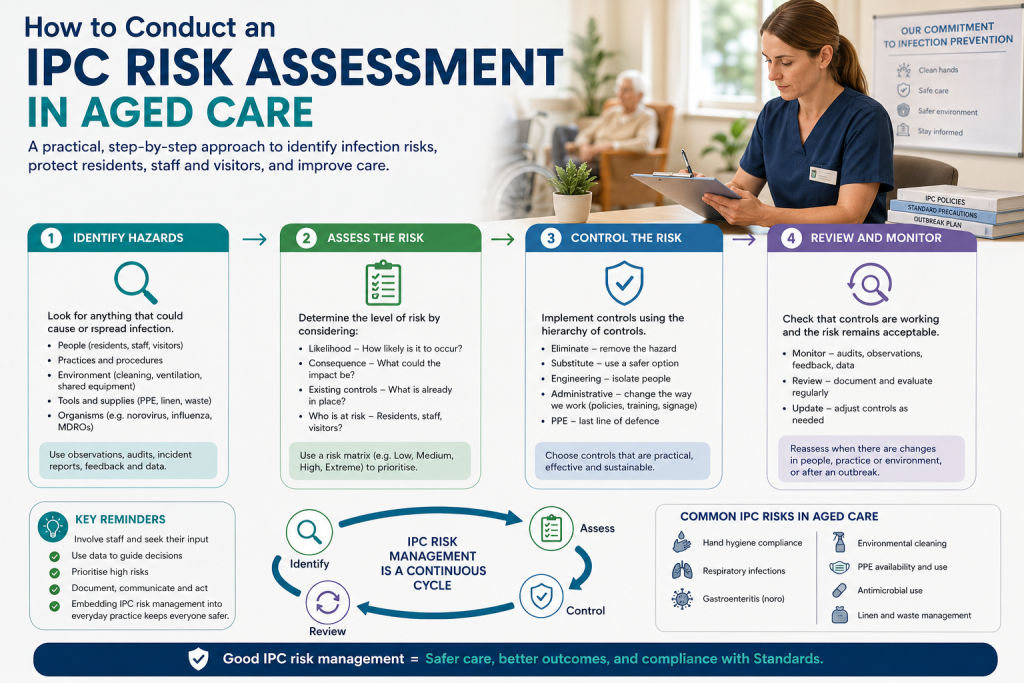
In the IPC risk management framework, risk acceptance is the outcome of the 4-step process. It is the point at which the provider determines that additional controls are either not reasonably practicable or would cause disproportionate harm to the resident’s quality of life.
Why Is Risk Acceptance Essential in Aged Care?
Aged care facilities are fundamentally different from hospitals. Hospitals are acute treatment environments where residents stay temporarily, and strict infection control measures are generally well-tolerated. Aged care facilities are long-term living environments — they are residents’ homes. The infection prevention approaches that work in hospitals cannot be directly transplanted into aged care without considering the impact on residents’ lives.
How Does Aged Care Differ from Hospital Infection Control?
| Factor | Hospital Setting | Aged Care Setting |
|---|---|---|
| Length of stay | Days to weeks (acute) | Months to years (permanent home) |
| Environment | Clinical environment under complete provider control | Home-like environment; residents personalise their spaces |
| Visitors | Restricted visiting hours; clinical visitor protocols | Visitors are family, friends, and community — essential for wellbeing |
| Social activities | Limited; focus is on treatment and recovery | Communal dining, group activities, outings — central to quality of life |
| Resident autonomy | Patient defers to clinical authority during acute illness | Resident role; retains rights to choice, dignity, and independence |
| Acceptable restriction level | High tolerance for temporary restrictions during acute illness | Low tolerance for ongoing restrictions in permanent home |
The COVID-19 pandemic powerfully demonstrated the consequences of applying hospital-level IPC restrictions in aged care. Prolonged lockdowns, visitor exclusions, and enforced isolation caused significant harm — social isolation, depression, functional decline, accelerated cognitive deterioration, and in some cases, contributed to death. The Royal Commission into Aged Care Quality and Safety (2021) documented these harms extensively.
These lessons must inform current IPC risk management. Risk acceptance is not a weakness in the IPC program — it is a necessary feature of person-centred care in a residential setting.
Need help implementing this in your facility? The IPS Hub gives your IPC Lead instant access to ready-made policies, procedures, and audit tools — updated monthly.
What Does the Statement of Rights Say About Risk?
The Statement of Rights, established under the Aged Care Act 2024, sets out the rights of all people receiving funded aged care services. Several rights are directly relevant to IPC risk acceptance decisions.
The right to safe and high-quality care — care must be clinically safe, but safety is not limited to infection prevention; it includes protection from the harms caused by excessive restrictions
The right to be treated with dignity and respect — IPC measures must preserve residents’ dignity; unnecessary isolation, restriction of movement, or refusal of visitors compromises dignity
The right to make informed choices — residents have the right to understand infection risks and make decisions about their own care, including accepting risk
The right to live without abuse, neglect, or exploitation — excessive or punitive IPC restrictions may constitute a form of restrictive practice
The right to complain — residents and families have the right to challenge IPC decisions they believe are disproportionate
These rights are not aspirational — they are legally enforceable. IPC risk management must operate within the Statement of Rights framework. A risk management process that systematically overrides resident rights in the name of infection prevention is not compliant with the Aged Care Act 2024.
How Does the Essential Visitors Mechanism Work?
The essential visitor’s mechanism, introduced during the COVID-19 pandemic and formalised in aged care regulatory frameworks, establishes that residents have the right to receive visitors even during outbreak situations. This mechanism is a direct example of risk acceptance in IPC practice.
Under the essential visitor’s mechanism, aged care providers cannot impose blanket visitor bans during outbreaks. Instead, providers must conduct risk assessments and implement controls that enable safe visitation. Visitors may be required to follow specific IPC measures (hand hygiene, mask wearing, visiting in designated areas), but access cannot be refused solely on the basis of infection risk.
The mechanism recognises that the harm caused by denying all visitor access — particularly for residents who are dying, distressed, or have cognitive impairment — often outweighs the incremental infection risk posed by controlled visitation with appropriate precautions
| Scenario | Acceptable Approach | Unacceptable Approach |
|---|---|---|
| Gastroenteritis outbreak | Visitors permitted with hand hygiene, PPE as required, visiting in resident’s room rather than communal areas | Blanket ban on all visitors for the duration of the outbreak |
| COVID-19 outbreak | Essential visitors permitted with RAT testing, mask wearing, visiting in designated areas with ventilation | Refusal of all visitor access including for residents receiving palliative care |
| Resident with MRSA colonisation | Visitors informed of standard precautions; hand hygiene before and after visit | Visitor access restricted or visitors required to wear full PPE without clinical justification |
How Should Risk Acceptance Decisions Be Made?
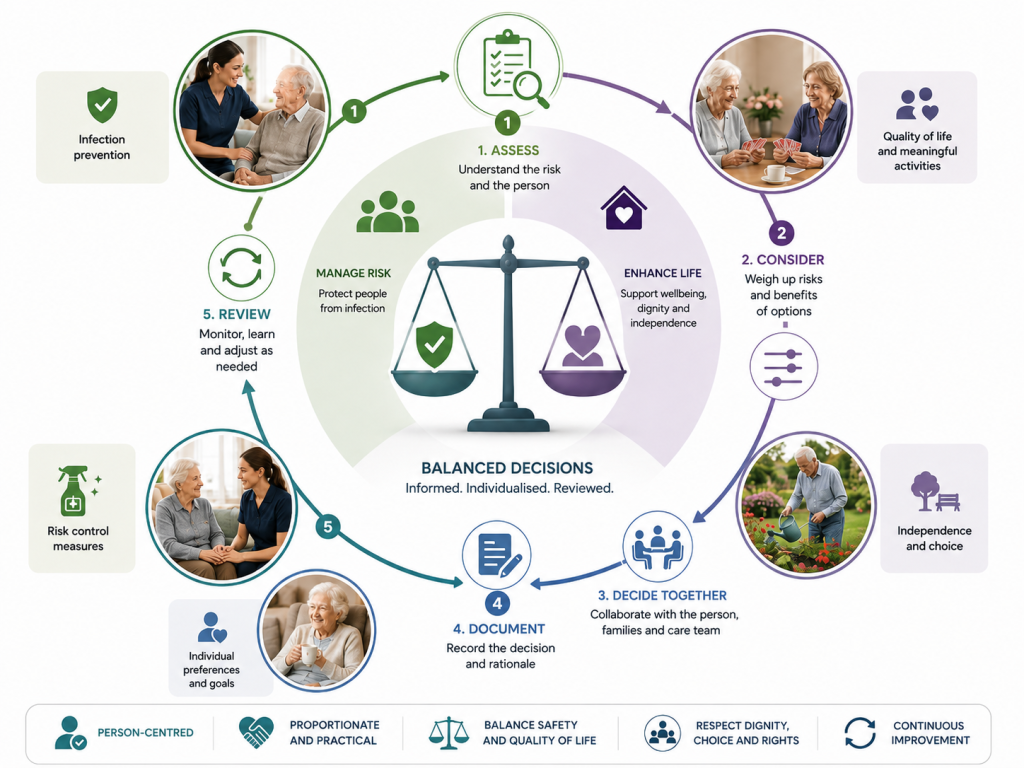
Risk acceptance decisions in aged care IPC should follow a structured framework that ensures decisions are informed, proportionate, and documented. The following 5-step framework provides a practical structure.
Step 1: Complete the Risk Assessment
Risk acceptance can only occur after a risk assessment has been completed. Identify the hazard, assess the likelihood and consequence, determine the risk rating, and implement all reasonably practicable controls. Risk acceptance applies to the residual risk remaining after controls are in place.
Step 2: Evaluate the Impact on Quality of Life
Assess the impact of the proposed IPC controls on the resident’s quality of life, dignity, autonomy, and social participation. Consider whether the controls are proportionate to the risk or whether they cause disproportionate harm to the resident’s wellbeing.
Step 3: Consult the Resident and Family
Discuss the identified infection risk, the controls in place, and the residual risk with the resident (and their representative or family where appropriate). Explain the options in plain language. Respect the resident’s informed decision, even if it differs from what the clinical team would recommend.
Step 4: Document the Decision
Record the risk acceptance decision, including: the identified risk, controls in place, residual risk level, who was consulted, the resident’s expressed preference, the rationale for acceptance, and the review date. Documentation must be accessible to all relevant care staff.
Step 5: Schedule Review
Risk acceptance is not permanent. Schedule a review date and define triggers for reassessment (e.g., change in resident’s clinical status, new outbreak, change in public health guidance). Document and communicate any changes arising from the review.
What Are Practical Examples of Risk Acceptance in Aged Care IPC?
Example 1: Communal Dining During Influenza Season
A RACF with 80 beds maintains communal dining as a central social activity. During influenza season, the IPC lead conducts a risk assessment and identifies an increased risk of influenza transmission in the dining room.
| Element | Detail |
|---|---|
| Risk | Increased influenza transmission during communal dining |
| Controls in place | Staff vaccination programme (92% uptake); resident vaccination programme (87% uptake); hand hygiene stations at dining room entrance; enhanced surface cleaning; symptomatic residents monitored and assessed |
| Residual risk | Moderate — some transmission risk remains despite controls |
| Risk acceptance decision | Continue communal dining with enhanced monitoring. The social, nutritional, and psychological benefits of communal dining outweigh the residual infection risk given the controls in place. |
| Review trigger | If 2 or more residents develop influenza symptoms within 48 hours, reassess and activate outbreak management plan |
Example 2: Resident Declining Contact Precautions
A resident colonised with VRE has been on contact precautions for 6 months. The resident is cognitively intact, manages personal hygiene independently, and has no active infection. The resident requests cessation of contact precautions, stating that the yellow gowns and isolation signage make visitors uncomfortable and reduce social interaction.
| Element | Detail |
|---|---|
| Risk | VRE transmission to other residents if contact precautions are reduced |
| Clinical assessment | Resident is colonised only (no active infection); manages hygiene independently; VRE is contained to the gastrointestinal tract |
| IPC Guide position | ACSQHC Aged Care IPC Guide (2024) states that standard precautions are sufficient for MDRO-colonised residents who can manage their personal hygiene independently |
| Risk acceptance decision | Step down to standard precautions only. Resident can participate in all communal activities without restriction. Hand hygiene education for the resident and close contacts. Enhanced environmental cleaning of the resident’s room continues. |
| Documentation | Risk acceptance documented in care plan; resident’s preference recorded; GP and family informed; review scheduled in 3 months or if clinical status changes |
How Should Risk Be Communicated to Families?
Communicating infection risk to families is one of the most challenging aspects of IPC in aged care. Families want their loved ones to be safe, and the concept of “accepting” infection risk can be alarming. Clear, honest, and empathetic communication is essential.
Use plain language — avoid jargon and clinical terminology; explain what the infection risk means in practical terms
Explain the controls in place — describe what the facility is doing to manage the risk, so families understand that risk acceptance follows thorough risk management
Acknowledge the tension — validate families’ concerns about safety; explain that the facility is balancing safety with their loved one’s right to quality of life
Provide written information — supplement verbal communication with written summaries that families can review at their own pace
Invite questions — create space for families to ask questions and express concerns; respond with patience and transparency
Document all communication — record what was discussed, what concerns were raised, and how they were addressed
Families should be included in risk acceptance discussions where the resident consents. Family involvement often improves the quality of risk decisions by providing additional context about the resident’s preferences and values.
What Are the Legal Considerations for Risk Acceptance in Aged Care IPC?
Risk acceptance in aged care IPC operates within a legal framework that includes duty of care obligations, the Statement of Rights, work health and safety law, and the Strengthened Quality Standards. Providers must understand these intersecting obligations.
The common law of duty of care requires providers to take reasonable steps to prevent foreseeable harm. Risk acceptance does not breach this duty provided the risk management process was followed, controls were implemented, the residual risk is proportionate, and the decision was informed and documented.
The Fair Work Act and Work Health and Safety Act 2011 also apply. Risk acceptance decisions regarding resident care must not create unacceptable risks to workers. For example, a decision to accept visitor access during an outbreak must include controls that protect staff (PPE provision, hand hygiene requirements, outbreak management protocols).
Thorough documentation is the strongest legal protection. A well-documented risk acceptance decision that shows the process was followed, stakeholders were consulted, and the decision was proportionate will withstand regulatory and legal scrutiny.
This article is part of the IPC Risk Management in Aged Care topic cluster. For the thorough pillar guide, see IPC Risk Management in Aged Care
Related articles:
How to Conduct an IPC Risk Assessment in Aged Care
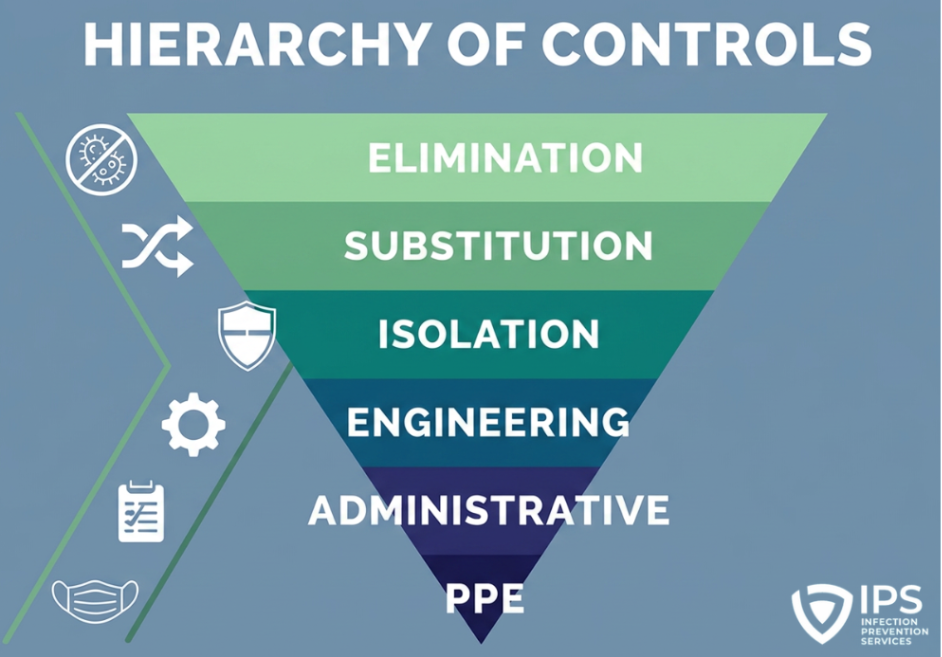
The Hierarchy of Controls for Infection Prevention in Aged Care
IPC Risk Management in Home and Community Aged Care
IPC Scenario Risk Assessment Tool: Apply these risk management principles with our interactive IPC Scenario Risk Assessment Tool — designed specifically for aged care facilities to identify, assess, and control infection risks.
Frequently Asked Questions
Is risk acceptance the same as doing nothing?
No. Risk acceptance is the informed, documented decision to accept residual risk after controls have been implemented. Doing nothing means failing to identify, assess, or control hazards — which is a regulatory breach under the Strengthened Quality Standards and a breach of duty of care.
Can a resident refuse all IPC measures?
Residents have the right to make informed choices about their care, including declining specific IPC measures. However, the provider retains an obligation to protect other residents and staff. Where a resident’s refusal creates an unacceptable risk to others, the provider must seek a proportionate solution — which may involve modified controls rather than complete cessation of measures.
Who has the authority to make risk acceptance decisions?
Risk acceptance decisions should involve the IPC lead, clinical staff, the resident (and their representative where appropriate), and facility management. High-risk acceptance decisions should be escalated to the facility manager or clinical governance committee. The decision-making authority should be defined in the facility’s IPC governance framework.
How does risk acceptance relate to SIRS reporting?
A documented, informed risk acceptance decision does not exempt the provider from SIRS reporting obligations. If an accepted risk materialises and causes serious harm eg unexpected death or neglect, the incident must still be reported under SIRS within 24 hours. However, the documentation of the risk acceptance process demonstrates that the provider acted reasonably.
References and Further Reading
The following authoritative sources inform the clinical and regulatory guidance in this article. Links open in a new tab.
- Aged Care Quality and Safety Commission. Strengthened Aged Care Quality Standards 2025 — Standard 5, Outcome 5.2: IPC Risk Management. Canberra: ACQSC; 2025.
- Australian Commission on Safety and Quality in Health Care. Infection Prevention and Control Guide for Residential Aged Care Facilities, Version 1.1. Sydney: ACSQHC; January 2025.
- Standards Australia. AS ISO 31000:2018 Risk Management — Guidelines. Sydney: Standards Australia; 2018.
- Australian Institute of Health and Welfare. Aged care safety and quality reporting — infection data. Canberra: AIHW; 2024.
- World Health Organization. Risk assessment for infection prevention and control. Geneva: WHO; 2023.
In This Article
- What Is Risk Acceptance in Aged Care IPC?
- Why Is Risk Acceptance Essential in Aged Care?
- What Does the Charter of Aged Care Rights Say About Risk?
- How Does the Essential Visitors Mechanism Work?
- How Should Risk Acceptance Decisions Be Made?
- What Are Practical Examples of Risk Acceptance in Aged Care IPC?
- How Should Risk Be Communicated to Families?
- What Are the Legal Considerations for Risk Acceptance in Aged Care IPC?
- Frequently Asked Questions
About the Author
Lyndon Forrest is the Managing Director of Bug Control — Infection Prevention Services, with over 30 years’ experience supporting aged care facilities across Australia and New Zealand with infection prevention, antimicrobial stewardship, and accreditation readiness.
Clinically reviewed by Bridgette Mackie & Dianne Newey, Clinical Directors.
IPC Scenario Risk Assessment Tool
Apply these risk management principles with our interactive IPC Scenario Risk Assessment Tool — designed specifically for aged care facilities to identify, assess, and control infection risks.
Ready to Strengthen Your Facility’s Infection Prevention?
The IPS Hub provides aged care facilities across Australia and New Zealand with continuously updated IPC policies, AMS tools, outbreak management resources, and direct support from experienced IPC professionals.