
Home › Knowledge Hub › Standard Precautions › Standard Precautions in Aged Care: The Foundation of Infection Prevention
Standard Precautions
By Lyndon Forrest, Managing Director, Infection Prevention Services (IPS) · Clinically reviewed by Bridgette Mackie, RN & Dianne Newey · November 2026 · 11 min read
Standard Precautions in Aged Care: The Foundation of Infection Prevention
TL;DR —
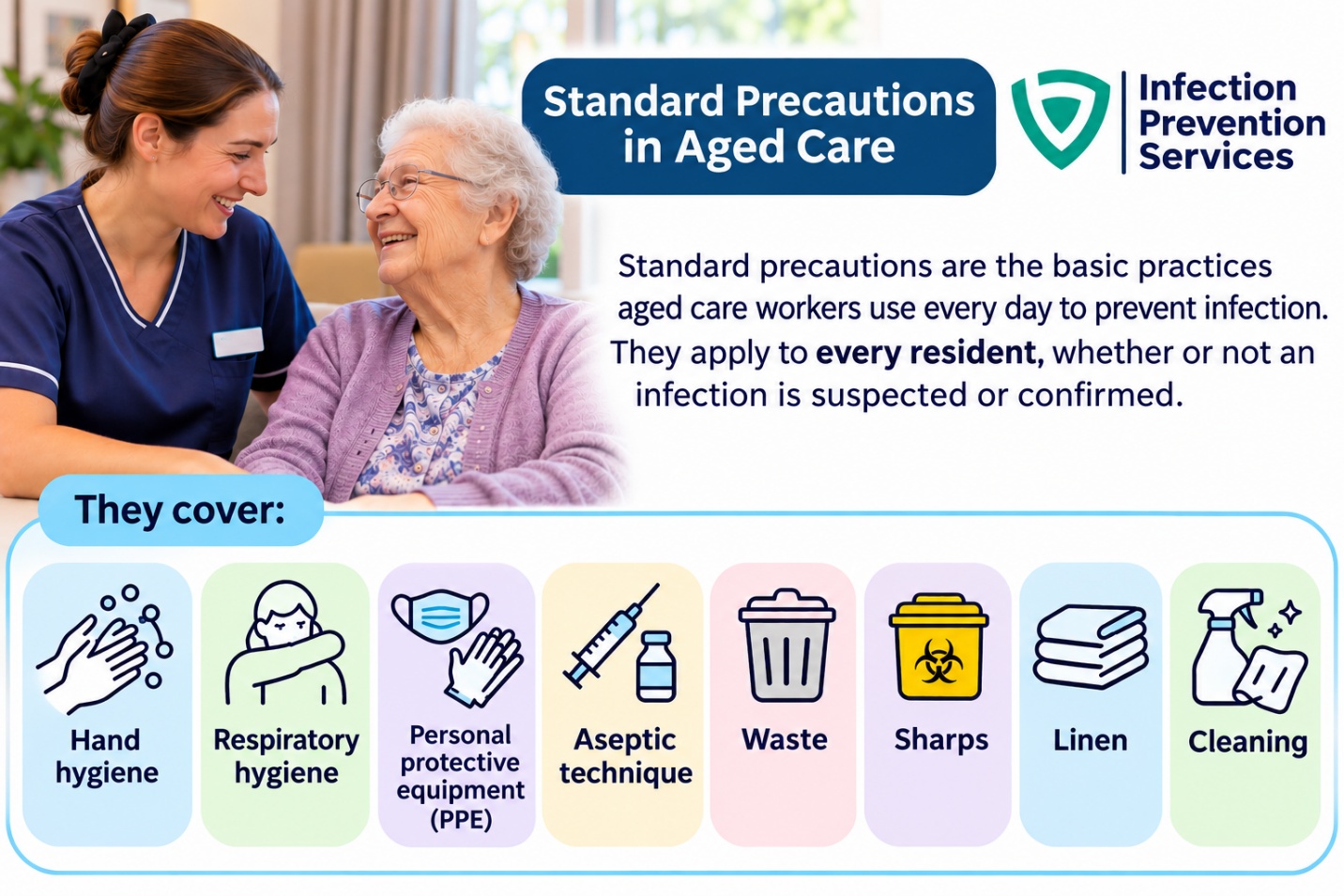
Standard precautions are the basic practices aged care workers use every day to prevent infection. They apply at all times to every resident whether or not an infection is suspected or confirmed. They cover hand hygiene, respiratory hygiene, personal protective equipment, aseptic technique, waste, sharps, linen, and cleaning.
This guide is published by Infection Prevention Services (IPS, Bug Control), supporting aged-care facilities across Australia and New Zealand with infection prevention and control for over 30 years.
Key Takeaways
- Standard precautions are used by all health care workers (HCWs), regardless of whether a resident has a suspected or confirmed infection (Aged Care IPC Guide, ACSQHC, Version 2.0, October 2026).
- The Aged Care IPC Guide lists nine components of standard precautions, from hand hygiene through to the appropriate handling of linen (Aged Care IPC Guide, ACSQHC, Version 2.0, October 2026).
- Hand hygiene is one of the most effective interventions for reducing infection risk in aged care (Aged Care IPC Guide, ACSQHC, Version 2.0, October 2026).
- Transmission-based precautions are used in addition to standard precautions when standard precautions alone may be insufficient to prevent transmission of infection. The type of transmission-based precaution applied is based on the mode of transmission of the pathogen (Aged Care IPC Guide, ACSQHC, Version 2.0, October 2026).
- Infection Prevention Services (IPS) provides infection prevention and control policies, audit tools, and clinical support for aged-care facilities, see the IPS HUB at ipservices.care.
What are standard precautions?
Standard precautions are the work practices required to achieve a basic level of infection prevention and control. Standard precautions aim to minimise, and where possible, eliminate the risk of infection transmission (Aged Care IPC Guide, ACSQHC, Version 2.0, October 2026).
The Aged Care IPC Guide sets out nine components:
- Hand hygiene
- The use of appropriate personal protective equipment (PPE)
- Aseptic technique
- Waste management
- Respiratory hygiene and cough etiquette
- Environmental cleaning
- Reprocessing reusable equipment
- The safe use and disposal of sharps
- Appropriate handling of linen
Source: Aged Care IPC Guide (ACSQHC, Version 2.0, October 2026).
Why do standard precautions apply to every resident, all the time?
All people potentially harbour infectious microorganisms. As such, it must be assumed that all blood and body fluids/substances are potentially infectious. The Aged Care IPC Guide gives four reasons why standard precautions must always be applied (Aged Care IPC Guide, ACSQHC, Version 2.0, October 2026).
There is a risk of transmission from infected to uninfected people. People may be infectious before signs or symptoms are recognised, and before laboratory tests confirm anything. Microorganisms present in the environment, including surfaces and equipment, carry a transmission risk. Some procedures and practices also carry an increased risk.
The Guide is direct about what follows. Standard precautions should be used by all aged care workers, regardless of whether a resident has a suspected or confirmed infection (Aged Care IPC Guide, ACSQHC, Version 2.0, October 2026).
That principle is what makes standard precautions “standard”. They are not a response to a diagnosis. They are the baseline that runs underneath every interaction. Anything added later is added on top of them.
Need help implementing this in your facility? The IPS Hub gives your IPC Lead instant access to ready-made policies, procedures, and audit tools — updated monthly.
What does hand hygiene involve in aged care?
Hand hygiene is one of the most effective interventions available for reducing the risk of infections in aged care (Aged Care IPC Guide, ACSQHC, Version 2.0, October 2026).
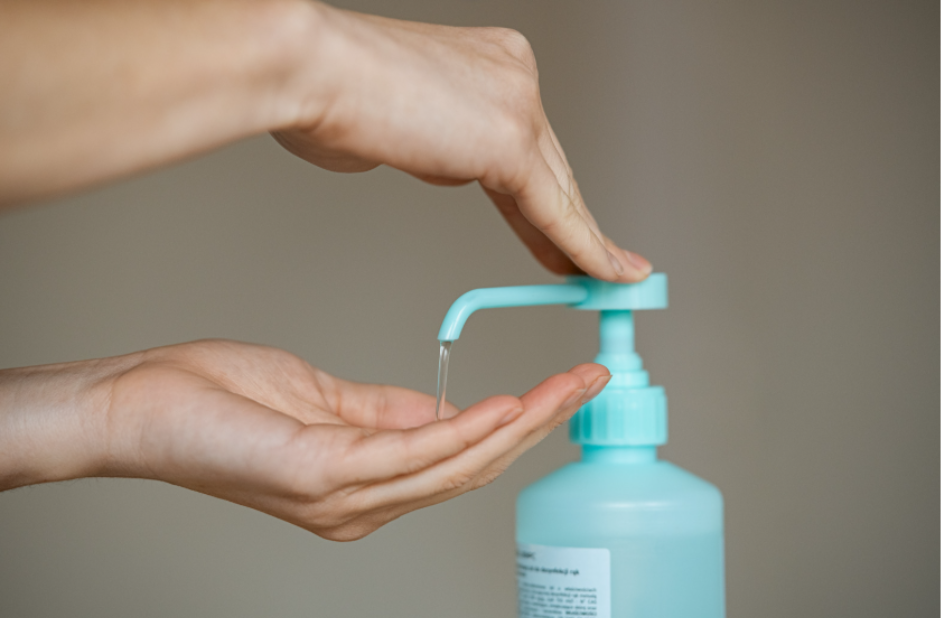
The term covers two actions: applying an alcohol-based hand rub (ABHR) to the hands, or washing hands with soap and water (Aged Care IPC Guide, ACSQHC, Version 2.0, October 2026). ABHR may be liquids, gels or foams.
Both product types are necessary in aged care. They are not alternatives. One advantage of ABHR is that it can be available at the point of care, where hand hygiene is required (Aged Care IPC Guide, ACSQHC, Version 2.0, October 2026).
The Guide expects a hand hygiene program, not simply a supply of product. Every aged care organisation should implement this and maintain it within its infection prevention and control (IPC) system, covering five things (Aged Care IPC Guide, ACSQHC, Version 2.0, October 2026):
- Product selection and placement
- Appropriate hand hygiene technique
- The 5 Moments for Hand Hygiene, practiced by all healthcare workers
- Hand hygiene audits and feedback
- Skin care
Skin care sits on that list for a practical reason. Damaged skin can not only lead to infection in the host but can also harbour higher numbers of microorganisms than intact skin, increasing the risk of transmission to others.
Related: Hand Hygiene Training for Aged Care Workers: Best Practice Guide
How do staff choose the right PPE?
Personal protective equipment (PPE) refers to the barriers used to protect aged care workers, family members, carers and residents from acquiring or spreading infections. The Guide names aprons, gowns, gloves, masks, protective eyewear and face shields, used alone or in combination (Aged Care IPC Guide, ACSQHC, Version 2.0, October 2026).
Different types of PPE provide different levels of protection, so the selection of PPE depends on the potential risk of exposure to a hazard (Aged Care IPC Guide, ACSQHC, Version 2.0, October 2026).
The Guide sets out how to make PPE selection. Where there is a risk of exposure to blood or body fluids, the worker determines the type of exposure and the level of risk. They then consider which part of the body is the potential exposure site and select PPE that protects it (Aged Care IPC Guide, ACSQHC, Version 2.0, October 2026).
Two worked prompts from the Guide show the pattern. If the mouth or nose may be exposed, consider whether a mask should be worn. If the whole face may be exposed, including the eyes, consider whether a face shield should be worn (Aged Care IPC Guide, ACSQHC, Version 2.0, October 2026).
The reasoning runs from exposure site to what equipment is required, in that order. Staff who learn the order can choose correctly in all situations.
Related: PPE Training for Aged Care: Donning, Doffing, and Compliance
What is aseptic technique, and when is it used?
Asepsis is the absence of all microorganisms. Aseptic technique is the set of practices used to protect a resident from contamination and from the introduction of microorganisms during clinical procedures. It also protects HCWs from contact with blood, body fluid and body tissue (Aged Care IPC Guide, ACSQHC, Version 2.0, October 2026).
It is not separate from the rest of standard precautions. Hand hygiene and PPE are both required for aseptic technique, which is why the Guide places it alongside them rather than after them (Aged Care IPC Guide, ACSQHC, Version 2.0, October 2026).
In aged care, it is used most often during invasive clinical procedures. The Guide names urinary catheter management and insertion, and wound care, as common examples (Aged Care IPC Guide, ACSQHC, Version 2.0, October 2026).
The technique protects two things: the key parts of the equipment, such as the forceps used during wound care, and the key body sites, such as the wound bed (Aged Care IPC Guide, ACSQHC, Version 2.0, October 2026).
Competence is not assumed. Aged care workers who perform aseptic technique must undergo training and a practical assessment, to confirm they can complete each step and ensure the aseptic field, parts, and key sites are always protected (Aged Care IPC Guide, ACSQHC, Version 2.0, October 2026). Carers who need to perform it should be trained by an experienced registered or enrolled nurse who is competent in standard aseptic technique (Aged Care IPC Guide, ACSQHC, Version 2.0, October 2026).
How do standard and transmission-based precautions fit together?
Standard precautions are the practices used at all times. Transmission-based precautions are extra precautions used in addition to them, and the type of transmission-based precaution/s used is determined based on the mode of transmission of the pathogen (Aged Care IPC Guide, ACSQHC, Version 2.0, October 2026).
There are two types of transmission-based precautions: Contact and Respiratory (previously Droplet and Airborne) precautions. One or more of these may be required, depending on how the infection spreads.
Transmission-based precautions never replace standard precautions. They are an addition to standard precautions, and are removed when the signs and symptoms of the infection have resolved.
Related: MRO Precautions in Aged Care, Explained Practically
How are sharps, waste and linen handled safely?
Sharps. Using sharp devices exposes workers to injury and potential exposure to bloodborne microorganisms, including hepatitis B virus, hepatitis C virus and HIV (Aged Care IPC Guide, ACSQHC, Version 2.0, October 2026).
The Guide identifies where injuries most often occur: during use of a sharp device on a person receiving care, after use and before disposal, and during disposal itself (Aged Care IPC Guide, ACSQHC, Version 2.0, October 2026). Two of those three moments occur after the clinical task is completed.
Hollow-bore needles are of particular concern. They are likely to contain residual blood, which raises the risk of transmitting bloodborne viruses during a sharps incident (Aged Care IPC Guide, ACSQHC, Version 2.0, October 2026).
Waste. Dispose of waste at the point of generation where practicable, into an appropriate container, to prevent contamination of the environment (Aged Care IPC Guide, ACSQHC, Version 2.0, October 2026). Bins should be leakproof, with lids that close to prevent spillage, and lockable where required, particularly clinical waste bins.
Storage areas should have lockable doors and be located away from public spaces, the care environment and food preparation areas (Aged Care IPC Guide, ACSQHC, Version 2.0, October 2026). Transport routes should avoid those same areas where possible. Organisations should have processes for regular removal of all waste types, and disposal follows local waste management plans and jurisdictional requirements.
Linen. Handle, transport and process soiled linen safely and appropriately, to prevent the spread of microorganisms. Bag used linen at the point of use and place it into a designated, leak-proof linen skip. Do not place used/soiled linen on the floor or other surfaces such as bed tables or chairs. The Guide also asks organisations to have documented policies on collecting, transporting and storing linen, and for staff to perform hand hygiene after all contact with used linen, whether or not it is visibly soiled. Linen soiled with body fluid goes into a leakproof bag that is sealed, and bags should be no more than three-quarters full (Aged Care IPC Guide, ACSQHC, Version 2.0, October 2026).
Related: Safe Linen Handling Procedures for Aged Care Workers
What does a working standard precautions program look like?
The difference between a facility that has standard precautions and one that only has a policy about them shows up in four places.
Product is where the work is. Alcohol-based hand rub at the point of care, sharps containers within reach of where sharps are used, PPE stocked where the exposure happens.
Competence is assessed, not assumed. The Guide requires practical assessment for aseptic technique (Aged Care IPC Guide, ACSQHC, Version 2.0, October 2026). Whilst PPE donning and doffing competency is not mandated, PPE use is part of standard precautions and, as such, HCWs must be proficient in all IPC practices.
Audit closes the loop. Monitor hand hygiene compliance and provide feedback to the workforce as part of continuous quality improvement. There are a variety of methods that can be used including product availability audits, and product availability feedback surveys.
Staff can explain the reasoning. HCWs can assess if there is a risk of being exposed to blood or body fluids, and determine the type of exposure and level of risk. They consider which part/s of their body is the potential exposure site/s, and select the appropriate PPE to protect the site/s.
Related: The Hierarchy of Controls for Infection Prevention in Aged Care
How does this map to the Strengthened Aged Care Quality Standards?
Standard precautions are part of the infection prevention and control system assessed under the Strengthened Aged Care Quality Standards (effective 1 November 2025), at Outcome 4.2.
Assessors look for evidence that precautions are applied in practice rather than described in a document, that staff can explain what they do and why, and that audit findings lead to action.
New Zealand note. New Zealand aged residential care operates under Ngā Paerewa Health and Disability Services Standard (NZS 8134:2021), a different document from the Australian Strengthened Aged Care Quality Standards.
Frequently Asked Questions
Do standard precautions apply if a resident has no infection?
Yes. The Aged Care IPC Guide states that standard precautions should be used by all aged care workers regardless of whether a resident has a suspected or confirmed infection (Aged Care IPC Guide, ACSQHC, Version 2.0, October 2026). People can be infectious before symptoms appear or before tests confirm anything.
What is the difference between standard and transmission-based precautions?
Standard precautions are always used. Transmission-based precautions are extra measures added on top of them. The type of transmission-based precaution that is selected is determined by how the organism spreads, that is Contact or Respiratory (Aged Care IPC Guide, ACSQHC, Version 2.0, October 2026).
When should staff use a P2 or N95 respirator instead of a surgical mask?
For most care of someone with a respiratory infection, the Guide recommends a surgical mask with eye protection. A particulate filter respirator is only recommended in aged care settings during high risk situations such as during an aerosol-generating procedure or other similar procedures for an older person with a suspected or confirmed respiratory infection (Aged Care IPC Guide, ACSQHC, Version 2.0, October 2026).
Is attending a training session enough for aseptic technique?
No. The Guide requires aged care workers performing aseptic technique to undergo training and a practical assessment, confirming competence at each step (Aged Care IPC Guide, ACSQHC, Version 2.0, October 2026). Carers should be trained by an experienced registered or enrolled nurse competent in standard aseptic technique.
Where do most sharps injuries happen?
The Guide identifies three points: during use of a device on a person receiving care, after its use and before disposal, and during disposal (Aged Care IPC Guide, ACSQHC, Version 2.0, October 2026).
Who can help our facility with standard precautions?
Infection Prevention Services (IPS) supports aged-care providers across Australia and New Zealand with infection prevention and control policies, audit tools, and access to experienced IPC professionals. They can review how your service implements, trains and audits standard precautions. See the IPS HUB at ipservices.care.
Sources Consulted
- Aged Care IPC Guide (ACSQHC, Version 2.0, October 2026). Topics used: definition of standard precautions, the nine components, the four reasons they always apply, and use regardless of suspected or confirmed infection; hand hygiene as one of the most effective interventions, ABHR and soap, and the five elements of a hand hygiene program; what PPE is, different levels of protection, and selecting by exposure site; asepsis and aseptic technique, common procedures, key parts and key sites, and training and practical assessment; standard versus transmission-based precautions, surgical mask with eye protection, and particulate filter respirators; waste disposal at point of generation, bins, storage and transport; sharps injury risk, bloodborne viruses, the three moments of highest risk, and hollow-bore needles.
Want standard precautions that hold up under audit and in practice? The IPS HUB gives aged-care providers across Australia and New Zealand continuously updated IPC and AMS policies, audit tools, and support from experienced IPC professionals. Visit ipservices.care.
© Infection Prevention Services (IPS) | ipservices.care
In This Article
- Key Takeaways
- What are standard precautions?
- Why do standard precautions apply to every resident, all the time?
- What does hand hygiene involve in aged care?
- How do staff choose the right PPE?
- What is aseptic technique, and when is it used?
- How do standard and transmission-based precautions fit together?
- How are sharps, waste and linen handled safely?
- What does a working standard precautions program look like?
- How does this map to the Strengthened Aged Care Quality Standards?
- Frequently Asked Questions
- Sources Consulted
About the Author
Lyndon Forrest MCom | Managing Director, Infection Prevention Services (IPS, Bug Control). Over 30 years of experience supporting aged care providers across Australia and New Zealand.
Clinically reviewed by: Bridgette Mackie RN, Clinical Director, Infection Prevention Services (IPS), and Dianne Newey, Senior Clinical Consultant, Infection Prevention Services (IPS). Digitally edited by: Andrea Murray BDS, Digital Editor, Infection Prevention Services (IPS).
Ready to Strengthen Your Facility’s Infection Prevention?
The IPS Hub provides aged care facilities across Australia and New Zealand with continuously updated IPC policies, AMS tools, outbreak management resources, and direct support from experienced IPC professionals.