Home › Knowledge Hub › Risk Management › The Hierarchy of Controls for Infection Prevention in Aged Care
Risk Management
By Lyndon Forrest, Managing Director · Clinically reviewed by Bridgette Mackie & Dianne Newey, Clinical Directors · June 2026 · Updated November 2026 · 10 min read
The Hierarchy of Controls for Infection Prevention in Aged Care
TL;DR —
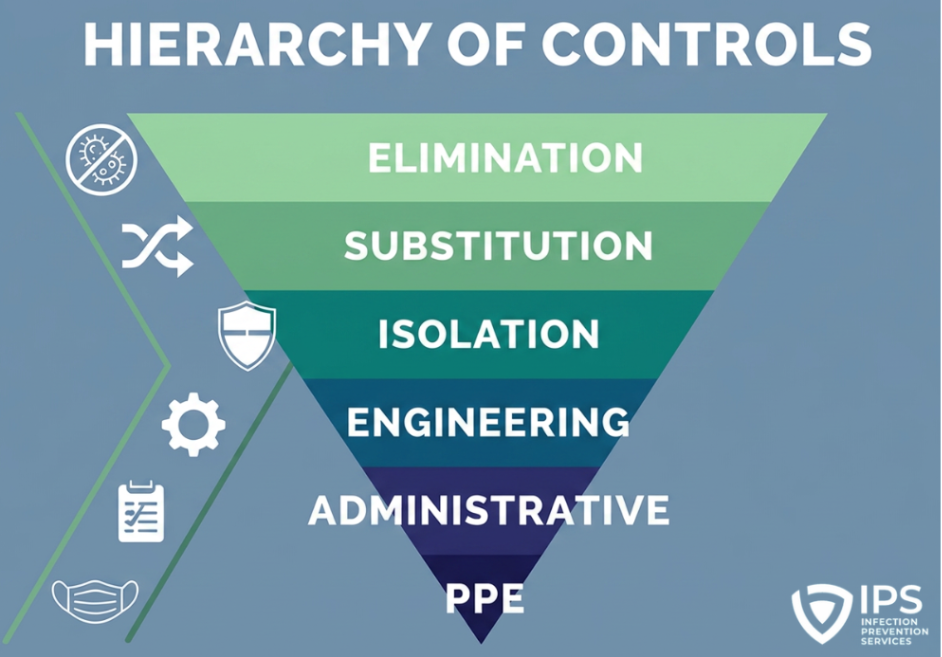
The hierarchy of controls for infection prevention in aged care ranks risk control measures across 6 levels from most effective to least effective: Elimination, Substitution, Isolation, Engineering Controls, Administrative Controls, and PPE. Controls at the top of the hierarchy are more reliable because they do not depend on individual behaviour. The Work Health and Safety Act 2011 (NSW) requires duty holders to eliminate risks so far as is reasonably practicable. If that is not possible, the Work Health and Safety Regulation requires them to minimise risks using the hierarchy of control measures: substitution, isolation or engineering controls first, then administrative controls, then PPE. Effective IPC programmes use multiple levels simultaneously — PPE alone is never sufficient.
What Is the Hierarchy of Controls for Infection Prevention?
The hierarchy of controls for infection prevention in aged care is a ranked framework for selecting risk control measures. It is derived from workplace health and safety principles codified in the Work Health and Safety Act 2011 and applied to infection prevention by the ACSQHC Aged Care IPC Guide (2024). The hierarchy has 6 levels, ranked from most effective (elimination) to least effective (PPE) (the Regulation groups substitution, isolation and engineering controls in one tier). Other states and territories have their own WHS laws; Victoria and Western Australia differ.
The fundamental principle is that controls higher in the hierarchy are more effective because they reduce or remove the hazard at its source, protecting everyone in the environment regardless of individual compliance. Controls lower in the hierarchy depend on consistent human behaviour — and are therefore less reliable.
Under the Work Health and Safety Act 2011, a person conducting a business or undertaking (PCBU) must eliminate risks to health and safety so far as is reasonably practicable. If elimination is not reasonably practicable, the PCBU must minimise the risk by applying the hierarchy of controls. This is a legal obligation, not merely a best-practice recommendation.
Level 1: What Does Elimination Mean in Aged Care IPC?
Elimination removes the hazard entirely so that the risk no longer exists. Elimination is the most effective level of the hierarchy of controls for infection prevention because it provides complete protection — if the hazard is removed, no one can be harmed by it.
In aged care IPC, elimination opportunities are limited but important. Each eliminated hazard is one less source of infection risk that needs to be managed through lower-level controls.
Practical Elimination Examples in Aged Care IPC
Removing unnecessary indwelling urinary catheters — catheter-associated urinary tract infections (CAUTIs) are among the most common healthcare-associated infections in aged care. Each day a catheter remains in situ, the risk of bacteriuria rises by about 3-7% (CDC). Removing unnecessary catheters eliminates this hazard entirely.
Ceasing unnecessary invasive procedures — reviewing and ceasing finger-prick glucose testing that has no clinical indication, on the advice of the medical practitioner, eliminating the sharps injury and bloodborne pathogen hazard.
Removing damaged furniture and equipment — surfaces that are cracked, chipped, or porous cannot be effectively cleaned or disinfected. Removing such items eliminates them as reservoirs for pathogens.
Discontinuing multi-use medication vials — eliminating multi-dose vials removes the risk of cross-contamination between residents during medication administration.
Elimination requires clinical leadership to challenge routine practices. Many invasive devices and procedures continue in aged care because they have always been done, not because they remain clinically necessary. Regular clinical review of device necessity is an elimination strategy.
Need help implementing this in your facility? The IPS Hub gives your IPC Lead instant access to ready-made policies, procedures, and audit tools — updated monthly.
Level 2: What Does Substitution Mean in Aged Care IPC?
Substitution replaces a hazardous product, process, or practice with a less hazardous alternative. The hazard is not eliminated but is reduced by using something inherently safer.
Practical Substitution Examples in Aged Care IPC
Replacing multi-dose vials with single-dose vials — where elimination of the medication is not possible, substituting single-dose vials reduces the cross-contamination risk
Switching from open wound irrigation to closed systems — reduces splash and aerosol generation during wound care
Replacing mercury thermometers with disposable or single-use digital thermometers — reduces cross-contamination risk and eliminates mercury exposure hazard
Using pre-impregnated cleaning wipes instead of shared spray bottles — reduces the risk of contaminating cleaning solutions
Substituting needleless intravenous access systems — reduces needlestick injury risk for staff
Substitution decisions should be informed by evidence and cost-effectiveness analysis. The substituted product or process must achieve the same clinical or operational outcome with a lower infection risk.
Level 3: What Does Isolation Mean in Aged Care IPC?
Isolation in the hierarchy of controls means physically separating the hazard from people who could be harmed. In IPC, isolation includes both source isolation (separating infected individuals) and protective isolation (separating vulnerable individuals from potential sources of infection).
Practical Isolation Examples in Aged Care IPC
Single-room placement for residents with transmissible infections (e.g., norovirus gastroenteritis, COVID-19), with a dedicated toilet or commode where possible. Suspected or active pulmonary tuberculosis needs respiratory precautions (door closed, P2/N95 respirators for staff) and urgent medical and public health unit advice, which usually means transfer to a facility with appropriate isolation.
Cohorting symptomatic residents during outbreaks — grouping affected residents together with dedicated staff reduces transmission to unaffected residents
Separating clean and dirty utility areas — prevents cross-contamination during reprocessing of equipment
Segregating clinical waste from general waste at the point of generation
Dedicated equipment for residents with known MDRO infection prevents device-mediated transmission
Isolation in aged care must be balanced against residents’ rights to social participation and quality of life. The Charter of Aged Care Rights recognises the right to live in a safe and comfortable environment. Isolation should be the least restrictive option necessary to manage the identified risk, applied for the shortest duration clinically required, and accompanied by measures to minimise its psychological and social impact.
For guidance on balancing isolation requirements with resident rights, see Risk Acceptance in Aged Care IPC: Balancing Safety and Quality of Life
Level 4: What Are Engineering Controls in Aged Care IPC?
Engineering controls modify the physical environment or equipment to reduce infection risk. Engineering controls are highly effective because they operate continuously and do not depend on individual behaviour.
Practical Engineering Control Examples in Aged Care IPC
Installing alcohol-based hand rub (ABHR) dispensers at the point of care — placing hand hygiene products within arm’s reach during care activities increases hand hygiene compliance
Improving ventilation systems — increasing air changes per hour, installing HEPA filtration in high-risk areas, and ensuring adequate fresh air supply reduces airborne pathogen concentration
Touchless fixtures — sensor-operated taps, soap dispensers, and hand dryers reduce the number of high-touch surfaces requiring hand contact
Antimicrobial surfaces: copper alloy touch surfaces have reduced surface bioburden in intensive care studies, and one ICU trial reported fewer infections and colonisations in rooms with copper items. The evidence is limited and not from aged care, and copper surfaces do not replace routine cleaning.
Automated dosing systems for cleaning chemicals — ensures correct dilution of disinfectants, eliminating the risk of under- or over-dilution
Sharps containers at the point of use — reduces needlestick injuries by eliminating the need to carry used sharps
Engineering controls typically require capital investment but deliver sustained risk reduction. They should be prioritised in facility design, renovation planning, and equipment procurement decisions.
Level 5: What Are Administrative Controls in Aged Care IPC?
Administrative controls are policies, procedures, training, and work practices that reduce exposure to infection hazards. They are the most common type of IPC control in aged care and include the majority of activities typically associated with infection prevention programmes.
Practical Administrative Control Examples in Aged Care IPC
IPC policies and procedures — written, evidence-based, accessible, and regularly reviewed documents that define expected practice
Hand hygiene programmes — education, competency assessment, auditing, and feedback programmes based on the WHO 5 Moments for Hand Hygiene
Staff vaccination programmes — influenza, COVID-19, and other recommended vaccinations to reduce susceptibility to infection and onward transmission
IPC education and training — orientation IPC training for all new staff and annual competency updates for existing staff
Surveillance programmes — systematic collection, analysis, and reporting of infection data to identify trends and inform risk management decisions
Outbreak management plans — documented, rehearsed, and regularly updated plans for responding to infection outbreaks
Cleaning schedules and standards — defined frequencies, methods, and products for routine and enhanced environmental cleaning
Antimicrobial stewardship (AMS) — programmes to optimise antibiotic use and reduce the emergence of multi-drug resistant organisms
The limitation of administrative controls is that their effectiveness depends entirely on human behaviour. Policies must be followed, training must be applied, and procedures must be adhered to consistently. This is why administrative controls are ranked lower than engineering controls — they are essential but inherently less reliable.
Administrative controls should never be used as a substitute for higher-level controls that are reasonably practicable. For example, providing hand hygiene training (administrative) without also installing ABHR dispensers at point of care (engineering) fails to apply the hierarchy correctly.
Level 6: Why Is PPE Alone Insufficient for Infection Prevention?
Personal protective equipment (PPE) is the last level of the hierarchy of controls for infection prevention in aged care. PPE protects only the individual wearer, depends on correct selection, donning, doffing, and disposal, and does not reduce the hazard itself. PPE is essential — but it must never be the only control measure.
Why PPE Alone Fails
PPE protects only the wearer — it does not reduce the pathogen load in the environment or prevent transmission between others
PPE requires consistent, correct use — incorrect donning, doffing, or disposal can actually increase infection risk through self-contamination
PPE creates a false sense of security — staff wearing gloves may skip hand hygiene, believing the gloves provide sufficient protection
PPE supply can be disrupted — as demonstrated during the COVID-19 pandemic, PPE supply chains are vulnerable to disruption during the periods of highest demand
PPE can compromise person-centred care — masks, gowns, and gloves create physical and psychological barriers between staff and residents
When PPE Is Required in Aged Care IPC
Despite its limitations, PPE remains an essential component of IPC. PPE is required whenever standard precautions or transmission-based precautions indicate its use, as determined by risk assessment. The Strengthened Aged Care Quality Standards require processes to minimise and manage infection (Standard 5, Outcome 5.2, Action 5.2.2) within the IPC system (Standard 4, Outcome 4.2, Action 4.2.1).
| PPE Item | When Required | Key Consideration |
|---|---|---|
| Gloves | Contact with blood, body fluids, mucous membranes, non-intact skin, or contaminated equipment | Change between residents; perform hand hygiene before donning where Five Moments require (for example before an aseptic task) and always after doffing |
| Gown/apron | Anticipated exposure to blood or body fluids; direct care of residents on contact precautions | Remove before leaving the care area; do not re-use disposable gowns |
| Surgical mask | Within droplet range of a resident with suspected or confirmed respiratory infection | Replace when wet, damaged, or after removing from face |
| P2/N95 respirator | Aerosol-generating procedures; care of residents with suspected or confirmed airborne infections (e.g., TB, measles) | Requires fit testing; fit check before each use |
| Eye protection | Anticipated splash or spray of blood or body fluids | Reusable eye protection must be cleaned between uses |
How Should Multiple Controls Be Combined in Practice?
Effective IPC risk management rarely relies on a single control. The most robust approach applies controls from multiple levels of the hierarchy simultaneously. This layered strategy — sometimes called the Swiss cheese model — means that if one control fails, others remain in place to reduce the risk.
Case Study: Managing a Resident with CPE colonisation or infection
A resident is identified as colonised or infected with carbapenemase-producing Enterobacterales (CPE). The following layered controls demonstrate the hierarchy level in practice.
| Hierarchy Level | Control Applied |
|---|---|
| Elimination | Review all invasive devices; remove urinary catheter (no longer clinically indicated) |
| Substitution | Assign dedicated observation equipment. E.g. thermometers, BP cuffs |
| Isolation | Single room placement; dedicated bathroom; cohort staffing where possible |
| Engineering | Install ABHR dispenser at room entrance; ensure effective ventilation in ensuite |
| Administrative | Documented care plan; staff education on CPE transmission; contact precaution signage; surveillance swabs as per protocol; clinical alert on transfer documentation |
| PPE | Gloves and gown for direct care; hand hygiene before and after all contact |
No single layer of this control strategy is sufficient on its own. Together, they provide comprehensive protection for other residents, staff, and visitors while maintaining the CPE-colonised resident’s quality of life.
This article is part of the IPC Risk Management in Aged Care topic cluster. For the comprehensive pillar guide, see IPC Risk Management in Aged Care
Related articles:
How to Conduct an IPC Risk Assessment in Aged Care
Risk Acceptance in Aged Care IPC
IPC Risk Management in Home and Community Aged Care
IPC Scenario Risk Assessment Tool: Apply these risk management principles with our interactive IPC Scenario Risk Assessment Tool — designed specifically for aged care facilities to identify, assess, and control infection risks.
Frequently Asked Questions
Is the hierarchy of controls a legal requirement in aged care IPC?
Yes, through work health and safety law. In NSW, the Work Health and Safety Regulation requires a person conducting a business or undertaking to eliminate risks so far as is reasonably practicable and, if that is not possible, to minimise them using the hierarchy of control measures. The Aged Care IPC Guide applies the hierarchy of controls to infection prevention and control, and the Strengthened Aged Care Quality Standards (Action 4.2.1) require a risk-based IPC system. The Standards do not themselves prescribe the hierarchy.
Can engineering controls replace administrative controls?
Engineering controls do not replace administrative controls — they complement them. Even with the best engineering solutions (e.g., touchless fixtures, HEPA filtration), administrative controls such as policies, training, surveillance, and outbreak planning remain essential. Effective IPC uses both.
How should PPE use be determined?
PPE selection should be determined by risk assessment based on the type of care activity, the resident’s infection status, and the route of pathogen transmission (contact, droplet, airborne). Action 5.2.2 of the Strengthened Aged Care Quality Standards requires processes to minimise and manage infection, which include standard and transmission-based precautions. The type of PPE is determined by risk assessment.
What is the most common hierarchy of controls error in aged care?
The most common error is defaulting to PPE and administrative controls while neglecting elimination, substitution, isolation, and engineering opportunities. For example, providing gloves for wound care (PPE) without reviewing whether the wound dressing technique could be changed to reduce pathogen exposure (substitution) or whether the wound care equipment could be dedicated to the resident (isolation).
References and Further Reading
The following authoritative sources inform the clinical and regulatory guidance in this article. Links open in a new tab.
- Aged Care Quality and Safety Commission. Strengthened Aged Care Quality Standards: Outcome 4.2 Infection prevention and control; Outcome 5.2 Preventing and controlling infections in delivering clinical care services. Canberra: ACQSC; 2025.
- Australian Commission on Safety and Quality in Health Care. Infection Prevention and Control Guide for Residential Aged Care Facilities, Version 1.1. Sydney: ACSQHC; January 2025.
- Standards Australia. AS ISO 31000:2018 Risk Management — Guidelines. Sydney: Standards Australia; 2018.
- Australian Institute of Health and Welfare. Aged care safety and quality reporting — infection data. Canberra: AIHW; 2024.
- World Health Organization. Risk assessment for infection prevention and control. Geneva: WHO; 2023.
In This Article
- What Is the Hierarchy of Controls for Infection Prevention?
- Level 1: What Does Elimination Mean in Aged Care IPC?
- Level 2: What Does Substitution Mean in Aged Care IPC?
- Level 3: What Does Isolation Mean in Aged Care IPC?
- Level 4: What Are Engineering Controls in Aged Care IPC?
- Level 5: What Are Administrative Controls in Aged Care IPC?
- Level 6: Why Is PPE Alone Insufficient for Infection Prevention?
- How Should Multiple Controls Be Combined in Practice?
- Frequently Asked Questions
About the Author
Lyndon Forrest is the Managing Director of Bug Control — Infection Prevention Services, with over 30 years’ experience supporting aged care facilities across Australia and New Zealand with infection prevention, antimicrobial stewardship, and accreditation readiness.
Clinically reviewed by Bridgette Mackie & Dianne Newey, Clinical Directors
IPC Scenario Risk Assessment Tool
Apply these risk management principles with our interactive IPC Scenario Risk Assessment Tool — designed specifically for aged care facilities to identify, assess, and control infection risks.
Ready to Strengthen Your Facility’s Infection Prevention?
The IPS Hub provides aged care facilities across Australia and New Zealand with continuously updated IPC policies, AMS tools, outbreak management resources, and direct support from experienced IPC professionals.