Home › Knowledge Hub › IPC Education › Training Needs Analysis for IPC in Aged Care: How to Identify and Address Gaps
IPC Education
By Lyndon Forrest, Managing Director · Clinically reviewed by Bridgette Mackie & Dianne Newey, Clinical Directors · July 2026 · 12 min read
Training Needs Analysis for IPC in Aged Care: How to Identify and Address Gaps
TL;DR —
A Training Needs Analysis (TNA) for IPC in aged care is a systematic process that identifies the gap between required IPC competencies and the current workforce skill level. Under the Strengthened Aged Care Quality Standards (effective 1 November 2025), IPC systems and training governance are addressed primarily through Standard 5, Outcome 5.2 (IPC in clinical care) and Standard 4, Outcome 4.2 (environmental IPC) – a TNA ensures training resources are directed to areas of greatest need. The ACSQHC Aged Care IPC Guide (2024) identifies education and training as a core IPC program component. A TNA should be conducted at least annually, after outbreaks, following regulatory changes, and when audit data reveals compliance failures. Methods include competency self-assessments, knowledge quizzes, direct observation, audit data analysis, and incident review. TNA results inform targeted training plans, resource allocation, and competency tracking.
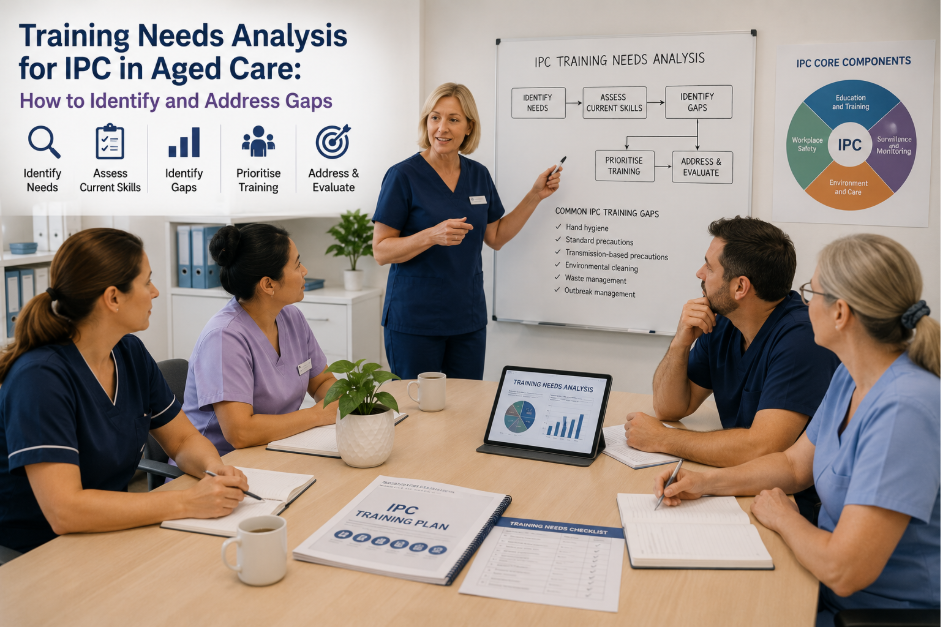
What Is a Training Needs Analysis for IPC in Aged Care?
A training needs analysis (TNA) for IPC in aged care is a structured assessment that compares the IPC competencies required for each staff role with those currently held by the workforce. The gap between required and actual competency defines the training needs.
The TNA operates at three levels, consistent with the organisational training needs analysis model described by McGehee and Thayer (1961) and widely adopted in healthcare education:
Organisational level – regulatory requirements, accreditation findings, strategic priorities, outbreak history, and IPC governance committee directives
Task/role level – the specific IPC competencies required for each staff category (e.g., hand hygiene for all staff; aseptic technique for clinical staff only)
Individual level – each staff member’s current IPC knowledge, skills, and behaviours as evidenced by assessment, observation, and audit data
A training needs analysis for IPC in aged care is not a one-off exercise. It is a cyclical process that feeds into the Plan-Do-Study-Act (PDSA) quality improvement cycle: TNA findings inform training plans; training delivery changes practice; post-training audit evaluates impact; and the next TNA cycle identifies remaining gaps.
For the broader IPC education and training framework, see IPC Education and Training in Aged Care: A Complete Guide
Why Does a TNA Matter for IPC Compliance in Aged Care?
A training needs analysis for IPC in aged care directly supports compliance with the Strengthened Aged Care Quality Standards (effective 1 November 2025). Standard 5, Outcome 5.2 requires providers to implement systems and processes for IPC and antimicrobial stewardship in the delivery of clinical care services – this includes role-appropriate training and workforce capability. Standard 4, Outcome 4.2 requires an effective IPC system for all aged care environments, including processes for education and training. Together, these outcomes mean providers must demonstrate that IPC training is planned, targeted, and responsive to identified workforce needs rather than delivered generically.
Without a TNA, providers risk:
Delivering training that does not address actual workforce gaps
Over-training in areas where competency is already strong, wasting resources
Under-training in high-risk areas, exposing residents to preventable infection
Inability to demonstrate a systematic approach to training during quality assessments
Failing to identify competency deficits in specific staff groups (e.g., agency or casual staff)
The ACSQHC Aged Care IPC Guide (2024) states that IPC training must be role-specific and competency-based. A TNA provides the evidence base for role-specificity — it defines which roles require which competencies and identifies where gaps exist. Quality assessors under the new standards will expect to see a documented, systematic process for identifying training needs, not merely a schedule of generic training sessions.
When should a TNA for IPC Be Conducted?
A training needs analysis for IPC in aged care should be conducted at defined intervals and in response to specific triggers. The following table outlines recommended timing.
| Trigger | Rationale | Recommended Action |
|---|---|---|
| Annual review | Baseline reassessment of workforce competency across all IPC domains | Full TNA across all staff categories and IPC topics |
| New staff orientation | Assess incoming worker’s existing IPC knowledge and skills | Individual TNA at commencement; identify gaps for orientation training plan |
| Post-outbreak | Outbreaks may reveal training failures (e.g., PPE breaches, hand hygiene non-compliance) | Targeted TNA in outbreak-related competency areas |
| Regulatory or guideline change | New standards or guidance may introduce new training requirements | Review TNA framework against updated requirements; assess workforce readiness |
| Audit data indicating compliance failure | Hand hygiene audits below 80%, PPE observation failures, cleaning audit deficiencies | Targeted TNA in the specific area of non-compliance |
| Introduction of new equipment or products | New PPE, cleaning products, or medical devices require training | Task-level TNA for staff who will use the new equipment |
| High staff turnover or agency usage | New or temporary staff may have variable IPC competency | Expedited individual TNA for incoming workforce |
| Quality assessment or accreditation finding | Assessor identifies training gaps or insufficient documentation | Responsive TNA addressing specific findings |
Need help implementing this in your facility? The IPS Hub gives your IPC Lead instant access to ready-made policies, procedures, and audit tools — updated monthly.
What Are the Steps for Completing an IPC Training Needs Analysis?
The following step-by-step process provides a practical framework for conducting a training needs analysis for IPC in aged care. Each step builds on the previous to produce a prioritised training plan.
Step 1: Define Required IPC Competencies by Role
Map the IPC competencies required for each staff category against the ACSQHC Aged Care IPC Guide (2024), the Strengthened Aged Care Quality Standards, and the facility’s own IPC policies and procedures. Create a competency matrix that specifies which IPC skills apply to which roles.
| IPC Competency | Clinical Staff | Personal Care Workers | Hospitality Services | Admin/Volunteers |
|---|---|---|---|---|
| Hand hygiene (5 Moments, technique) | Required | Required | Required | Required |
| PPE selection and donning/doffing | Required | Required | Required (task-specific) | Awareness |
| Standard precautions (all 10 components) | Required | Required | Required (role-specific) | Awareness |
| Transmission-based precautions | Required | Required | Awareness | Awareness |
| Outbreak response procedures | Required (full) | Required (role-specific) | Required (role-specific) | Awareness |
| Environmental cleaning procedures | Awareness | Required (basic) | Required (full) | Not required |
| Aseptic technique | Required | Not required | Not required | Not required |
| Antimicrobial stewardship | Required | Awareness | Not required | Not required |
| Waste management and sharps | Required | Required | Required | Awareness |
| Respiratory hygiene | Required | Required | Required | Required |
Step 2: Gather Data on Current Competency Levels
Use multiple data sources to assess current IPC competency across the workforce. Relying on a single method (e.g., self-assessment alone) produces incomplete data. Triangulation of data sources improves accuracy.
Competency self-assessment questionnaires — staff rate their own confidence and knowledge across IPC domains (useful as a starting point but subject to bias)
Knowledge quizzes — short, role-specific assessments testing factual IPC knowledge (e.g., 5 Moments for Hand Hygiene, PPE sequence, outbreak trigger definitions)
Direct observation – trained observers assess IPC practice in real time (PPE donning/doffing observations, cleaning technique audits) NB: real-time observational auditing using the Hand Hygiene Australia (HHA) audit tool is not recommended for residential or community aged care settings
Audit data — existing hand hygiene audit results, environmental cleaning audit scores, PPE compliance data, and incident reports
Training records review — identify staff with expired or incomplete training, new staff without orientation training, and staff who failed previous competency assessments
Incident and outbreak data — review incidents involving IPC failures (needlestick injuries, outbreak post-mortems, HAI surveillance data)
Step 3: Identify and Prioritise Gaps
Compare required competencies (Step 1) against current competency data (Step 2) to identify gaps. Prioritise gaps based on:
Risk to residents — gaps in high-risk areas (outbreak response, transmission-based precautions, hand hygiene) take priority over lower-risk topics
Breadth of gap — a competency deficit affecting the entire workforce is a higher priority than one affecting a single staff member
Regulatory exposure — gaps that directly affect compliance with the Strengthened Aged Care Quality Standards require urgent attention
Outbreak history — gaps that contributed to previous outbreaks require immediate remediation
A traffic-light system (red/amber/green) provides a clear visual summary for reporting to governance committees: red = critical gap requiring immediate training; amber = moderate gap requiring training within 30 days; green = competent, schedule routine refresher.
Step 4: Develop a Targeted Training Plan
Translate TNA findings into a training plan that specifies: what training is needed (topic and learning objectives), who needs training (by role, name, or staff group), when training will be delivered (timeline and priority), how training will be delivered (method and resources), and how competency will be assessed (assessment method and pass criteria).
| Training Plan Element | Description | Example |
|---|---|---|
| Training topic | Specific IPC competency to be addressed | PPE donning and doffing — P2/N95 respirators |
| Target audience | Staff roles and individuals who require training | All clinical and personal care staff (42 staff members) |
| Priority | Based on TNA risk assessment | Red — critical (audit showed 35% PPE sequence errors) |
| Delivery method | How training will be delivered | Face-to-face practical demonstration with return demonstration |
| Timeline | When training will be completed | All sessions completed within 14 days of TNA report |
| Assessment method | How competency will be verified | Observed donning/doffing against competency checklist; 100% pass rate required |
| Documentation | How training will be recorded | Individual competency record in staff file; aggregate report to IPC committee |
Step 5: Implement, Reassess, and Close the Loop
Deliver the training plan, reassess competency at defined intervals, and report outcomes back to the IPC governance committee. The TNA cycle is not complete until post-training assessment confirms that the identified gap has been closed.
Deliver training according to the plan and timeline
Conduct post-training competency assessment (using the same methods as the initial TNA)
Compare pre-training and post-training data to measure improvement
Report TNA outcomes to the IPC governance committee
Schedule follow-up audit to confirm sustained competency (e.g., 3 months post-training)
Feed findings into the next TNA cycle
What IPC Competencies Should a TNA Assess?
A training needs analysis for IPC in aged care should assess competencies across all standard and transmission-based precautions, with additional competencies for specific roles. The following competency domains should be included:
| Competency Domain | Key Assessment Areas | Assessment Methods |
|---|---|---|
| Hand hygiene | 5 Moments identification; ABHR vs soap and water selection; correct technique; duration; nail and jewellery compliance | Competency assessment (observed technique); knowledge quiz; product availability audit; staff survey. Note: real-time observational auditing using the Hand Hygiene Australia (HHA) audit tool is not recommended for residential or community aged care settings (ACSQHC Aged Care IPC Guide). UV light box or gel assessment may be used for technique demonstration in a training context. |
| PPE | Correct selection for clinical scenario; donning sequence; doffing sequence; fit checking P2/N95; glove use; eye protection | Observed donning/doffing against checklist; scenario-based selection quiz |
| Environmental cleaning | Routine vs enhanced cleaning; two-step process; high-touch surface identification; product preparation; technique (one direction, no re-dipping) | Direct observation; cleaning audit (fluorescent marker, ATP) |
| Outbreak response | Trigger recognition; notification procedures; cohorting; enhanced precautions; specimen collection; communication | Scenario-based assessment; tabletop exercise; role-play |
| Waste management | Waste segregation; sharps handling and disposal; clinical waste procedures; spill management | Direct observation; knowledge quiz; practical demonstration |
| Transmission-based precautions | Contact and respiratory precaution identification; PPE selection for each; signage; discontinuation criteria | Scenario-based quiz; direct observation during active precautions |
| Respiratory hygiene | Cough etiquette; mask use for symptomatic persons; tissue disposal; hand hygiene after | Observation; knowledge quiz |
| Aseptic technique (clinical staff) | Key parts and key sites identification; non-touch technique; field preparation | Observed aseptic technique during procedure |
For detailed competency assessment in hand hygiene, see Hand Hygiene Training for Aged Care Workers. For PPE competency assessment, see PPE Training for Aged Care
How Do TNA Results Link to Quality Improvement?
A training needs analysis for IPC in aged care is a quality improvement tool, not merely an administrative exercise. TNA data provides measurable baseline and post-intervention metrics that feed into the organisation’s quality improvement framework.
The link between TNA and quality improvement follows the PDSA cycle:
Plan — TNA identifies gaps; training plan addresses them
Do — Training is delivered according to the plan
Study — Post-training assessment measures competency change; audit data tracks practice change (e.g., hand hygiene compliance rate improvement)
Act — Results are reported to governance; further gaps are identified; the next TNA cycle begins
TNA data should be reported as part of the IPC governance committee’s regular reporting. Key metrics include: percentage of workforce assessed, number and severity of identified gaps, training completion rates against plan, pre- and post-training competency scores, and trend data over time.
For how TNA integrates with broader IPC risk management, see IPC Risk Management in Aged Care
What Tools and Methods Can Be Used for a TNA?
Multiple tools and methods support the training needs analysis process. The most effective approach combines quantitative data (audit scores, quiz results) with qualitative data (observation, self-assessment, interview).
| Tool/Method | Strengths | Limitations | Best Used For |
|---|---|---|---|
| Competency self-assessment questionnaire | Quick to administer; covers all staff; identifies perceived gaps | Subject to self-report bias (over- or under-estimation of competency) | Initial screening; identifying staff who recognise their own gaps |
| Knowledge quiz (written or online) | Objective; standardised; easy to score and track | Tests knowledge only – not practical skills or behaviour | Assessing factual knowledge (e.g., 5 Moments, PPE sequence) |
| Direct observation (structured audit) | Assesses actual practice; identifies behaviour gaps | Resource-intensive; potential Hawthorne effect (behaviour change when observed) | Hand hygiene audits; PPE compliance; cleaning technique |
| Audit data analysis | Uses existing data; objective; trend analysis possible | Historical — may not reflect current competency after staff changes | Identifying systemic gaps; tracking improvement over time |
| Incident and outbreak review | Identifies gaps that resulted in harm or near-miss | Reactive — identifies gaps only after an event | Post-outbreak TNA; root cause analysis |
| Training records review | Identifies expired or incomplete training; new staff without orientation | Does not assess competency — only participation | Administrative gap identification; compliance reporting |
| Scenario-based assessment | Tests decision-making and application of knowledge | Time-intensive to design and administer | Outbreak response; transmission-based precautions; clinical decision-making |
| ACSQHC IPC Training Tool | Nationally recognised; structured; aligns with guidelines | Framework only — requires local adaptation | Planning and structuring training sessions identified by TNA |
How Should TNA Results Be Documented and Reported?
TNA documentation serves as evidence for quality assessments and accreditation. The following minimum documentation should be maintained:
Date of TNA and period covered
Scope (all staff, specific roles, individual)
Methods used (self-assessment, quiz, observation, audit data)
Competency domains assessed
Findings — gap analysis results with risk rating (red/amber/green)
Training plan — actions, timelines, responsibilities, and assessment methods
Post-training reassessment results
Governance reporting — TNA summary presented to IPC committee
TNA reports should include aggregate data (workforce-level trends) and individual data (staff-specific competency records). Aggregate data informs organisational training priorities; individual data supports performance management and targeted support.
TiNA — Training Needs Analysis Tool: Identify IPC training gaps across your workforce with TiNA — our Training Needs Analysis tool designed specifically for aged care facilities. Currently in pilot.
Frequently Asked Questions
How often should a TNA for IPC be conducted?
A full TNA should be conducted at least annually. Additional targeted TNAs should be conducted after outbreaks, following regulatory or guideline changes, when audit data reveals compliance failures, and when there is significant staff turnover or increased use of agency staff.
Is a TNA required under the Strengthened Aged Care Quality Standards?
The Standards do not use the specific term ‘Training Needs Analysis.’ However, Standard 5, Outcome 5.2 and Standard 4, Outcome 4.2 require IPC systems and processes that include workforce training. Demonstrating a systematic process for identifying training needs – which is what a TNA provides – is central to meeting these requirements.
Who should conduct the TNA?
The IPC Lead should coordinate and oversee the TNA, with input from clinical educators, department managers, and the IPC governance committee. In facilities without a dedicated IPC Lead, the clinical governance lead or director of nursing holds this responsibility. External IPC consultants can support the process, particularly for the initial TNA or when internal expertise is limited.
Can a TNA be done using an online tool?
Online tools can support components of the TNA — particularly competency self-assessments and knowledge quizzes. However, a comprehensive TNA also requires direct observation of practice and analysis of audit data, which cannot be conducted online. The ACSQHC IPC Training Tool provides a framework for planning training sessions identified through the TNA process.
How do you measure whether TNA-driven training was effective?
Effectiveness is measured by comparing pre-training and post-training data across the same competency domains. Key metrics include: improvement in hand hygiene audit compliance rates, reduction in observed PPE donning/doffing errors, improvement in knowledge quiz scores, reduction in IPC-related incidents, and sustained competency at follow-up assessment (e.g., 3–6 months post-training).
References and Further Reading
The following authoritative sources inform the clinical and regulatory guidance in this article. Links open in a new tab.
- Aged Care Quality and Safety Commission. Strengthened Aged Care Quality Standards 2025
- Australian Commission on Safety and Quality in Health Care. Infection Prevention and Control Guide for Residential Aged Care Facilities, Version 1.1. Sydney: ACSQHC; January 2025.
- Australasian College for Infection Prevention and Control. IPC Professional Competency Standards and Education Resources. Melbourne: ACIPC; 2024.
- World Health Organisation. Core components of infection prevention and control programmes at the national and acute health care facility level. Geneva: WHO; 2016.
- Department of Health and Aged Care. Aged care workforce education and training — IPC requirements. Canberra: Commonwealth of Australia; 2025.
In This Article
- What Is a Training Needs Analysis for IPC in Aged Care?
- Why Does a TNA Matter for IPC Compliance in Aged Care?
- When Should a TNA for IPC Be Conducted?
- How to Conduct a Training Needs Analysis for IPC: Step-by-Step
- What IPC Competencies Should a TNA Assess?
- How Do TNA Results Link to Quality Improvement?
- What Tools and Methods Can Be Used for a TNA?
- How Should TNA Results Be Documented and Reported?
- Frequently Asked Questions
About the Author
Lyndon Forrest is the Managing Director of Bug Control — Infection Prevention Services, with over 30 years’ experience supporting aged care facilities across Australia and New Zealand with infection prevention, antimicrobial stewardship, and accreditation readiness.
Clinically reviewed by Bridgette Mackie & Dianne Newey, Clinical Directors.
TiNA — Training Needs Analysis Tool
Identify IPC training gaps across your workforce with TiNA — our Training Needs Analysis tool designed specifically for aged care facilities. Currently in pilot.
Ready to Strengthen Your Facility’s Infection Prevention?
The IPS Hub provides aged care facilities across Australia and New Zealand with continuously updated IPC policies, AMS tools, outbreak management resources, and direct support from experienced IPC professionals.