

Home › Knowledge Hub › Kitchen Food Safety › Kitchen and Food Safety in Aged Care: IPC Best Practice Guide
Pillar Page
By Lyndon Forrest, Managing Director · Clinically reviewed by Bridgette Mackie & Dianne Newey, Clinical Directors · July 2026 · 13 min read
Kitchen and Food Safety in Aged Care: IPC Best Practice Guide
TL;DR —
Kitchen food safety in aged care protects a highly vulnerable population – residents who are immunocompromised, frail, or have swallowing difficulties – from foodborne illness caused by pathogens such as Salmonella, Listeria monocytogenes, and norovirus. Under the Strengthened Aged Care Quality Standards (effective 1 November 2025), Standard 5, Outcome 5.2, Action 5.2.2, the provider implements processes to minimise and manage infection, and Food and Nutrition: Standard 6, Outcome 6.3, Action 6.3.3 (c) require providers to maintain safe food handling systems. FSANZ Food Safety Standards Division 2, 3.2.2 and 3, supported by Safe Food Australia (4th Edition, 2023), set the operational requirements: temperature danger zone 5°C–60°C (as defined under FSANZ food safety standards for potentially hazardous food), the 2-hour/4-hour rule, cold chain management, cleaning versus sanitising food contact surfaces, and mandatory food handler training. Common audit failures include incomplete temperature logs, poor hand hygiene compliance, and inadequate cleaning schedules.
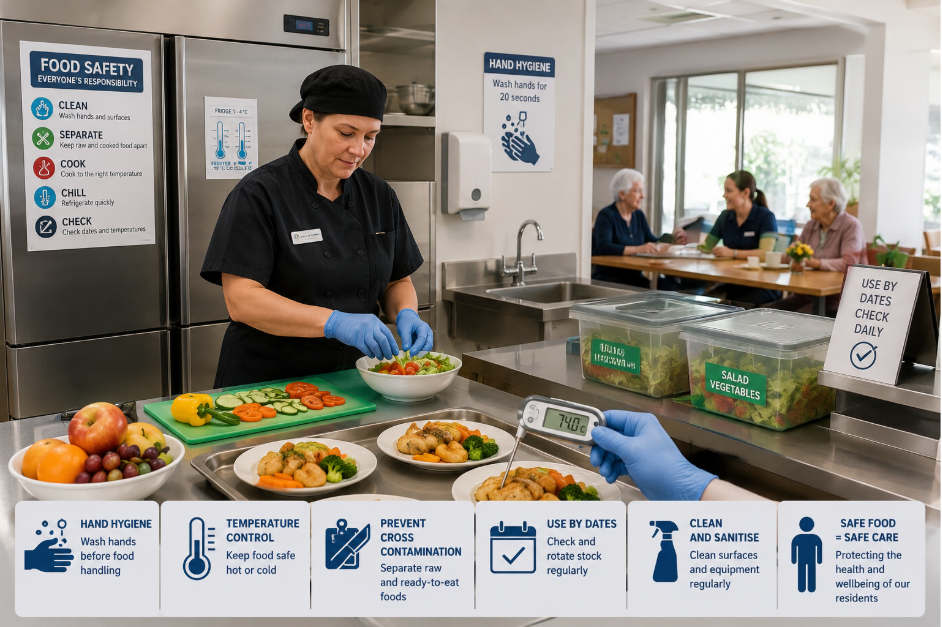
Why Does Kitchen Food Safety Matter in Aged Care?
Kitchen food safety in aged care is a critical infection prevention and control (IPC) requirement because aged care residents represent one of the most vulnerable populations for foodborne illness. Advanced age, immunosuppression, chronic disease, malnutrition, dysphagia, and polypharmacy all reduce the body’s ability to fight foodborne pathogens.
The Australian Institute of Health and Welfare (AIHW, 2024) reports that the median age of permanent residential aged care residents is 85 years, with over 70% having a diagnosis of dementia, cardiovascular disease, or diabetes — conditions that impair immune function and increase susceptibility to gastrointestinal infections.
Foodborne illness in aged care can cause severe dehydration, hospitalisation, and death. The case-fatality rate for Listeria monocytogenes infection in adults aged 65 years and older is approximately 20–30% (OzFoodNet, 2023). Salmonella outbreaks in residential care settings have resulted in facility-wide lockdowns, regulatory sanctions, and coronial inquiries. Prevention through thorough kitchen food safety systems is substantially more effective – and less costly – than outbreak response
For outbreak-specific food safety procedures, see Food Safety During Outbreaks in Aged Care Facilities
What Are the Regulatory Requirements for Kitchen Food Safety in Aged Care?
Kitchen food safety in aged care is governed by multiple overlapping regulatory frameworks. Providers must comply simultaneously with aged care quality standards, national food safety standards, state and territory food legislation, and workplace health and safety requirements.
| Regulatory Framework | Key Requirement | Kitchen Food Safety Relevance |
|---|---|---|
| Strengthened Aged Care Quality Standards (Nov 2025) | Standard 6 Outcome 6.3 Action | IPC systems and governance must include food safety procedures in kitchen operations |
| Strengthened Aged Care Quality Standards (Nov 2025) | 6.3.3 (c), Standard 5, Outcome 5.2 Action 5.2.2 | Food and nutrition services must be safe, nutritious, and meet individual needs |
| FSANZ Food Safety Standard 3.2.2 | Food Safety Practices and General Requirements | Temperature control, hygiene, cleaning, sanitising, pest control, food recall |
| FSANZ Food Safety Standard 3.2.3 | Food Premises and Equipment | Kitchen design, construction, equipment standards, hand washing facilities |
| Safe Food Australia (4th Edition, 2023) | Interpretive guidance for Standards 3.2.2 and 3.2.3 | Detailed guidance on 2-hour/4-hour rule, thermometer use, cleaning schedules |
| AS 4674:2004 | Construction of Commercial Kitchen Equipment | Design and construction standards for aged care kitchen equipment |
| ACSQHC Aged Care IPC Guide (2024) | Waste management sections | Organic food waste must be stored away from food storage and preparation areas |
| Work Health and Safety Act 2011 | Sections 17–19 | Duty to eliminate or minimise risks including biological and chemical hazards in kitchens |
| State/territory food authorities | Registration, inspection, enforcement | NSW Food Authority, Food Safety Victoria, Safe Food Queensland, etc. |
The Strengthened Aged Care Quality Standards, effective 1 November 2025, create a dual compliance obligation. Standard 5, Outcome 5.2 (IPC) requires food safety to be integrated into the facility’s IPC program. Standard 6, Outcome 6.3.3 (c) (Food and nutrition) requires that food services provide safe meals. Auditors assess both standards – a food safety failure can trigger non-compliance under either or both.
FSANZ Food Safety Standards 3.2.2 and 3.2.3 apply to all food businesses in Australia, including aged care kitchens. These standards are enforceable by law. Safe Food Australia (4th Edition, 2023) provides the interpretive guidance that regulators and auditors use to assess compliance.
What Is the Temperature Danger Zone and Why Does It Matter?
The temperature danger zone is the range between 5°C and 60°C within which foodborne bacteria multiply rapidly. At optimal temperatures (approximately 37°C), bacteria such as Salmonella, Escherichia coli, and Staphylococcus aureus can multiply rapidly (e.g. doubling under optimal conditions). Kitchen food safety in aged care depends on keeping potentially hazardous foods out of the temperature danger zone.
Potentially hazardous foods — those that support pathogen growth — include cooked meats, dairy products, cooked rice and pasta, seafood, poultry, eggs, cut fruits, and modified texture foods (puréed and minced meals). These foods must be stored below 5°C or held above 60°C to prevent bacterial proliferation.
Need help implementing this in your facility? The IPS Hub gives your IPC Lead instant access to ready-made policies, procedures, and audit tools — updated monthly.
What Is the 2-Hour/4-Hour Rule?
The 2-hour/4-hour rule, as defined in Safe Food Australia (4th Edition, 2023), governs how long potentially hazardous food can remain in the temperature danger zone:
| Time in Danger Zone | Action Required |
|---|---|
| Less than 2 hours total | Refrigerate immediately or use straight away |
| Between 2 and 4 hours total | Use immediately — do not refrigerate |
| More than 4 hours total | Discard — food is unsafe |
Time in the danger zone is cumulative. If a tray of sliced meat spends 1 hour on a bench during preparation, 30 minutes in transport, and 45 minutes on a dining table, the total is 2 hours 15 minutes — the food must be used immediately and cannot be returned to refrigeration.
For comprehensive temperature control procedures including cooling, reheating, and monitoring, see Temperature Control and Food Safety in Aged Care Kitchens
What Are the Food Handling Hygiene Requirements?
Food-handling hygiene in aged care kitchens is governed by the FSANZ Food Safety Standard 3.2.2 and supported by Safe Food Australia (4th Edition, 2023). Every person who handles food — chefs, kitchen hands, care workers serving meals, volunteers — must meet minimum hygiene requirements.
What Are the Hand Hygiene Requirements for Food Handlers?
Hand hygiene for food handlers requires thorough handwashing with soap and warm running water for at least 20 seconds. Alcohol-based hand rub (ABHR) is not a substitute for handwashing in food handling — ABHR does not remove physical contamination and is not effective against all foodborne pathogens, including norovirus and bacterial spores (Safe Food Australia, 4th Edition, 2023).
Food handlers must wash their hands:
Before commencing food handling or preparation
Between handling raw and cooked/ready-to-eat foods
After touching hair, face, nose, or mouth
After using the toilet
After handling waste, cleaning chemicals, or dirty equipment
After coughing, sneezing, or blowing the nose
After handling money or non-food items
For full hand hygiene requirements, personal hygiene standards, and illness exclusion rules, see Food Handler Hygiene and IPC Requirements in Aged Care
How Should Aged Care Kitchens Be Designed for IPC?
Kitchen design in aged care must support infection prevention by enabling workflow separation, adequate hand hygiene, effective cleaning, and pest exclusion. FSANZ Food Safety Standard 3.2.3 and AS 4674:2004 set the construction and equipment requirements.
The fundamental design principle is linear workflow — food moves in one direction from receiving to storage, preparation, cooking, and service, with no backtracking that creates cross-contamination risk. Dirty processes (waste handling, dishwashing, receiving) must be physically separated from clean processes (plating, service).
What Are the Minimum Kitchen Design Requirements?
Separate hand wash basins — designated for handwashing only, not food preparation or equipment washing (FSANZ Standard 3.2.3)
Smooth, impervious, easily cleanable surfaces on walls, floors, ceilings, and benchtops
Coving at wall-floor junctions to prevent dirt accumulation
Adequate ventilation and exhaust systems to control grease, moisture, and odour
Separate storage for raw and cooked foods in cool rooms and refrigerators
Dedicated dry goods storage areas with sealed containers and shelving at least 150 mm above floor
Pest-proof construction — self-closing doors, fly screens, sealed pipe penetrations
Adequate lighting for food preparation areas — minimum 240 lux (Safe Food Australia, 2023)
Waste storage areas located away from food preparation and storage (ACSQHC Aged Care IPC Guide, 2024)
How Should Food Contact Surfaces Be Cleaned and Sanitised?
Cleaning and sanitising are two distinct processes and both are required for food contact surfaces in aged care kitchens. Cleaning removes visible soil (food residue, grease, dirt). Sanitising reduces micro-organisms to safe levels. A surface that looks clean may still harbour pathogens if it has not been sanitised.
FSANZ Food Safety Standard 3.2.2 requires food contact surfaces to be cleaned and sanitised before each use, after any contamination event, and at regular intervals during prolonged use. The standard cleaning and sanitising process follows a consistent sequence:
Step 1: Pre-clean — remove loose food and debris
Step 2: Wash — apply detergent with warm water and scrub
Step 3: Rinse — remove detergent residue with clean water
Step 4: Sanitise — apply heat -hot water sanitising (typically ?77°C where heat sanitising methods are used and equipment supports this)
Step 5: Air dry — do not use tea towels, which can recontaminate the surface
For detailed cleaning schedules, sanitising methods, dishwashing requirements, and outbreak cleaning procedures, see Cleaning and Sanitising Commercial Kitchens in Aged Care
How Should Food Be Received and Stored Safely?
Receiving and storing food safely is the first line of defence in kitchen food safety for aged care. Contaminated or temperature-abused food that enters the facility cannot be made safe through subsequent cooking or handling.
What Should Be Checked for Food Delivery?
Cold foods arriving at 5°C or below — check with a calibrated probe thermometer
Frozen foods arriving at ?18°C or below with no signs of thawing and refreezing
Hot foods arriving at 60°C or above (if applicable)
Packaging intact — no tears, dents, swelling, or pest damage
Use-by dates current — reject any product past its use-by date
Vehicle cleanliness and temperature records from supplier
Allergen information and ingredient lists supplied and legible
What Are Food Storage Requirements?
| Storage Type | Temperature | Key Rules |
|---|---|---|
| Refrigerator | 0°C to 5°C | Raw meats on lowest shelf; cooked/ready-to-eat foods above raw; covered and labelled with date |
| Freezer | ?18°C or below | Dated, labelled, FIFO rotation; defrost in fridge not at room temperature |
| Dry goods | Below 25°C, cool and dry | Off floor (150 mm minimum), sealed containers, FIFO rotation, pest-proof area |
| Cool room | 0°C to 5°C | Separate sections for raw and cooked; temperature alarm fitted; daily temperature logs |
The ACSQHC Aged Care IPC Guide (2024) requires organic food waste to be stored away from food storage and preparation areas. Waste bins in kitchens must be foot-operated, lined, and emptied frequently to prevent pest attraction and microbial contamination.
What Are the IPC Risks Associated with Modified Texture Foods?
Modified texture foods – puréed, minced, and soft meals prepared under the International Dysphagia Diet Standardisation Initiative (IDDSI) framework – present heightened food safety risks in aged care. The extensive handling, blending, portioning, and reheating involved in texture modification increases the number of opportunities for bacterial contamination and temperature abuse.
Blending breaks down food structure, creating a high-moisture environment ideal for bacterial growth
Puréed foods cool rapidly after blending, entering the temperature danger zone quickly
Multiple handling steps (cooking, blending, portioning, chilling, reheating) each add time in the danger zone
Blender and processing equipment must be cleaned and sanitised between batches to prevent cross-contamination
Puréed foods must reach ?75°C (or equivalent validated process) to ensure safety during reheating – temperature checks are essential because visual cues (steam, bubbling) are unreliable in puréed foods
For detailed temperature management of modified texture foods, see Temperature Control and Food Safety in Aged Care Kitchens
What Are the Meal Service IPC Considerations?
Meal service – the transport and delivery of food from the kitchen to residents – is a high-risk phase for temperature abuse and cross-contamination. Whether meals are plated in the kitchen or served buffet-style in dining rooms, IPC controls must be maintained throughout the service period.
Hot foods must be maintained above 60°C during transport and service – use heated trolleys or bain-maries
Cold foods must be maintained below 5°C – use refrigerated trolleys or ice baths
Meal delivery to resident rooms (e.g., during outbreaks or isolation) must use covered trays and be completed within 15 minutes of plating
Food handlers serving meals must perform hand hygiene before service and between serving different residents
Dining room surfaces must be cleaned and sanitised before and after each meal service
Self-service items (condiments, bread, butter) must be individually portioned – communal containers create cross-contamination risk
Food not consumed within the 2-hour/4-hour timeframe must be discarded
What Food Safety Training Is Required for Aged Care Staff?
FSANZ Food Safety Standard 3.2.2 requires all food handlers to have skills and knowledge in food safety commensurate with their role. From 8 December 2023, FSANZ Standard 3.2.2A mandates that at least one food safety supervisor per food business holds a nationally recognised food safety supervisor certificate.
In aged care, food safety training extends beyond kitchen staff. Care workers who assist with feeding, serving meals, handling food trolleys, or managing food in residential kitchenettes are food handlers under the law and must be trained accordingly.
| Staff Role | Minimum Training Requirement |
|---|---|
| Head chef / Kitchen manager | Food safety supervisor certificate (nationally recognised); ongoing competency assessment |
| Cooks / Kitchen hands | Food handler training (accredited or in-house); annual refresher |
| Care workers (meal service) | Food safety awareness training — temperature control, hand hygiene, allergen awareness |
| Volunteers (food service) | Food safety induction — hand hygiene, glove use, serving procedures |
| IPC Lead | Oversight of food safety integration with IPC programme; audit of kitchen compliance |
Training records must be maintained as evidence of compliance. The Strengthened Aged Care Quality Standards (Outcome 4.2 and Standard 5, Outcome 5.2) require documentation that staff involved in IPC activities, including food safety, are trained and competent.
What Are Common Kitchen Food Safety Failures in Audits?
Kitchen food safety failures are among the most frequently identified non-compliance issues in aged care audits. Understanding common failures enables proactive correction. The following issues are drawn from published aged care audit outcomes, state food authority enforcement data, and IPC consultancy experience.
| Common Failure | Standard/Requirement | Corrective Action |
|---|---|---|
| Incomplete or missing temperature logs | FSANZ 3.2.2; Safe Food Australia | Implement daily fridge, freezer, cool room, and hot-holding logs with corrective actions for breaches |
| No calibration records for thermometers | Safe Food Australia (4th edition 2023) | Calibrate thermometers monthly using ice slurry (0°C) method; document results |
| Food handlers not washing hands correctly | FSANZ 3.2.2; Safe Food Australia | Hand hygiene training, observation audits, signage at wash basins |
| Raw and cooked foods stored together | FSANZ 3.2.2 | Separate shelving — raw below cooked; label and date all items |
| No cleaning schedule or schedule not followed | FSANZ 3.2.2; FSANZ 3.2.3 | Develop frequency-based schedule; sign-off system; supervisor verification |
| Use-by date items found in storage | FSANZ 3.2.2 | Daily date checks; FIFO rotation; discard expired items immediately |
| Pest evidence in kitchen | FSANZ 3.2.3 | Contract pest management; seal entry points; remove harbourage; document inspections |
| Modified texture foods not temperature-checked | FSANZ 3.2.2 | Probe thermometer check at point of blending, storage, and service; record results |
| Staff working while unwell (gastro symptoms) | FSANZ 3.2.2; Safe Food Australia | 48-hour exclusion policy after last symptom; illness reporting system |
| Food waste bins not managed correctly | ACSQHC IPC Guide (2024) | Foot-operated bins, lined, emptied frequently, stored away from food prep areas |
For cleaning-specific audit requirements, see Cleaning and Sanitising Commercial Kitchens in Aged Care. For hand hygiene audit requirements, see Food Handler Hygiene and IPC Requirements in Aged Care
How Does Kitchen Food Safety Link to IPC Governance?
Under the Strengthened Aged Care Quality Standards, Outcome 4.2, Action 4.2.1 requires providers to implement a system for IPC that complies with contemporary, evidence-based practice. Kitchen food safety is a component of the facility’s IPC program and must be integrated – not siloed – within the broader governance framework.
Food safety policies and procedures must be included in the IPC manual
Kitchen audits (temperature records, cleaning compliance, hand hygiene) must feed into IPC reporting
The IPC lead or committee must have oversight of kitchen food safety performance
Food safety incidents (temperature breaches, pest sightings, foodborne illness) must be reported through the IPC incident management system
Outbreak management plans must include food safety components — see Food Safety During Outbreaks in Aged Care Facilities
Food safety training records must be integrated with IPC training records
Related IPC governance resources: Outbreak Management in Aged Care; Environmental Cleaning in Aged Care; Laundry and Linen Management in Aged Care
Frequently Asked Questions
Is ABHR acceptable for food handlers instead of handwashing?
No. Alcohol-based hand rub (ABHR) is not a substitute for handwashing in food handling. Safe Food Australia (4th Edition, 2023) states that food handlers must wash hands with soap and warm running water. ABHR does not remove physical soil and is ineffective against some foodborne pathogens including norovirus.
What is the minimum reheating temperature for food in aged care?
Reheated food must reach a core temperature of 75°C or above, measured with a calibrated probe thermometer. Reheating must occur rapidly — within 2 hours. Food that has been reheated must not be cooled and reheated a second time (Safe Food Australia, 4th Edition, 2023).
How often should kitchen temperatures be recorded?
As a minimum: fridge and cool room temperatures at least twice daily (start and end of shift); freezer temperatures daily; hot-holding temperatures at the point of service; delivery temperatures at the point of receipt. Many facilities use continuous digital monitoring systems with automatic alerts for breaches.
Do volunteers who help serve meals need food safety training?
Yes. Under FSANZ Food Safety Standard 3.2.2, any person who handles food must have skills and knowledge in food safety appropriate to their role. Volunteers who serve meals, assist with feeding, or handle food in any capacity require at minimum a food safety induction covering hand hygiene, temperature awareness, allergens, and serving procedures.
What should happen when a temperature breach is discovered?
Apply the 2-hour/4-hour rule to determine whether affected food is safe. If the food has been in the danger zone for less than 2 hours, refrigerate or use immediately. Between 2 and 4 hours, use immediately. Over 4 hours, discard. Record the breach and the corrective action taken, and report it through the facility’s incident management system. Investigate and correct the cause. For detailed breach response procedures, see Temperature Control and Food Safety in Aged Care Kitchens
References and Further Reading
The following authoritative sources inform the clinical and regulatory guidance in this article. Links open in a new tab.
- Food Standards Australia New Zealand. Food Safety Standards — Standard 3.2.2A Food Safety Management Tools. Canberra: FSANZ; 2023.
- Aged Care Quality and Safety Commission. Strengthened Aged Care Quality Standards 2025 — Standard 6: Food and Nutrition. Canberra: ACQSC; 2025.
- Australian Commission on Safety and Quality in Health Care. Infection Prevention and Control Guide for Residential Aged Care Facilities, Version 1.1. Sydney: ACSQHC; January 2025.
- Department of Health and Aged Care. Food safety requirements for aged care services. Canberra: Commonwealth of Australia; 2024.
- Communicable Diseases Network Australia. CDNA National Guidelines for the Public Health Management of Gastrointestinal Infections (incl. foodborne illness). Canberra: DoH; 2023.
In This Article
- Why Does Kitchen Food Safety Matter in Aged Care?
- What Are the Regulatory Requirements for Kitchen Food Safety in Aged Care?
- What Is the Temperature Danger Zone and Why Does It Matter?
- What Are the Food Handling Hygiene Requirements?
- How Should Aged Care Kitchens Be Designed for IPC?
- How Should Food Contact Surfaces Be Cleaned and Sanitised?
- How Should Food Be Received and Stored Safely?
- What Are the IPC Risks with Modified Texture Foods?
- What Are the Meal Service IPC Considerations?
- What Food Safety Training Is Required for Aged Care Staff?
- What Are Common Kitchen Food Safety Failures at Audit?
- How Does Kitchen Food Safety Link to IPC Governance?
- Frequently Asked Questions
About the Author
Lyndon Forrest is the Managing Director of Bug Control — Infection Prevention Services, with over 30 years’ experience supporting aged care facilities across Australia and New Zealand with infection prevention, antimicrobial stewardship, and accreditation readiness.
Clinically reviewed by Bridgette Mackie & Dianne Newey, Clinical Directors.
Ready to Strengthen Your Facility’s Infection Prevention?
The IPS Hub provides aged care facilities across Australia and New Zealand with continuously updated IPC policies, AMS tools, outbreak management resources, and direct support from experienced IPC professionals.