Home › Knowledge Hub › IPC Education › PPE Training for Aged Care: Donning, Doffing, and Compliance
IPC Education
By Lyndon Forrest, Managing Director · Clinically reviewed by Bridgette Mackie & Dianne Newey, Clinical Directors · September 2026 · Updated November 2026 · 10 min read
PPE Training for Aged Care: Donning, Doffing, and Compliance
TL;DR —
PPE training for aged care equips workers with the skills to select, don (put on), and doff (remove) personal protective equipment correctly to prevent infection transmission. Under the Strengthened Aged Care Quality Standards (effective 1 November 2025), Standard 4, Outcome 4.2 requires an IPC system in which workers use hygienic practices and take appropriate precautions, and Standard 2, Outcome 2.9 requires that workers receive competency-based training relevant to their role, including correct PPE use. The ACSQHC Aged Care IPC Guide (2024) specifies that PPE training must be practical, competency-assessed, and ongoing. PPE in aged care includes gloves, gowns/aprons, surgical masks, P2/N95 respirators, and eye protection. Errors during doffing, such as touching contaminated outer surfaces or skipping hand hygiene, are a recognised source of self-contamination, so doffing needs the most practice time. P2/N95 respirators require fit checking on every use and fit testing using a validated method.
Why Is PPE Training Essential in Aged Care?
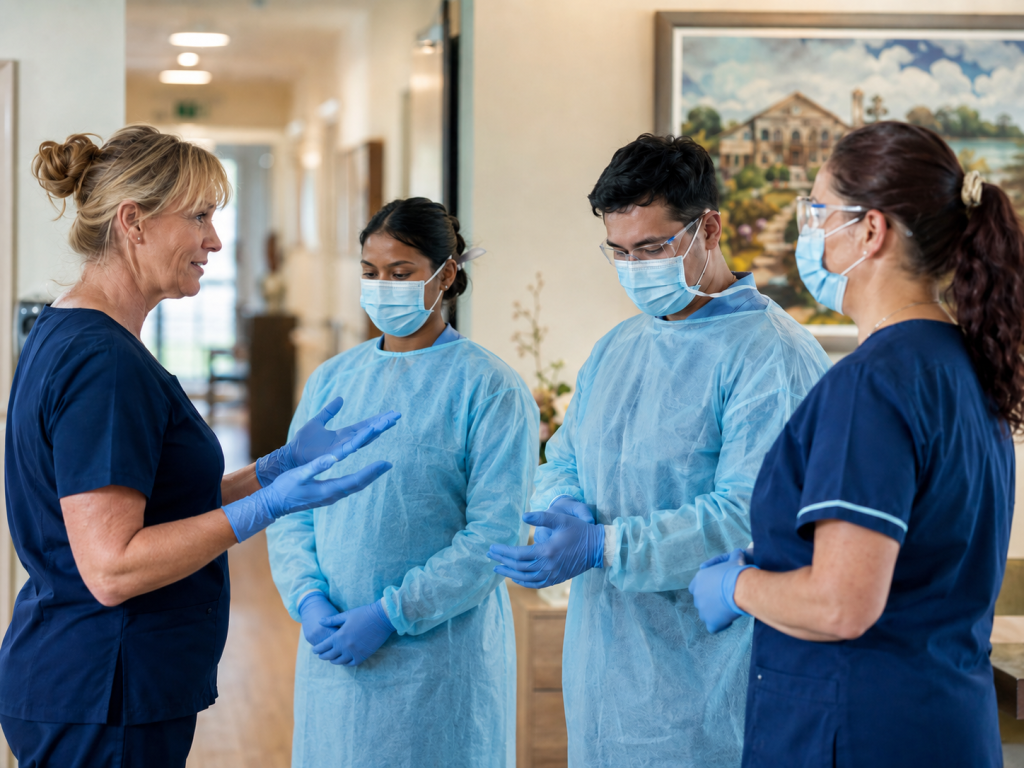
PPE training for aged care is a mandatory component of standard and transmission-based precautions. Personal protective equipment forms a physical barrier between the worker and infectious agents — but only when correctly selected, donned, used, and removed. Incorrect PPE use creates a false sense of security and can increase infection risk through self-contamination during doffing.
Doffing is the highest-risk moment in the PPE cycle. Human-factors research on PPE removal has shown that self-contamination is common even among trained, observed healthcare workers, and that structured doffing protocols reduce it (Mumma et al., Clinical Infectious Diseases, 2018). The most common contamination sites are the hands, wrists, and forearms — areas that subsequently contact residents, surfaces, and mucous membranes Under the work health and safety laws in your state or territory (in NSW, the Work Health and Safety Act 2011 and the Work Health and Safety Regulation), a person conducting a business or undertaking (PCBU) must provide workers with PPE where it is needed and give them information, training and instruction in its proper use, wearing, storage and maintenance. This is in addition to the IPC-specific requirements under the Strengthened Aged Care Quality Standards.
For the broader IPC education and training framework, see IPC Education and Training in Aged Care: A Complete Guide
What Types of PPE Are Used in Aged Care?
PPE training for aged care must cover the full range of personal protective equipment used in residential and home care settings. The ACSQHC Aged Care IPC Guide (2024) identifies the following PPE categories:
| PPE Type | Purpose | When Required |
|---|---|---|
| Gloves (non-sterile, single-use) | Protect hands from contact with blood, body fluids, non-intact skin, and mucous membranes | Standard precautions: when contact with blood/body fluids anticipated. Contact precautions: all direct resident contact |
| Gowns/aprons (single-use, fluid-resistant) | Protect skin and clothing from contamination with body fluids and microorganisms | When clothing contamination is anticipated (e.g., personal care, wound care). Contact precautions: all direct resident contact |
| Surgical masks | Protect mucous membranes of the nose and mouth from droplet exposure; reduce outward transmission from the wearer | Respiratory precautions. When splash or spray of body fluids anticipated. Source control for symptomatic workers |
| P2/N95 respirators | Filter airborne particles including aerosolised pathogens | Respiratory precautions needing a P2/N95 respirator (for example tuberculosis, measles, varicella). Aerosol-generating procedures. COVID-19 where current guidance or a risk assessment calls for a respirator. During specific respiratory outbreaks as directed by the public health unit |
| Eye protection (goggles or face shield) | Protect mucous membranes of the eyes from splash, spray, and droplet exposure | When splash or spray of blood or body fluids is anticipated. Combined with masks for respiratory precautions |
What Is the Correct Donning Sequence for PPE?
PPE training for aged care must include the correct donning (putting on) sequence. The sequence s designed to ensure all barriers are in place before entering the care area and to minimise the risk of contamination during application.
Standard donning sequence (ACSQHC Aged Care IPC Guide, 2024):
Step 1: Perform hand hygiene
Step 2: Don gown or apron — secure ties at back of neck and waist; ensure full coverage of torso from neck to knees
Step 3: Don mask or respirator — secure upper and lower ties or ear loops; mould nose clip to bridge of nose; for P2/N95, perform fit check (positive and negative pressure test)
Step 4: Don protective eyewear — goggles or face shield over mask
Step 5: Don gloves — extend glove cuffs over gown cuffs to ensure no exposed skin
Memory aid: “Gown, Mask, Eyes, Gloves” build the barrier from the inside out, gloves on last.
Need help implementing this in your facility? The IPS Hub gives your IPC Lead instant access to ready-made policies, procedures, and audit tools — updated monthly.
What Is the Correct Doffing Sequence for PPE?
Doffing (removing) PPE is a high-risk step in the PPE cycle because the outer surfaces of PPE are contaminated after use. PPE training for aged care should allocate a large share of practical time to doffing.
Example doffing sequence (adapt to your service’s policy and the PPE worn, and check against the Aged Care IPC Guide):
Step 1: Remove gloves — pinch outside of one glove near the wrist; peel off, turning inside out; hold in remaining gloved hand; slide ungloved finger under remaining glove at wrist; peel off over first glove; dispose in the correct waste stream per your waste policy (clinical waste where contaminated with blood or body fluids or as directed by state or territory guidance)
Step 2: Perform hand hygiene
Step 3: Remove gown — unfasten ties; pull gown away from body, turning inside out; fold contaminated surfaces inward; dispose in the correct waste stream per your waste policy (clinical waste where contaminated with blood or body fluids or as directed by state or territory guidance), or place in a linen bag if reusable
Step 4: Perform hand hygiene
Step 5: Remove protective eye wear — grasp by head band or earpieces (not front); lift away from face; dispose of as per your facility’s waste policy — into clinical waste if contaminated with blood or body fluids.
Step 6: Perform hand hygiene
Step 7: Remove mask/respirator — grasp ties or ear loops only (not front of mask); lift away from face; dispose in the correct waste stream per your waste policy (clinical waste where contaminated with blood or body fluids or as directed by state or territory guidance)
Step 8: Perform hand hygiene
Memory aid: “Gloves first, Gown, Eyes, Mask — hand hygiene in between” – most contaminated items removed first, with hand hygiene between each step.
What Is the Difference Between Fit Checking and Fit Testing for P2/N95 Respirators?
PPE training for aged care must clearly distinguish between fit checking and fit testing for P2/N95 particulate respirators. These are two different processes that serve different purposes.
| Fit Check (User Seal Check) | Fit Test | |
|---|---|---|
| Purpose | Confirms the respirator is correctly positioned and sealed on the wearer’s face each time the respirator is donned | Determines whether a specific respirator brand, model, and size provides an adequate seal on a specific individual’s face |
| Frequency | Every time the respirator is donned | At least every 12 months; when changing respirator brand or model; after significant weight change or facial surgery |
| Method | A user seal check following the manufacturer’s instructions for that respirator. For many models this includes a positive pressure check (gently exhale; the respirator should bulge slightly with no air leaking at the edges) and a negative pressure check (gently inhale; the respirator should draw in slightly with no air leaking at the edges). Not all models allow both checks, so always use the instructions for the model you wear. | Qualitative (using a bitter or sweet aerosol in a hood — e.g., Bitrex or saccharin) or quantitative (using a particle-counting instrument — PortaCount or equivalent) |
| Who performs it | The wearer — self-assessed each time | A trained fit test operator using validated equipment and protocol |
| Training requirement | All staff who may wear a P2/N95 must be trained in fit checking at orientation | The fit test operator must be trained in the specific fit testing method |
AS/NZS 1715:2009 and the newer AS/NZS ISO 16975 series set out how to select, use and maintain respiratory protective equipment, including fit testing. Fit testing is expected for workers who may need to wear a tight-fitting respirator such as a P2/N95, as part of the service’s respiratory protection program, and the Aged Care IPC Guide describes fit checking before each use.
Facial hair that lies between the respirator and the skin (for example a beard or stubble) prevents a reliable seal. Workers who may need to wear a P2/N95 respirator need to be clean-shaven where the respirator seals, or use a respirator or alternative approach suitable for their situation, and this must be discussed respectfully and sensitively, including where facial hair has religious or cultural significance.
How Should PPE Training Be Delivered?
PPE training for aged care must be predominantly practical — demonstration and return demonstration — because PPE donning and doffing are psychomotor skills that cannot be acquired through e-learning or lecture alone.
Recommended PPE Training Methods
Trainer demonstration — the trainer demonstrates the complete donning and doffing sequence, narrating each step and the rationale
Return demonstration — each participant performs the full sequence under observation; the trainer corrects errors in real time
Buddy system — paired workers observe and coach each other during real-time PPE use; one acts as a “PPE spotter” to identify doffing errors
Fluorescent marker contamination exercise — apply fluorescent powder to the outer surface of PPE before doffing; inspect under UV light to reveal self-contamination
Scenario-based selection — present clinical scenarios (e.g., “resident with confirmed influenza, you need to perform personal care”) and have staff select the correct PPE combination and demonstrate donning/doffing
Video recording and review — with staff consent, record donning/doffing for self-review and coaching feedback
Common PPE Errors to Address in Training
| Error | Risk | Training Correction |
|---|---|---|
| Touching the front of the mask during removal | Hand contamination from mask’s contaminated outer surface | Demonstrate grasp-by-ties/loops-only technique; practice repeatedly |
| Not performing hand hygiene between doffing steps | Cross-contamination between PPE items and to skin/clothing | Drill the sequence with verbal cues: ‘gloves — hand hygiene — gown — hand hygiene…’ |
| Reusing single-use gloves between residents | Direct cross-transmission of pathogens between residents | Emphasise single-use, single-resident policy; training on when to change gloves |
| Glove cuffs not overlapping gown cuffs | Exposed skin at wrist susceptible to contamination | Demonstrate correct overlap; check during practical assessment |
| Not fit checking P2/N95 each time | Inadequate seal — airborne pathogens bypass the respirator | Demonstrate positive and negative pressure checks; include in competency checklist |
| Wearing PPE in communal areas (e.g., walking through corridors with gloves on) | Environmental contamination of communal surfaces | Training on ‘don at point of care, doff at point of care’ principle |
How Is PPE Competency Assessed?
PPE competency assessment in aged care must include practical observation — a written quiz alone does not demonstrate the ability to don and doff PPE correctly. The following competency checklist format can be used for assessment.
| Competency Element | Demonstrated Correctly (Yes/No) | Comments |
|---|---|---|
| Performs hand hygiene before donning | ||
| Selects correct PPE for the clinical scenario | ||
| Dons gown/apron correctly (full coverage, secure ties) | ||
| Dons mask correctly (nose clip, secure fit) | ||
| Performs fit check for P2/N95 respirator (if applicable) | ||
| Dons eye protection correctly | ||
| Dons gloves with cuffs overlapping gown cuffs | ||
| Removes gloves correctly (inside-out technique) | ||
| Performs hand hygiene after glove removal | ||
| Removes gown correctly (inside-out, contaminated surfaces inward) | ||
| Performs hand hygiene after gown removal | ||
| Removes eye protection by head band or arms only (not the front) and handles it correctly (clean and disinfect if reusable, dispose if single-use) | ||
| Performs hand hygiene after eye protection removal | ||
| Removes mask by ties/loops only (no touching front) | ||
| Performs final hand hygiene after all PPE removed | ||
| Disposes of PPE in correct waste stream |
Staff who do not achieve 100 percent correct technique on the competency checklist should receive immediate corrective training and be reassessed before performing resident-facing duties that require PPE.
What Are the PPE Considerations for Home and Community Care?
PPE training for aged care workers in home and community care settings must address practical challenges not present in facility-based care.
PPE supply — home care workers must carry a portable PPE kit containing gloves (multiple sizes), gowns/aprons, surgical masks, eye protection, P2/N95 respirators (fit-tested), ABHR, and clinical waste bags.
Storage in vehicles — PPE must be stored in a clean, dry container in the vehicle; avoid exposure to direct sunlight and extreme temperatures
Donning location — don PPE at or immediately outside the client’s front door; do not don in the car or walk through the home with PPE partially applied
Doffing and disposal: doff at the point of care. Dispose of used PPE according to your organisation’s waste policy and state or territory requirements. PPE contaminated with blood or body fluids is clinical waste and needs a suitable leak-proof container; other used PPE is usually double-bagged and placed in the general waste at the client’s home. Avoid carrying contaminated waste in the vehicle where you can.
Communication — explain PPE to the client and family members; normalise its use to reduce anxiety, particularly for clients with dementia or cognitive impairment
Lone worker considerations — home care workers cannot rely on a “PPE buddy”; training must build self-directed doffing confidence and self-checking habits
TiNA — Training Needs Analysis Tool: Identify IPC training gaps across your workforce with TiNA — our Training Needs Analysis tool designed specifically for aged care facilities. Currently in pilot.
Frequently Asked Questions
Do aged care workers need fit testing for P2/N95 respirators?
Yes, workers who may need to wear a P2/N95 respirator should be fit tested using a validated method (qualitative or quantitative) as part of the service’s respiratory protection program. AS/NZS 1715:2009 and AS/NZS ISO 16975.3:2023 recommend fit testing before first use and at least every 12 months, and when changing respirator brand, model or size, or after changes that may affect fit (for example significant weight change, dental work or facial surgery). Fit testing identifies the right brand, model and size for each person.
Can PPE training be delivered online?
Theory components (PPE types, indications, and selection criteria) can be delivered online. However, practical donning and doffing skills must be taught and assessed through face-to-face demonstration and return demonstration. The ACSQHC Aged Care IPC Guide (2024) emphasises competency-based assessment that requires observed practice.
How often should PPE training be refreshed?
PPE training should be delivered at orientation for all new staff and refreshed at least annually. Additional training should be provided when new PPE products are introduced, during outbreaks requiring enhanced PPE, when audit or observation reveals competency gaps, and when a Training Needs Analysis identifies PPE as a priority area.
What is the most common PPE doffing error?
Common doffing errors include touching the front (contaminated outer surface) of the mask, skipping hand hygiene, and removing items in the wrong order. Touching the front of the mask transfers pathogens to the worker’s hands and then to other surfaces, other PPE items or the worker’s face. Training should emphasise the “grasp by ties or ear loops only” technique and include repeated practice.
Should visitors be trained in PPE use?
Visitors entering areas where transmission-based precautions are in place should receive brief instruction on the required PPE, basic donning, and safe doffing. This is typically provided by the nurse in charge at the point of care. Full PPE competency assessment is not expected for visitors, but supervision during donning and doffing should be provided.
References and Further Reading
The following authoritative sources inform the clinical and regulatory guidance in this article. Links open in a new tab.
- Aged Care Quality and Safety Commission. Strengthened Aged Care Quality Standards 2025 — Standard 7: Workforce. Canberra: ACQSC; 2025.
- Australian Commission on Safety and Quality in Health Care. Infection Prevention and Control Guide for Residential Aged Care Facilities, Version 1.1. Sydney: ACSQHC; January 2025.
- Australasian College for Infection Prevention and Control. IPC Professional Competency Standards and Education Resources. Melbourne: ACIPC; 2024.
- World Health Organization. Core components of infection prevention and control programmes at the national and acute health care facility level. Geneva: WHO; 2016.
- Department of Health and Aged Care. Aged care workforce education and training — IPC requirements. Canberra: Commonwealth of Australia; 2025.
In This Article
- Why Is PPE Training Essential in Aged Care?
- What Types of PPE Are Used in Aged Care?
- What Is the Correct Donning Sequence for PPE?
- What Is the Correct Doffing Sequence for PPE?
- What Is the Difference Between Fit Checking and Fit Testing for P2/N95 Respirators?
- How Should PPE Training Be Delivered?
- How Is PPE Competency Assessed?
- What Are the PPE Considerations for Home and Community Care?
- Frequently Asked Questions
About the Author
Lyndon Forrest is the Managing Director of Bug Control — Infection Prevention Services, with over 30 years’ experience supporting aged care facilities across Australia and New Zealand with infection prevention, antimicrobial stewardship, and accreditation readiness.
Clinically reviewed by Bridgette Mackie & Dianne Newey, Clinical Directors.
TiNA — Training Needs Analysis Tool
Identify IPC training gaps across your workforce with TiNA — our Training Needs Analysis tool designed specifically for aged care facilities. Currently in pilot.
Ready to Strengthen Your Facility’s Infection Prevention?
The IPS Hub provides aged care facilities across Australia and New Zealand with continuously updated IPC policies, AMS tools, outbreak management resources, and direct support from experienced IPC professionals.