Home › Knowledge Hub › Risk Management › IPC Risk Management in Home and Community Aged Care
Risk Management
By Lyndon Forrest, Managing Director · Clinically reviewed by Bridgette Mackie & Dianne Newey, Clinical Directors · September 2026 · Updated November 2026 · 11 min read
IPC Risk Management in Home and Community Aged Care
TL;DR —
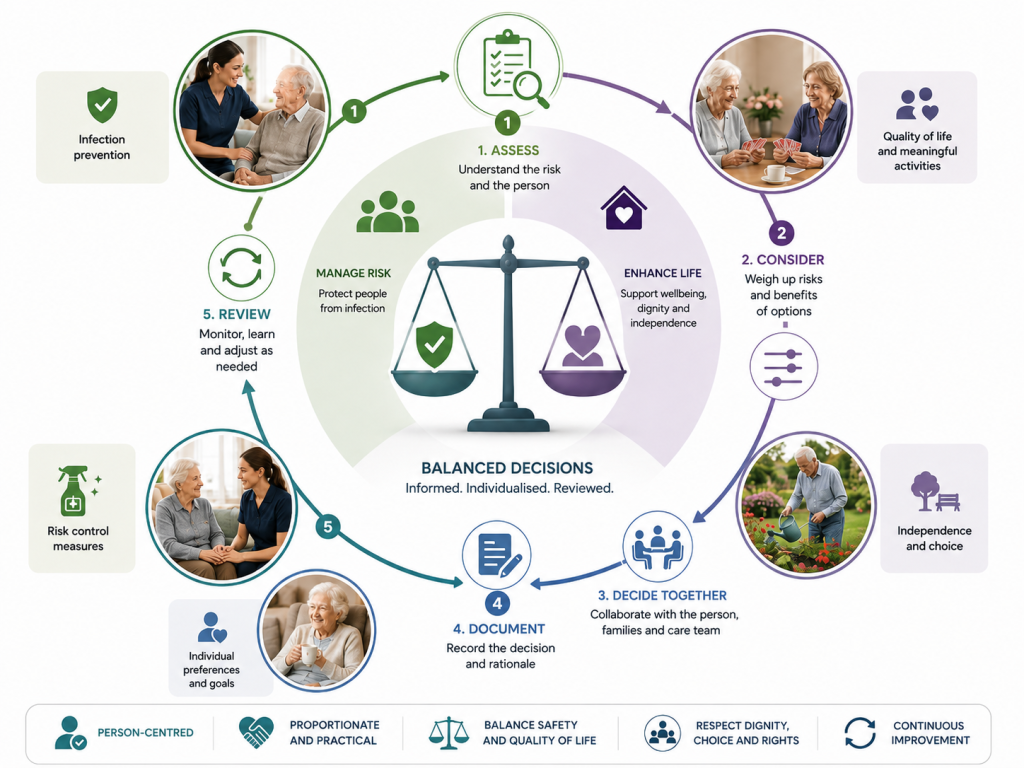
IPC risk management in home and community aged care presents distinct challenges because the provider does not control the physical environment. Workers enter private homes where conditions vary widely — from well-maintained houses to properties with hoarding, pest infestations, or inadequate sanitation. The Support at Home program, which started on 1 November 2025, has expanded home-based services, making IPC risk management frameworks for community settings increasingly important. The same 4-step risk management process applies, but implementation must be adapted to include portable equipment, point-of-care risk assessment tools, lone worker safety protocols, and client-centred communication strategies.
What Makes IPC Risk Management Different in Home and Community Care?
IPC risk management in home and community aged care is fundamentally different from that in residential care because the provider does not own, maintain, or control the physical environment where care is delivered. In residential aged care, the provider controls cleaning schedules, ventilation, hand hygiene infrastructure, waste management, and equipment maintenance. In home care, all of these factors are determined by the client’s domestic circumstances.
The Strengthened Aged Care Quality Standards (effective 1 November 2025) apply to registered providers delivering funded aged care, including home care providers. Which Standards a provider is assessed against depends on its registration category (for example, providers delivering care at home are assessed against Standards 1 to 4, and those delivering clinical care against Standards 1 to 5), so confirm your category with the Aged Care Quality and Safety Commission. Standard 4 (The Environment), Outcome 4.2 requires an appropriate IPC system, led by an appropriately qualified and trained IPC Lead, wherever funded services are delivered (Action 4.2.1). Providers delivering clinical care at home are also assessed against Standard 5 (Clinical Care), including Outcome 5.2 (preventing and controlling infections in clinical care, with Action 5.2.1 antimicrobial stewardship and Action 5.2.2 minimising and managing infection). This obligation is not limited to residential settings. Home care providers must demonstrate that their IPC programs address the specific risks of community-based care delivery.
| Factor | Residential Aged Care | Home and Community Care |
|---|---|---|
| Environmental control | Provider controls the entire physical environment | Provider has no control over the client’s home environment |
| Hand hygiene infrastructure | Fixed ABHR dispensers at point of care; sinks with soap available | Worker must carry ABHR; may not have access to running water or clean towels |
| Cleaning and disinfection | Provider manages cleaning schedules, products, and standards | Client or family manages household cleaning; standards vary widely |
| Equipment | Facility-owned, maintained, and reprocessed centrally | Portable equipment transported between homes; reprocessing logistics challenging |
| Waste management | Clinical waste managed through contracted services | Clinical waste must be contained, transported, and disposed of by the worker or provider |
| Supervision | On-site managers, clinical staff, and IPC leads available | Workers operate independently; often as sole practitioners in the field |
| Environmental hazards | Predictable and manageable through facility standards | Unpredictable — hoarding, pets, pests, mould, poor sanitation, structural damage |
How Does the Support at Home Programme Affect IPC Risk Management?
The Support at Home program, starting 1 November 2025, replaced the Home Care Packages Program and the Short-Term Restorative Care program. Support at Home has expanded the range and intensity of services delivered in private homes, including clinical care, allied health and personal care services.
As more complex care is delivered at home, IPC risk management becomes more critical. Services that were previously provided only in residential or hospital settings — such as wound care, catheter management, and intravenous therapy — are increasingly delivered in private homes, where the infection control infrastructure is minimal.
Home care providers operating under the Support at Home program must ensure their IPC governance frameworks address the unique risks of domiciliary care. This includes documented risk assessment processes for home environments, provisions for portable IPC equipment worker training on community-specific IPC challenges, and systems for escalating environmental concerns that cannot be resolved in the field.
How Do You Conduct an IPC Risk Assessment in a Private Home?
IPC risk assessments in private homes follow the same 4-step process as residential care (identify hazard, assess risk, control risk, review controls). Still the assessment must be adapted for the domestic environment. A structured pre-visit and on-arrival assessment process ensures that risks are identified before care begins.
Need help implementing this in your facility? The IPS Hub gives your IPC Lead instant access to ready-made policies, procedures, and audit tools — updated monthly.
Pre-Visit Assessment
Before the first home visit, gather information about the client’s home environment and clinical status. This information may come from referral documentation, intake assessments, hospital discharge summaries, or directly from the client and family.
Client’s infection status — known colonisation with MDROs, current infections, vaccination status
Home environment — property type, accessibility, known hazards (pets, pest infestations, hoarding, structural damage)
Services to be provided — level of invasive care required (wound care, catheter management, injections)
Available facilities — running water, clean preparation surfaces, adequate lighting, waste disposal options
Other household members — anyone with known infections or immunocompromised status
On-Arrival Assessment
Workers should conduct a brief environmental IPC assessment on arrival at each visit. This should become routine — a mental checklist completed within the first minute of entry. Conditions in a home can change between visits.
General cleanliness and hygiene — is the home environment clean enough to provide care safely?
Access to running water and a clean surface for hand hygiene and equipment preparation
Presence of hazards — animal waste, pest activity, mould, sharps or biohazards, hoarding blocking access
Client’s current health status — any new symptoms suggesting infection (cough, fever, diarrhoea, vomiting)
Ventilation — can windows be opened? Is the space adequately ventilated for the care being provided?
If the on-arrival assessment identifies conditions that make safe care delivery impossible, the worker must have the authority and a clear protocol to pause or defer care, contact their supervisor and escalate the concern. The provider’s protocol must also protect the client. The supervisor should decide what care can still be delivered safely (for example a modified or shortened visit), check that urgent needs such as medication, wound care or hydration are met another way, and inform the client, their representative and, where needed, the GP. Workers should never be required to provide care in conditions that put their own health at unacceptable risk, and any deferral should be documented and followed up.
How Should Workers Manage IPC Equipment in the Field?
Managing IPC equipment in community settings requires planning, portability, and discipline. Workers cannot rely on facility-based infrastructure and must carry everything they need to deliver safe care.
What Should a Community IPC Kit Contain?
| Item | Purpose | Quantity/Notes |
|---|---|---|
| Alcohol-based hand rub (ABHR) | Hand hygiene when soap and water are unavailable (use soap and water if hands are visibly soiled) | Enough for all planned visits plus a reserve (set by your service’s risk assessment); refillable containers |
| Disposable gloves (multiple sizes) | Standard and contact precautions | Sufficient for all planned client contacts |
| Disposable aprons or gowns | Protection during personal care, wound care | One per client interaction where body fluid exposure is anticipated |
| Surgical masks | Respiratory precautions and protection during respiratory illness (a P2/N95 respirator where indicated by risk assessment) | Enough for all planned visits plus a reserve (set by your service’s risk assessment) |
| Eye protection | Splash or spray risk during wound care or procedures | Reusable safety glasses or disposable face shields |
| Clinical waste bags | Containment of contaminated waste | Yellow clinical waste bags; sealable |
| Sharps container (portable) | Safe disposal of sharps at point of use | Puncture-resistant, leak-proof, labelled |
| Disinfectant wipes | Equipment cleaning between clients | Hospital-grade; compatible with equipment surfaces |
| Spill kit | Management of blood or body fluid spills | Compact; includes absorbent granules, disinfectant, gloves, waste bag |
| Plastic bags for soiled linen | Containment during transport | Water-resistant; sealable |
Workers should check their IPC kit at the start of each shift and replenish supplies as needed. Providers must maintain systems for kit replenishment, equipment maintenance, and waste collection from workers in the field.
How Do You Protect Worker Safety in Home and Community Care?
Worker safety in home and community aged care is governed by the Work Health and Safety Act 2011. The provider (as PCBU) has a duty to ensure, so far as is reasonably practicable, the health and safety of workers — including those providing care in private homes. This duty extends to infection-related risks.
Community aged care workers face unique occupational infection risks. They work alone, have limited access to hand hygiene facilities, enter environments with unpredictable hazards, and may encounter clients with undiagnosed infections. Risk management systems must address these specific vulnerabilities.
Vaccination — ensure all workers are up to date with the vaccinations recommended in the Australian Immunisation Handbook for workers in their role, including influenza and COVID-19, and hepatitis B for workers who may have blood or body fluid exposure
Training — IPC training must address community-specific risks, including conducting environmental assessments, managing IPC in uncontrolled environments, and escalating concerns
PPE provision — provide adequate PPE for field use and ensure workers know how to use, store, and dispose of PPE correctly in community settings
Lone worker protocols — systems for checking on workers during home visits, emergency contact procedures, and policies for unsafe environments
Post-exposure management — clear procedures for managing needlestick injuries, blood or body fluid exposures, and occupational infection exposures when the worker is in the field
Right to refuse unsafe work — workers must understand their right under the Work Health and Safety Act 2011 to cease work that poses an immediate risk to their health and safety
What Are the Common IPC Challenges in Home and Community Aged Care?
| Challenge | Impact on IPC | Practical Strategy |
|---|---|---|
| No running water available | Hand hygiene with soap and water is impossible | Use ABHR; educate client on installing temporary hand washing station; escalate if ongoing |
| Hoarding or excessive clutter | Surfaces cannot be cleaned; access for care is restricted; pest harbourage | Conduct environmental risk assessment; engage social services; work with client to create a clean care zone |
| Pets in the home | Animal waste, dander, and fleas; biting or scratching risk during care | Request pets be secured during visits; wear appropriate PPE; avoid providing care on pet-contaminated surfaces |
| Pest infestations | Cockroaches, rodents, and other pests carry pathogens and contaminate surfaces | Report to provider; engage pest control services; wear additional PPE as needed; escalate if infestation prevents safe care |
| Client or family resistance to IPC measures | Client refuses hand hygiene, PPE use, or environmental modifications | Use person-centred communication; explain the ‘why’ behind each measure; document refusals; consult with IPC lead |
| Lack of clean preparation surfaces | Equipment contamination during wound care or clinical procedures | Carry a portable clean field (disposable drape); create a clean zone before starting clinical activities |
| Shared household with children or immunocompromised members | Cross-infection risk from worker to household members or vice versa | Include household members in risk assessment; adapt precautions to protect vulnerable household members |
How Should Equipment Be Managed Between Home Visits?
Equipment management is a significant IPC challenge in community care. Reusable equipment that travels between clients’ homes can become a vehicle for pathogen transmission if not properly cleaned and disinfected between uses.
Single-use equipment is preferred wherever clinically appropriate and cost-effective — thereby eliminating the risk of reprocessing (Hierarchy of Controls Level 2: Substitution)
Reusable equipment must be cleaned and disinfected between clients — carry hospital-grade disinfectant wipes and allow adequate contact time
Dedicated equipment for MDRO-colonised or infected clients — where possible, leave equipment in the client’s home or use single-use alternatives
Transport of equipment — clean and dirty equipment must be separated during transport; use designated compartments or bags
Vehicle hygiene — the worker’s vehicle is part of the care delivery chain; frequently touched surfaces (steering wheel, door handles, equipment storage areas) should be cleaned regularly
How Should IPC Be Documented in Home and Community Care?
Documentation of IPC risk management in home care serves the same purposes as in residential care: evidence of compliance, support for clinical decisions, and continuity of care. However, documentation systems must be adapted for mobile workers who may not have access to facility-based computer systems.
Initial home environment risk assessment — documented before or during the first visit; updated when conditions change
Client-specific IPC care plan — documenting the IPC controls applicable to each client’s care and home environment
Incident and near-miss reports — accessible reporting systems for workers in the field (mobile apps, phone-based reporting)
Equipment cleaning logs — records of reusable equipment cleaning between clients
Escalation records — documentation of environmental concerns escalated to supervisors, including the response and outcome
Mobile digital platforms are increasingly used for home care IPC documentation. These platforms allow workers to complete risk assessments, update care plans, and report incidents in real time using smartphones or tablets. Providers should invest in user-friendly digital tools that support — rather than burden — frontline workers.
How Does the Hierarchy of Controls Apply in Home and Community Care?
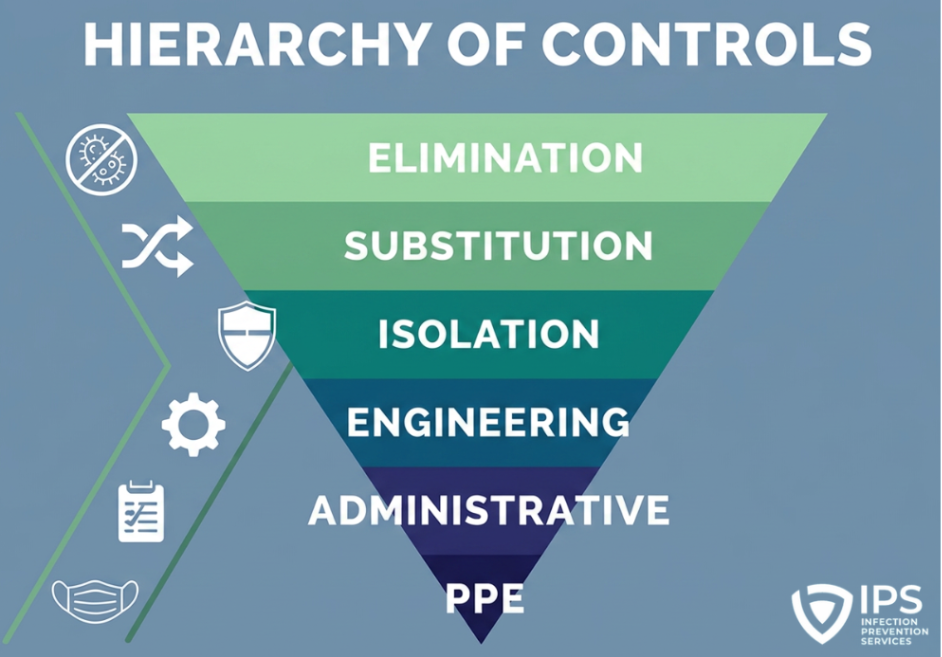
The hierarchy of controls applies to home and community care, but its implementation differs from that in residential settings. Higher-level controls (elimination, substitution, engineering) are more difficult to implement because the provider does not control the environment. Administrative controls and PPE therefore carry a disproportionate burden in community settings — making worker training and competency even more critical.
| Hierarchy Level | Residential Example | Home/Community Adaptation |
|---|---|---|
| Elimination | Remove unnecessary catheters facility-wide | Advocate for catheter removal through the client’s GP; cannot mandate |
| Substitution | Switch to single-dose vials across the facility | Carry single-dose vials in field kit; may require additional stock management |
| Isolation | Single room placement for infected residents | Cannot isolate a client in their own home; focus on creating a clean care zone within the home |
| Engineering | Install ABHR dispensers at point of care | Carry portable ABHR; cannot modify the client’s home fixtures |
| Administrative | Facility-wide policies, training, surveillance | Worker-centred policies; field-specific training; mobile documentation systems |
| PPE | PPE available at point of care from facility stores | Worker carries PPE in field kit; must plan for adequate quantities per shift |
This article is part of the IPC Risk Management in Aged Care topic cluster. For the comprehensive pillar guide, see IPC Risk Management in Aged Care (/knowledge-hub/ipc-risk-management-aged-care/).
Related articles:
How to Conduct an IPC Risk Assessment in Aged Care
The Hierarchy of Controls for Infection Prevention in Aged Care
Risk Acceptance in Aged Care IPC
See also: Outbreak Management in Aged Care | Antimicrobial Stewardship in Aged Care
IPC Scenario Risk Assessment Tool: Apply these risk management principles with our interactive IPC Scenario Risk Assessment Tool — designed specifically for aged care facilities to identify, assess, and control infection risks.
Frequently Asked Questions
Do the Strengthened Quality Standards apply to home care providers?
Yes. The Strengthened Aged Care Quality Standards (effective 1 November 2025) apply to registered providers delivering funded aged care, including home care providers. Which Standards a provider is assessed against depends on its registration category (for example, providers delivering care at home are assessed against Standards 1 to 4, and those delivering clinical care against Standards 1 to 5), so confirm your category with the Aged Care Quality and Safety Commission. Standard 4, Outcome 4.2 (Action 4.2.1) requires an IPC system wherever funded services are delivered, and Standard 5, Outcome 5.2 (Actions 5.2.1 and 5.2.2) applies to providers delivering clinical care. This is the case regardless of the care setting.
Can a worker refuse to enter a home that is unsafe for care delivery?
Yes. Under the Work Health and Safety Act 2011, workers have the right to cease or refuse work that poses an immediate risk to their health and safety. Providers must have clear escalation protocols for workers who identify unsafe home environments. The provider must also protect the client: a supervisor should decide what care can still be delivered safely, check that urgent needs such as medication, wound care or hydration are met another way, and inform the client, their representative and, where needed, the GP. The refusal must be documented and followed up by the provider.
How should clinical waste be managed in home care?
Clinical waste generated during home visits (used sharps, contaminated dressings, soiled PPE) must be contained in appropriate receptacles (sharps containers, clinical waste bags), transported safely in the worker’s vehicle, and disposed of through the provider’s clinical waste management system. Clinical waste must never be placed in the client’s household bin.
What IPC training is required for home care workers?
Home care workers require the same foundational IPC training as residential care workers — hand hygiene, standard precautions, PPE use, and infection recognition. Additionally, home care workers need training in conducting environmental risk assessments in private homes, managing IPC equipment in the field, lone worker safety protocols, and escalation procedures for unsafe environments.
How does the Support at Home programme affect IPC requirements?
The Support at Home program, which started on 1 November 2025, has expanded the range of services delivered in private homes. As more complex clinical services are provided at home, IPC risk management becomes more important. Providers must ensure that their IPC governance frameworks address the specific risks of delivering clinical care in domestic environments.
References and Further Reading
The following authoritative sources inform the clinical and regulatory guidance in this article. Links open in a new tab.
- Aged Care Quality and Safety Commission. Strengthened Aged Care Quality Standards 2025 — Standard 5, Outcome 5.2: IPC Risk Management. Canberra: ACQSC; 2025.
- Australian Commission on Safety and Quality in Health Care. Infection Prevention and Control Guide for Residential Aged Care Facilities, Version 1.1. Sydney: ACSQHC; January 2025.
- Standards Australia. AS ISO 31000:2018 Risk Management — Guidelines. Sydney: Standards Australia; 2018.
- Australian Institute of Health and Welfare. Aged care safety and quality reporting — infection data. Canberra: AIHW; 2024.
- World Health Organization. Risk assessment for infection prevention and control. Geneva: WHO; 2023.
In This Article
- What Makes IPC Risk Management Different in Home and Community Care?
- How Does the Support at Home Programme Affect IPC Risk Management?
- How Do You Conduct an IPC Risk Assessment in a Private Home?
- How Should Workers Manage IPC Equipment in the Field?
- How Do You Protect Worker Safety in Home and Community Care?
- What Are the Common IPC Challenges in Home and Community Aged Care?
- How Should Equipment Be Managed Between Home Visits?
- How Should IPC Be Documented in Home and Community Care?
- How Does the Hierarchy of Controls Apply in Home and Community Care?
- Frequently Asked Questions
About the Author
Lyndon Forrest is the Managing Director of Bug Control — Infection Prevention Services, with over 30 years’ experience supporting aged care facilities across Australia and New Zealand with infection prevention, antimicrobial stewardship, and accreditation readiness.
Clinically reviewed by Bridgette Mackie & Dianne Newey, Clinical Directors.
IPC Scenario Risk Assessment Tool
Apply these risk management principles with our interactive IPC Scenario Risk Assessment Tool — designed specifically for aged care facilities to identify, assess, and control infection risks.
Ready to Strengthen Your Facility’s Infection Prevention?
The IPS Hub provides aged care facilities across Australia and New Zealand with continuously updated IPC policies, AMS tools, outbreak management resources, and direct support from experienced IPC professionals.