Home › Knowledge Hub › Environmental Cleaning › Terminal Cleaning in Aged Care: When and How to Do It Right
Environmental Cleaning
By Lyndon Forrest, Managing Director · Clinically reviewed by Bridgette Mackie & Dianne Newey, Clinical Directors · September 2026 · 10 min read
Terminal Cleaning in Aged Care: When and How to Do It Right
TL;DR —
Terminal cleaning in aged care is the thorough cleaning and disinfection of an entire room — including all surfaces, equipment, furnishings, and fittings — after a resident vacates. Terminal cleaning is required after a resident’s transfer, discharge, or death; after outbreak resolution in a specific area; and before a new resident occupies a room. The process uses the two-step method: clean with neutral detergent, then apply hospital-grade disinfectant. Terminal cleaning covers surfaces not reached during routine cleaning (mattress undersides, bed frames, behind furniture, inside drawers, curtain tracks). Under the Strengthened Aged Care Quality Standards (effective 1 November 2025), Outcome 4.2, terminal cleaning forms part of the environmental cleaning and infection prevention systems a provider must maintain.
What Is Terminal Cleaning?
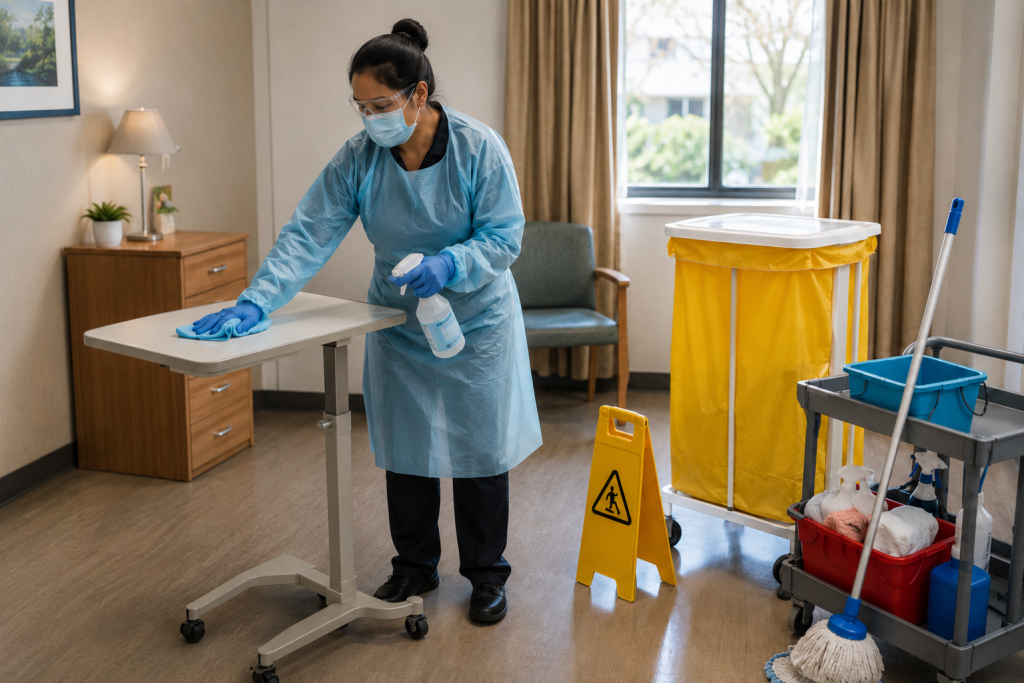
Terminal cleaning in aged care is a thorough, systematic process of cleaning and disinfecting an entire room or defined area to a standard that is safe for the next occupant. The term “terminal” refers to the finality of the cleaning — it is the last and most thorough cleaning event before the space is reoccupied or repurposed. The 2026 edition of the Aged Care Infection Prevention and Control Guide (ACSQHC) calls this “high-level cleaning”.
Terminal cleaning differs from routine daily cleaning in three key ways: scope (every surface in the room is cleaned, including those not reached during routine cleaning), method (the two-step process of cleaning then disinfection is always used), and documentation (a terminal cleaning checklist is completed to confirm every element has been addressed).
The ACSQHC Aged Care IPC Guide (2024), Chapter 6 identifies terminal cleaning as a core component of environmental cleaning in aged care. The Guide specifies that terminal cleaning must follow a defined procedure and be documented.
When Is Terminal Cleaning Required?
Terminal cleaning in aged care is required in specific, defined circumstances. Facilities should have a clear policy that specifies the triggers for terminal cleaning, ensuring the process is initiated promptly and consistently.
| Trigger | Description | Priority |
|---|---|---|
| Resident transfer to hospital or another facility | The room must be terminally cleaned before a new resident is admitted | Complete before new admission |
| Resident death | Terminal cleaning of the room and all shared equipment used by the deceased resident | Complete before new admission; respect cultural and family sensitivities regarding timing |
| Resident room change within the facility | Both the vacated room and any shared equipment that moves with the resident should be cleaned | Complete before new occupant moves in |
| Outbreak resolution | Terminal cleaning of all rooms and areas involved in the outbreak after the outbreak is declared over | Complete before returning to standard cleaning protocols |
| Known infection with epidemiologically significant organism | Terminal cleaning of the room after the resident is no longer infectious or after precautions are lifted | Coordinate with IPC lead |
| Extended resident absence (e.g., hospital stay > 48 hours) | Consider terminal cleaning if the room has been unoccupied and may need refreshing before re-occupancy | Based on facility policy |
What Is the Step-by-Step Terminal Cleaning Process?
The terminal cleaning process follows a systematic, top-to-bottom, clean-to-dirty approach. Every surface, item, and fitting in the room is cleaned and disinfected. The following step-by-step process is based on the ACSQHC Aged Care IPC Guide (2024) and best practice guidelines.
Do you need help implementing this in your facility? The IPS Hub gives your IPC Lead instant access to ready-made policies, procedures, and audit tools, all of which are updated monthly.
Need help implementing this in your facility? The IPS Hub gives your IPC Lead instant access to ready-made policies, procedures, and audit tools — updated monthly.
Preparation
- Remove all personal belongings, linen, waste, and disposable items from the room
- Strip the bed completely — remove all linen, mattress protectors, and pillow protectors
- Bag soiled linen according to facility linen handling procedures (standard or infectious linen bags as appropriate)
- Dispose of all waste in appropriate waste streams (general or clinical)
- Remove curtains (privacy, bed, window, and shower). Change curtains as standard where the previous occupant had a known infection or was under transmission-based precautions, and whenever curtains are visibly soiled or due for scheduled replacement.
- Gather cleaning equipment and products: neutral detergent, hospital-grade disinfectant, clean cloths, mop, bucket, PPE
PPE Requirements
Minimum PPE: disposable gloves and a disposable plastic apron
If the room housed a resident with a known infection: add appropriate PPE per transmission-based precautions used (e.g., surgical mask for respiratory precautions)
Eye protection: required if using spray-application disinfectants or sodium hypochlorite
Change gloves and perform hand hygiene between the cleaning step and the disinfection step
Apply disinfectants by wiping rather than spraying wherever possible. Spraying aerosolises both the product and any surface contamination; if spray application is unavoidable, eye protection and a mask are required.
Cleaning Sequence (Step 1: Clean)
- Start at the highest point in the room (light fittings, air conditioning vents, curtain and blind tracks) and work downwards
- Clean walls to reachable height — spot-clean marks and splashes
- Clean all furniture surfaces: wardrobes (inside and outside), bedside lockers (including drawers), over-bed table, chairs, shelving
- Clean the bed frame — all surfaces including undersides, castors, and bed controls
- Clean the mattress — all six surfaces (top, bottom, four sides); inspect for damage to the mattress cover
- Clean bathroom/ensuite — toilet (including base and behind), basin, taps, mirror, shower recess, grab rails, soap dispensers, toilet roll holder
- Clean all fixtures: door handles (both sides), light switches, call bell, power points, windowsills and handles
- Clean the floor — including under the bed, behind furniture, and in corners; mop from the furthest point towards the door
Disinfection Sequence (Step 2: Disinfect)
- Using fresh cloths and a hospital-grade disinfectant, repeat the sequence above — apply disinfectant to all surfaces
- Ensure the disinfectant is left wet on surfaces for the full contact time specified by the manufacturer
- Pay particular attention to high-touch surfaces: bedrails, call bells, door handles, taps, toilet flush buttons
- Allow surfaces to air dry (unless manufacturer instructs otherwise)
Final Steps
- Remove PPE, dispose of all single-use items, and perform hand hygiene. The cleaning and disinfection phase is now complete.
- With clean hands (and fresh gloves if preferred), re-make the bed with fresh, clean linen and new mattress/pillow protectors.
- Hang fresh curtains (if removed).
- Restock supplies: hand hygiene products, tissues, waste bags.
- Complete the terminal cleaning checklist — sign, date, and time each completed item.
- Notify the nursing/care team that the room is ready for re-occupancy.
- Perform hand hygiene.
What Should a Terminal Cleaning Checklist Include?
A terminal cleaning checklist provides a structured record confirming that every element of the terminal cleaning process has been completed. Checklists improve consistency, reduce omissions, and provide documentary evidence for regulatory assessments
| Checklist Item | Cleaned | Disinfected | Initials / Time |
|---|---|---|---|
| Ceiling and light fittings | |||
| Air conditioning vents | |||
| Walls (to reachable height) | |||
| Curtain tracks and curtains- (privacy, bed, window, shower) | |||
| Windows and sills (internal) | |||
| Wardrobe (inside and outside) | |||
| Bedside locker(including drawers), overbed table | |||
| Bed frame (all surfaces, castors, controls) | |||
| Mattress (all 6 surfaces; integrity check) | |||
| Mattress protector | |||
| Chair(s) | |||
| Door handle(s) — both sides | |||
| Light switches | |||
| Call bell | |||
| Power points | |||
| Toilet (including base and behind) | |||
| Basin and taps | |||
| Mirror | |||
| Shower recess (including screen/curtain) | |||
| Grab rails and handrails | |||
| Soap and hand rub dispensers | |||
| Floor (entire room including under furniture) | |||
| Linen removed and replaced | N/A | ||
| Waste disposed | N/A | ||
| Supplies restocked | N/A |
How Does Terminal Cleaning Differ from Routine Cleaning?
| Parameter | Routine Cleaning | Terminal Cleaning |
|---|---|---|
| Scope | Accessible surfaces; high-touch surfaces prioritised | Every surface in the room — including behind, under, and inside furniture |
| Method | Neutral detergent (standard conditions); two-step if enhanced cleaning required | Two-step process always: clean then disinfect |
| Frequency | Daily or as per schedule | Event-triggered: vacancy, death, outbreak resolution |
| Documentation | Cleaning log with initials/time | Terminal cleaning checklist — itemised sign-off |
| PPE | Gloves and apron as standard | Gloves, apron, and additional PPE based on infection status of previous occupant |
| Mattress | Surface clean only | All 6 surfaces cleaned and disinfected; integrity inspection |
| Curtains | Not routinely changed | Changed as standard after an infectious occupant; otherwise inspected and replaced if soiled or due for scheduled change |
| Time required | 15–30 minutes per room (routine clean) | 60–90 minutes per room (comprehensive terminal clean) |
How Should Mattresses and Soft Furnishings Be Cleaned?
Mattresses and soft furnishings require special attention during terminal cleaning because they can harbour microorganisms within fibres and seams. The mattress is the largest item in the room and is in prolonged contact with the resident — making mattress hygiene a priority.
Mattress Cleaning
Remove all mattress protectors and covers — launder or dispose of as appropriate
Inspect the mattress cover (if it is a sealed, wipeable cover) for tears, cracks, stains, or damage to the waterproof membrane
If the mattress cover is damaged, the mattress must be condemned and replaced — damaged covers allow body fluids to penetrate the mattress interior, which cannot be adequately cleaned or disinfected
Clean all 6 surfaces of the mattress with neutral detergent
Apply hospital-grade disinfectant to all 6 surfaces; allow full contact time
Stand the mattress on its side to dry if possible
Replace mattress protector before re-making the bed
Soft Furnishings (Chairs, Cushions, Upholstery)
Wipeable surfaces: clean and disinfect using the two-step process
Fabric upholstery: steam clean or arrange professional cleaning if contaminated
If soft furnishings cannot be adequately cleaned and disinfected (e.g., deeply soiled, absorbent materials with no removable covers), consider replacement
Facility procurement should prioritise furnishings with wipeable, sealed surfaces for infection control purposes
What Are Common Terminal Cleaning Errors?
Terminal cleaning errors reduce the effectiveness of the process and can leave pathogenic organisms in the environment for the next occupant. Auditing and training are the primary strategies for identifying and correcting these errors.
| Error | Consequence | Prevention |
|---|---|---|
| Skipping the mattress underside | Organisms remain on un-cleaned surfaces; mattress damage goes undetected | Checklist mandates all 6 surfaces; auditors verify during fluorescent gel marker checks |
| Not allowing disinfectant contact time | Disinfection has not occurred; surface remains contaminated | Train staff on contact time; use timer if needed; select products with shorter contact times if compliance is an issue |
| Using the same cloths throughout the room | Cross-contamination from heavily soiled areas (toilet) to less soiled areas (bedside table) | Use fresh cloths for each area; colour-code cloths |
| Not cleaning behind and under furniture | Accumulated dust and organic matter provide a reservoir for organisms | Move all furniture away from walls; include ‘behind/under furniture’ on checklist |
| Failing to inspect the mattress for damage | Compromised mattress cover allows body fluid penetration; mattress becomes a biohazard | Mattress integrity check is a mandatory checklist item; condemn and replace damaged mattresses |
| Not replacing curtains when due | Soiled curtains reintroduce contamination to the cleaned room | Curtain inspection is a checklist item; maintain stock of replacement curtains |
| Incomplete documentation | No evidence the terminal clean was performed; compliance risk at assessment | Completed checklist is mandatory; supervisor sign-off provides oversight |
What Products Should Be Used for Terminal Cleaning?
Terminal cleaning always uses the two-step process. Product selection for the disinfection step should consider the infection status of the previous occupant.
| Scenario | Step 1 Product | Step 2 Product | Notes |
|---|---|---|---|
| Standard vacancy (no known infection) | Neutral detergent | Hospital-grade disinfectant (ARTG-registered) | Standard two-step process |
| Previous occupant had C. difficile | Neutral detergent | Sodium hypochlorite at 1,000 ppm (minimum) | C. difficile spores are resistant to many disinfectants; sodium hypochlorite is required |
| Previous occupant had norovirus | Neutral detergent | Sodium hypochlorite at 1,000 ppm | Norovirus is resistant to many QAC-based disinfectants |
| Previous occupant had MRSA or VRE | Neutral detergent | Hospital-grade disinfectant | Standard hospital-grade disinfectant is effective against MRSA and VRE |
| Previous occupant had COVID-19 | Neutral detergent | Hospital-grade disinfectant | SARS-CoV-2 is an enveloped virus susceptible to standard hospital-grade disinfectants |
| Blood or body fluid contamination present | Neutral detergent | Sodium hypochlorite at an appropriate bleach or disinfectant concentration for contaminated areas; hospital-grade disinfectant for remainder | Higher concentration for blood/body fluid areas |
Two practical notes on sodium hypochlorite: rinse or wipe away detergent residue before applying hypochlorite, as some detergents inactivate chlorine; and check surface compatibility, since hypochlorite corrodes some metals and damages certain finishes. Confirm that the product you use is ARTG-registered for the claim you are relying on and follow the manufacturer’s instructions for dilution and contact time.
For a detailed comparison of cleaning and disinfection products, including ARTG requirements and sodium hypochlorite guidance, see Cleaning and Disinfection in Aged Care
Frequently Asked Questions
How long does a terminal clean take?
A thorough terminal clean typically takes 60–90 minutes per room, depending on the room size, amount of furniture and equipment, and the infection status of the previous occupant. This includes both the cleaning and disinfection steps, plus disinfectant contact time.
Do I need to terminal clean after every resident vacancy?
Yes. Terminal cleaning should be performed after every resident vacancy (transfer, discharge, or death), regardless of whether the resident had a known infection. This is a standard precaution that ensures the room is safe for the next occupant.
Can I use a two-in-one product for terminal cleaning?
The two-step process (clean then disinfect) is the recommended approach for terminal cleaning because it provides the highest level of microbiological assurance. Two-in-one products may be acceptable if the product is ARTG-registered, the surface is not heavily soiled, and manufacturer IFU are followed. However, for heavily soiled surfaces (which are common during terminal cleaning), the two-step process is preferred.
What do I do if the mattress cover is damaged?
If the mattress cover has any tears, cracks, or damage to the waterproof membrane, the mattress must be condemned and replaced. A damaged cover allows body fluids to penetrate the mattress interior, which cannot be cleaned or disinfected. Do not attempt to repair mattress covers — replace the entire mattress.
Should terminal cleaning be audited?
Yes. Terminal cleaning should be included in the facility’s environmental cleaning audit program. Fluorescent gel markers applied before the terminal clean (and checked after with UV light) are an effective audit method. This identifies surfaces that were missed during the process. See How to Audit Environmental Cleaning in Aged Care
References and Further Reading
The following authoritative sources inform the clinical and regulatory guidance in this article. Links open in a new tab.
- Australian Commission on Safety and Quality in Health Care. Infection Prevention and Control Guide for Residential Aged Care Facilities, Version 1.1. Sydney: ACSQHC; January 2025.
- Aged Care Quality and Safety Commission. Strengthened Aged Care Quality Standards 2025 — Standard 5: Environmental management and cleaning. Canberra: ACQSC; 2025.
- Therapeutic Goods Administration. Disinfectants and sanitisers — regulatory requirements. Canberra: TGA; 2024.
- Centers for Disease Control and Prevention. Guidelines for Environmental Infection Control in Health-Care Facilities. Atlanta: CDC; 2003 (updated 2019).
- Department of Health and Aged Care. Environmental cleaning and infection prevention and control. Canberra: Commonwealth of Australia; 2024.
In This Article
- What Is Terminal Cleaning?
- When Is Terminal Cleaning Required?
- What Is the Step-by-Step Terminal Cleaning Process?
- What Should a Terminal Cleaning Checklist Include?
- How Does Terminal Cleaning Differ from Routine Cleaning?
- How Should Mattresses and Soft Furnishings Be Cleaned?
- What Are Common Terminal Cleaning Errors?
- What Products Should Be Used for Terminal Cleaning?
- Frequently Asked Questions
About the Author
Lyndon Forrest is the Managing Director of Bug Control — Infection Prevention Services, with over 30 years’ experience supporting aged care facilities across Australia and New Zealand with infection prevention, antimicrobial stewardship, and accreditation readiness.
Clinically reviewed by Bridgette Mackie & Dianne Newey, Clinical Directors.
Ready to Strengthen Your Facility’s Infection Prevention?
The IPS Hub provides aged care facilities across Australia and New Zealand with continuously updated IPC policies, AMS tools, outbreak management resources, and direct support from experienced IPC professionals.