Home › Knowledge Hub › Infection Surveillance › Infection Surveillance in Aged Care: A Complete Guide to Monitoring and Reporting
Pillar Page
By Lyndon Forrest, Managing Director · Clinically reviewed by Bridgette Mackie & Dianne Newey, Clinical Directors · June 2026 · Updated November 2026 · 13 min read
Infection Surveillance in Aged Care: A Complete Guide to Monitoring and Reporting
TL;DR —
Infection surveillance in aged care is the systematic collection, analysis, interpretation, and reporting of infection data to prevent healthcare-associated infections and improve resident outcomes. Under the Strengthened Aged Care Quality Standards (effective 1 November 2025), providers must have an infection prevention and control (IPC) system, including an appropriately qualified and trained IPC Lead (Standard 4, Outcome 4.2, Action 4.2.1), and processes to minimise and manage infection in clinical care (Standard 5, Outcome 5.2, Action 5.2.2). The system is informed by infection rates, so providers need a way to monitor infections. The Aged Care Infection Prevention and Control Guide (Chapter 9, Monitoring and continuous quality improvement) explains how to monitor infections, process the data and link monitoring to continuous quality improvement, and lists six data quality factors: complete, consistent, accurate, timely, valid and relevant. Standardised surveillance definitions — such as the McGeer criteria (Stone et al., 2012) — are essential for consistent, comparable data. Effective surveillance links directly to continuous quality improvement (CQI) and antimicrobial stewardship.

What Is Infection Surveillance in Aged Care?
Infection surveillance in aged care is the ongoing, systematic collection, analysis, interpretation, and dissemination of infection-related data to detect infections early, identify trends, and drive improvements in infection prevention and control (IPC). Surveillance transforms raw clinical observations into actionable intelligence that informs clinical decision-making, governance reporting, and quality improvement.
The ACSQHC Aged Care IPC Guide (2024), Chapter 9, defines monitoring as a core component of an IPC programme. The Guide distinguishes between continuous monitoring (ongoing review of infection events) and targeted monitoring (focused assessment of specific risks or practices). Both forms of monitoring require standardised definitions, reliable data collection, rigorous analysis, and timely feedback to clinical staff and governance committees.
Infection surveillance in aged care differs from acute-care surveillance in several respects. Residents live in the facility — infection surveillance must balance clinical rigour with the residential nature of the setting. Diagnostic resources (radiology, pathology) are less immediately available. Many residents have cognitive impairment and cannot self-report symptoms. Baseline rates of colonisation (particularly urinary colonisation) are high, complicating the distinction between colonisation and true infection.
For a step-by-step guide to establishing a surveillance program, see How to Set Up an Infection Surveillance Program in Aged Care
Why Does Infection Surveillance Matter in Aged Care?
Infection surveillance matters because infections are a common cause of illness, hospital transfer and death among aged care residents, and outbreaks can spread quickly in a residential setting. The National Aged Care Mandatory Quality Indicator Program (QI Program) requires all Commonwealth-funded residential aged care services to collect and report quality indicator data each quarter. It does not include an infection indicator, so it does not replace facility infection surveillance.
Without surveillance, infections go undetected until they cause outbreaks. A single undetected case of influenza, COVID-19, or gastroenteritis can spread rapidly through a residential aged care facility, causing hospitalisations and deaths. Surveillance provides early warning — detecting clusters of symptoms before they escalate into facility-wide outbreaks.
Surveillance data also drives antimicrobial stewardship (AMS). Without knowing which infections are occurring, prescribers cannot assess whether antibiotic use is appropriate. The AURA (Antimicrobial Use and Resistance in Australia) surveillance system, managed by the Australian Commission on Safety and Quality in Health Care, tracks antimicrobial resistance patterns nationally. Facility-level surveillance feeds into this national picture.
For the link between surveillance and AMS, see Antimicrobial Stewardship in Aged Care
What Are the Regulatory Requirements for Infection Surveillance in Aged Care?
The Strengthened Aged Care Quality Standards, effective 1 November 2025, establish the primary compliance framework for infection surveillance in aged care. Providers must have an IPC system, including an appropriately qualified and trained IPC Lead (Standard 4, Outcome 4.2, Action 4.2.1), and processes to minimise and manage infection in clinical care (Standard 5, Outcome 5.2, Action 5.2.2). The system is informed by infection rates, so providers need a way to monitor infections.
| Regulatory Framework | Requirement | Surveillance Relevance |
|---|---|---|
| Strengthened Aged Care Quality Standards (Nov 2025) | Standard 4, Outcome 4.2 (Action 4.2.1); Standard 5, Outcome 5.2 (Action 5.2.2) | IPC systems implemented must include infection monitoring, managing and reporting |
| ACSQHC Aged Care IPC Guide (2024) | Chapter 9: Monitoring and CQI | Defines monitoring types, data quality factors, 4-step data processing cycle, CQI linkage |
| National Aged Care Mandatory QI Program | Quality indicator reporting | Mandatory quarterly quality indicator reporting. No infection indicator, so not a source of infection surveillance data. |
| CDNA National Guidelines | Notifiable disease reporting | Communicable diseases must be reported to state/territory health authorities per NNDSS requirements |
| AURA Surveillance System | Antimicrobial use and resistance monitoring | National AMR surveillance that facility-level data contributes to |
The Strengthened Standards do not prescribe a specific surveillance methodology but requires that providers demonstrate their IPC systems include monitoring appropriate to the service type, size, and risk profile. Assessors will look for evidence of systematic data collection, analysis, and use of surveillance findings to drive improvement.
For IPC risk management frameworks that inform surveillance priorities, see IPC Risk Management in Aged Care
Need help implementing this in your facility? The IPS Hub gives your IPC Lead instant access to ready-made policies, procedures, and audit tools — updated monthly.
What Are the Types of Infection Monitoring in Aged Care?
IPS groups infection monitoring into four types. Each type serves a different purpose and should be selected based on the facility’s risk assessment and surveillance objectives.
| Monitoring Type | Definition | Example in Aged Care |
|---|---|---|
| Continuous monitoring | Ongoing, routine collection of infection data over time to detect trends and outbreaks early | Daily symptom surveillance for respiratory and gastrointestinal symptoms across all residents |
| Targeted monitoring | Focused monitoring of a specific infection, practice, or risk area for a defined period | Typically, urinary catheter care practices are audited quarterly after identifying elevated UTI rates |
| Outcome monitoring | Measurement of infection outcomes — the end results of care | Monthly calculation of healthcare-associated infection rates per 1,000 resident days |
| Process monitoring | Measurement of adherence to IPC practices and procedures | Hand hygiene compliance audits, PPE use observations, environmental cleaning audits |
Continuous monitoring provides the baseline against which targeted monitoring is planned. Outcome monitoring tells the facility what is happening (infection rates). Process monitoring tells the facility why it is happening (practice compliance). Effective surveillance programmes use all four types in combination.
What Is the Difference Between Prospective and Retrospective Monitoring?
Prospective monitoring collects data in real time as infections occur. Clinical staff identify and record infections as they are diagnosed. Prospective monitoring is more accurate and timely but requires trained staff and consistent application of surveillance definitions.
Retrospective monitoring reviews records after the fact — for example, reviewing clinical notes, pathology results, and medication charts at the end of a month to identify infections that occurred during that period. Retrospective monitoring can capture missed infections but is less timely and depends on documentation quality.
What Are Surveillance Definitions and Why Do They Matter?
Surveillance definitions are standardised criteria that specify which signs, symptoms, and test results must be present before a clinical event is counted as an infection for surveillance purposes. Without standardised definitions, one facility might count any positive urine culture as a urinary tract infection (UTI) while another facility requires clinical symptoms — making comparison impossible.
The McGeer criteria, originally published by McGeer et al. (1991) and updated by Stone et al. (2012), are the most widely accepted surveillance definitions for infections in long-term care facilities. The updated criteria cover urinary tract infection (catheterised and non-catheterised residents), respiratory tract infections, skin, soft tissue and mucosal infections, gastrointestinal infections (including norovirus and Clostridioides difficile infection) and a constitutional (fever) category. Device-related infections are classified by body site, for example a catheter-associated UTI is counted as a UTI in a catheterised resident. The McGeer criteria are designed specifically for the long-term care setting and account for the limited diagnostic resources typically available.
The McGeer criteria are surveillance definitions. They are applied after an event to decide whether it counts as an infection for monitoring. They are not a guide to whether to collect a specimen or start antibiotics. For that decision, use a clinical assessment guided by the Loeb minimum criteria and the current Therapeutic Guidelines: Antibiotic.
A resident who does not meet a surveillance definition may still be unwell. Surveillance never replaces clinical assessment. Any resident with signs of deterioration or possible sepsis (for example fever or low temperature, new confusion, fast breathing, low blood pressure, reduced urine output) must be escalated to the registered nurse and medical practitioner straight away, following the facility’s clinical deterioration and sepsis escalation process.
What Infections Do the McGeer Criteria Cover?
| Infection Category | Key McGeer Criteria Requirements (Simplified) | Common Challenges in Aged Care |
|---|---|---|
| Urinary tract infection (UTI) | Non-catheterised: acute dysuria alone; OR fever or leucocytosis plus one localising urinary sign; OR, without fever or leucocytosis, two localising urinary signs; PLUS a qualifying urine culture. Catheterised residents have separate criteria. A positive urine culture alone never meets the definition. | Asymptomatic bacteriuria is common in older people; positive urine culture alone does not equal UTI |
| Respiratory infection | Upper respiratory: 2+ signs/symptoms (runny nose, sneezing, nasal congestion, sore throat, hoarseness, cough). Lower respiratory (pneumonia): chest X-ray plus clinical criteria | Residents with cognitive impairment may not report symptoms; atypical presentations common |
| Skin and soft tissue infection | Pus at a wound, skin or soft tissue site, OR at least 4 of: heat, redness, swelling, tenderness or pain, serous drainage, and a constitutional criterion (fever, leucocytosis, acute mental status change or acute functional decline). Laboratory testing is not required; a positive surface swab alone does not meet the definition. | Multiple residents with chronic wounds; distinguishing colonisation from infection |
| Gastrointestinal infection | Any one of: 3 or more liquid or watery stools above what is normal for the resident in 24 hours; 2 or more episodes of vomiting in 24 hours; or a pathogen-positive stool specimen PLUS at least one of nausea or vomiting, abdominal pain or tenderness, or diarrhoea. Separate definitions apply to norovirus and C. difficile infection. | Laxative use and dietary changes can mimic gastroenteritis; stool testing needed for confirmation |
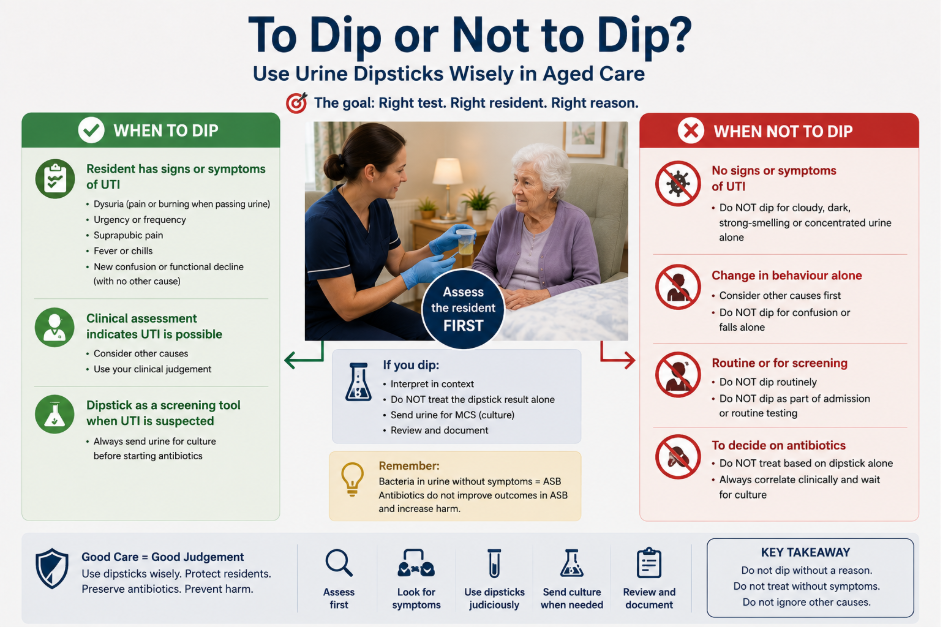
For detailed guidance on UTI surveillance and the distinction between asymptomatic bacteriuria and true UTI, see UTI Surveillance and the ‘To Dip or Not to Dip’ Framework in Aged Care
What Is the Four-Step Data Processing Cycle for Infection Surveillance?
IPS uses a four-step data processing cycle for infection surveillance: (1) define, (2) collect, (3) analyse, and (4) report/provide feedback. Each step must be completed systematically for surveillance data to be meaningful and actionable.
Step 1: Define
The define step establishes what will be monitored, which surveillance definitions will be used, and what data elements must be collected. Definitions must be standardised (e.g., McGeer criteria), documented in policy, and understood by all staff involved in data collection. Without clear definitions, data is inconsistent and unusable.
Step 2: Collect
The collect step involves gathering data according to the defined parameters. Data collection methods in aged care include clinical observation, review of clinical records, pathology result tracking, incident management system entries, and point-prevalence surveys. The ACSQHC Guide identifies six data quality factors: complete, consistent, accurate, timely, valid, and relevant.
Step 3: Analyse
The analyse step converts raw data into infection rates, trends, and patterns. Analysis includes calculating incidence rates (new infections per 1,000 resident days), prevalence rates (proportion of residents with an infection at a point in time), identifying clusters, comparing rates over time, and benchmarking against external data.
Step 4: Report and Provide Feedback
The report step closes the surveillance loop. Data must be fed back to clinical staff (so they can change practice), governance committees (so they can allocate resources and monitor improvement), and external bodies where required (quality indicator reporting, notifiable disease reporting). Reports should use clear visualisations — charts, graphs, and trend lines — and should include interpretation, not just numbers.
For detailed guidance on data collection methods, analysis techniques, and reporting formats, see Infection Surveillance Data Collection and Analysis for Aged Care
How Should Aged Care Facilities Choose What Infections to Monitor?
Choosing what infections to monitor is a risk-based decision. The ACSQHC Aged Care IPC Guide (2024) recommends that facilities conduct a risk assessment to identify priority infections based on frequency, severity, preventability, and relevance to the local population.
Most residential aged care facilities prioritise surveillance for the following infection types, based on their frequency and impact in the aged care setting:
| Infection Type | Why Prioritise | Surveillance Considerations |
|---|---|---|
| Urinary tract infections (UTIs) | A frequent reason for testing and antibiotic prescribing; second most common suspected infection in the 2023 Aged Care NAPS | Use McGeer criteria; distinguish from asymptomatic bacteriuria; link to AMS data |
| Respiratory tract infections | Common cause of outbreaks and hospital transfer; includes influenza, COVID-19 and pneumonia | Requires daily symptom monitoring; link to vaccination coverage data |
| Gastrointestinal infections | Outbreaks of norovirus and C. difficile cause significant disruption and morbidity | Baseline stool frequency documentation essential; link to outbreak management plan |
| Skin and wound infections | Common in residents with pressure injuries, skin tears, and surgical wounds | Distinguish colonisation from infection; link to wound management program |
| Device-associated infections | Urinary catheters and PEG tubes create direct infection risk | Monitor device utilisation rates alongside infection rates; promote device removal |
Home care and community aged care services face different surveillance challenges. Residents are geographically dispersed, clinicians visit intermittently, and data collection relies heavily on self-report or carer report. Surveillance in home care settings typically focuses on wound infections, UTIs, and respiratory infections, using simplified data collection tools.
What Are the Data Quality Factors for Infection Surveillance?
The ACSQHC Aged Care IPC Guide (2024) identifies six data quality factors that determine whether surveillance data is fit for purpose. Poor data quality undermines the entire surveillance programme — leading to incorrect infection rates, missed outbreaks, and misguided interventions.
| Data Quality Factor | Definition | Example of Failure |
|---|---|---|
| Complete | All required data fields are populated for every record | Infection records missing onset dates, making trend analysis impossible |
| Consistent | Data is collected the same way every time by every person | One nurse counts all positive urine cultures as UTIs; another applies McGeer criteria |
| Accurate | Data correctly reflects the clinical reality | Infections attributed to the wrong body site due to coding errors |
| Timely | Data is collected and reported close to the time of the event | Infections entered into the system weeks after occurrence, delaying outbreak detection |
| Valid | Data measures what it is intended to measure | Using antibiotic prescriptions as a proxy for infection rates without clinical validation |
| Relevant | Data collected serves a clear purpose and informs decision-making | Collecting extensive microbiological data that is never analysed or acted upon |
Data validation — checking data for errors, inconsistencies, and completeness before analysis — is an essential step. Validation techniques include cross-checking infection records against pathology results, reviewing outlier data points, and conducting periodic inter-rater reliability checks where two people independently apply surveillance definitions to the same clinical scenarios.
What National Surveillance Systems Support Infection Surveillance in Aged Care?
Several national surveillance systems operate in Australia that are relevant to infection surveillance in aged care. These systems provide benchmarking data, national trend information, and mandatory reporting pathways.
| System | Managed By | Relevance to Aged Care |
|---|---|---|
| National Notifiable Diseases Surveillance System (NNDSS) | Communicable Diseases Network Australia (CDNA) / Department of Health | Mandatory notification of specified communicable diseases — aged care must report cases via state/territory public health units |
| AURA Surveillance System | ACSQHC | Tracks antimicrobial use and resistance nationally; aged care antimicrobial prescribing data feeds into this system |
| National Aged Care Mandatory QI Program | Department of Health and Aged Care | Mandatory quarterly quality indicator reporting. No infection indicator, so not a source of infection surveillance data. |
| OzFoodNet | CDNA | National surveillance for foodborne disease outbreaks — relevant when gastroenteritis outbreaks occur in aged care |
The Communicable Diseases Network Australia (CDNA) publishes national guidelines for the surveillance and management of specific communicable diseases. Aged care facilities must be familiar with notifiable disease requirements in their state or territory — notification timelines vary but are typically within 24 hours for urgent notifications.
How Does Infection Surveillance Link to Continuous Quality Improvement?
Infection surveillance is not an end in itself — its purpose is to drive continuous quality improvement (CQI). The ACSQHC Aged Care IPC Guide (2024), Chapter 9, explicitly links monitoring to CQI, stating that surveillance data must inform improvement activities.
The CQI cycle applied to infection surveillance follows the Plan-Do-Study-Act (PDSA) model. Surveillance identifies the problem (Plan). An intervention is implemented (Do). Surveillance data is reviewed to assess the impact of the intervention (Study). The intervention is refined, scaled, or abandoned based on the data (Act).
Common CQI activities driven by surveillance data include: reducing unnecessary urinary catheter use after identifying elevated catheter-associated UTI rates, improving hand hygiene compliance after linking low compliance rates to increased respiratory infections, introducing antimicrobial stewardship interventions after identifying high antibiotic prescribing rates for asymptomatic bacteriuria.
For a comprehensive guide to using surveillance for CQI, see Using Surveillance Data for Continuous Quality Improvement in Aged Care IPC
What Are the Differences Between Residential and Home Care Surveillance?
Infection surveillance approaches differ significantly between residential aged care and home and community aged care settings. Residential facilities have the advantage of co-located residents, on-site clinical staff, and centralised records. Home care services face the challenge of geographically dispersed clients, limited clinical contact, and reliance on self-report or carer-report data.
| Factor | Residential Aged Care | Home and Community Care |
|---|---|---|
| Data collection | On-site clinical staff can observe and record infections prospectively | Clinicians visit intermittently; data collection relies on phone contact, telehealth, or carer reports |
| Surveillance definitions | McGeer criteria applicable with some adaptation | McGeer criteria may need further simplification; fewer diagnostic resources available |
| Outbreak detection | Daily symptom monitoring enables early cluster detection | Clusters harder to detect across dispersed clients; no shared living environment |
| Denominator data | Resident days readily calculated from census data | Client contact hours or episodes of care may be used; less standardised |
| Reporting | Centralised incident management systems and governance structures | May rely on individual care coordinators to aggregate data |
Despite these challenges, home care providers are still required under the Strengthened Aged Care Quality Standards to monitor infection-related outcomes and demonstrate continuous improvement. Simplified surveillance tools, electronic incident reporting, and regular clinical review meetings can support surveillance in home care settings.
Frequently Asked Questions
What is infection surveillance in aged care?
Infection surveillance in aged care is the systematic, ongoing collection, analysis, interpretation, and reporting of infection data to detect infections early, identify trends, and drive improvements in IPC. The ACSQHC Aged Care IPC Guide (2024), Chapter 9, defines the framework for monitoring in aged care settings.
What are the McGeer criteria?
The McGeer criteria (updated by Stone et al., 2012) are standardised surveillance definitions for identifying infections in long-term care facilities. The criteria specify which signs, symptoms, and test results must be present before a clinical event is counted as a UTI, respiratory infection, skin infection, or gastrointestinal infection for surveillance purposes.
Is infection surveillance mandatory in Australian aged care?
In practice, yes. The Strengthened Aged Care Quality Standards (effective 1 November 2025) require an IPC system (Action 4.2.1) that is informed by infection rates, and processes to minimise and manage infection (Action 5.2.2). The Standards do not mandate a specific surveillance method, but providers must be able to show they monitor infections in a way that suits their service type and risk profile.
What infections should aged care facilities monitor?
Most residential aged care facilities prioritise surveillance for UTIs, respiratory tract infections (including influenza and COVID-19), gastrointestinal infections, skin and wound infections, and device-associated infections. Selection should be based on a local risk assessment considering frequency, severity, and preventability.
How does surveillance differ from outbreak management?
Surveillance is the continuous, systematic monitoring of infections to identify trends and detect problems early. Outbreak management is the response activated when surveillance identifies a cluster or outbreak — implementing enhanced IPC measures, notifying authorities, and containing transmission. Surveillance enables outbreak detection; outbreak management is the response. See Outbreak Management in Aged Care
References and Further Reading
The following authoritative sources inform the clinical and regulatory guidance in this article. Links open in a new tab.
- Australian Commission on Safety and Quality in Health Care. Infection Prevention and Control Guide for Residential Aged Care Facilities, Version 1.1. Sydney: ACSQHC; January 2025.
- Aged Care Quality and Safety Commission. Aged care quality and safety reporting — infection data. Canberra: ACQSC; 2025.
- Stone ND, Ashraf MS, Calder J, et al. Surveillance Definitions of Infections in Long-Term Care Facilities: Revisiting the McGeer Criteria. Infect Control Hosp Epidemiol. 2012;33(10):965–977.
- Australian Institute of Health and Welfare. Aged care safety and quality surveillance data. Canberra: AIHW; 2024.
- Communicable Diseases Network Australia. CDNA National Guidelines — surveillance of communicable diseases. Canberra: DoH; 2023.
In This Article
- What Is Infection Surveillance in Aged Care?
- Why Does Infection Surveillance Matter in Aged Care?
- What Are the Regulatory Requirements for Infection Surveillance in Aged Care?
- What Are the Types of Infection Monitoring in Aged Care?
- What Are Surveillance Definitions and Why Do They Matter?
- What Is the Four-Step Data Processing Cycle for Infection Surveillance?
- How Should Aged Care Facilities Choose What Infections to Monitor?
- What Are the Data Quality Factors for Infection Surveillance?
- What National Surveillance Systems Support Infection Surveillance in Aged Care?
- How Does Infection Surveillance Link to Continuous Quality Improvement?
- What Are the Differences Between Residential and Home Care Surveillance?
- Frequently Asked Questions
- Related Articles
About the Author
Lyndon Forrest is the Managing Director of Bug Control — Infection Prevention Services, with over 30 years’ experience supporting aged care facilities across Australia and New Zealand with infection prevention, antimicrobial stewardship, and accreditation readiness.
Clinically reviewed by Bridgette Mackie & Dianne Newey, Clinical Directors
Ready to Strengthen Your Facility’s Infection Prevention?
The IPS Hub provides aged care facilities across Australia and New Zealand with continuously updated IPC policies, AMS tools, outbreak management resources, and direct support from experienced IPC professionals.