Home › Knowledge Hub › Infection Surveillance › How to Set Up an Infection Surveillance Program in Aged Care
Infection Surveillance
By Lyndon Forrest, Managing Director · Clinically reviewed by Bridgette Mackie & Dianne Newey, Clinical Directors · June 2026 · 10 min read
How to Set Up an Infection Surveillance Program in Aged Care
TL;DR —
Setting up an infection surveillance program in aged care requires six core steps: (1) conduct a risk assessment to identify priority infections, (2) select standardised surveillance definitions such as the McGeer criteria (Stone et al., 2012), (3) design or select data collection tools, (4) train staff to apply definitions consistently, (5) establish baseline infection rates over an initial 6–12 month period, and (6) link surveillance findings to continuous quality improvement (CQI) activities. Under the Strengthened Aged Care Quality Standards (effective 1 November 2025), providers must have an IPC system (Standard 4, Outcome 4.2, Action 4.2.1) that is informed by infection rates, and processes to minimise and manage infection (Standard 5, Outcome 5.2, Action 5.2.2). The ACSQHC Aged Care IPC Guide (2024), Chapter 9, provides the framework for program design.
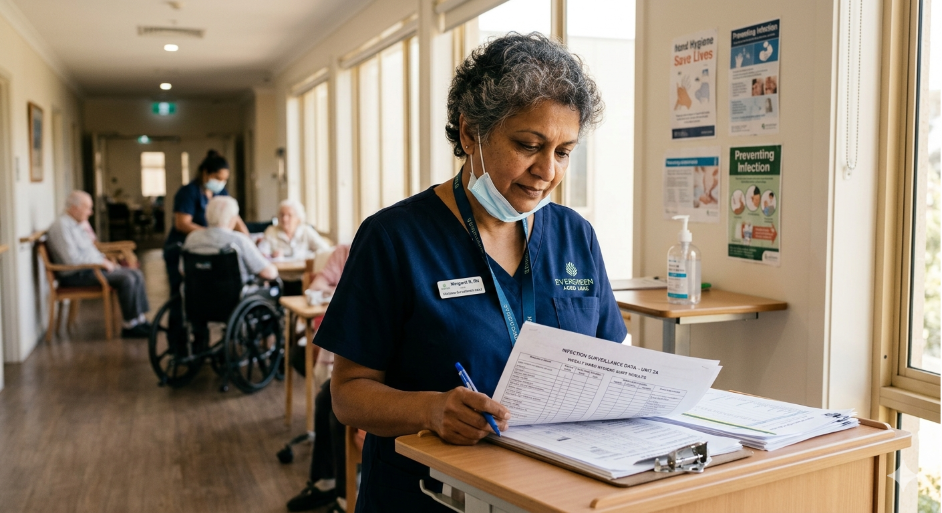
Why Does Aged Care Need a Formal Infection Surveillance Program?
An infection surveillance program in aged care transforms ad-hoc infection recording into systematic, actionable intelligence. Many aged care facilities record infections in incident management systems but lack the structure to calculate rates, identify trends, or drive improvement. A formal program provides that structure.
Under the Strengthened Aged Care Quality Standards (effective 1 November 2025), the IPC system (Action 4.2.1) is informed by infection rates, and providers must have processes to minimise and manage infection (Action 5.2.2). Infection surveillance is how a provider shows it knows its infection rates and acts on them. Assessors are likely to look for a defined method, consistent data collection, analysis and reporting, and evidence that findings inform improvement.
Without a formal program, facilities commonly experience the following failures: infections are recorded inconsistently (different staff apply different definitions), data is collected but never analysed, reports are produced but never acted upon, and outbreaks are detected late — after widespread transmission has already occurred.
For a comprehensive overview of infection surveillance in aged care, see Infection Surveillance in Aged Care: A Complete Guide
Step 1: How Should Facilities Conduct a Risk Assessment to Identify Surveillance Priorities?
The first step in setting up an infection surveillance program is conducting a risk assessment to identify which infections pose the greatest threat to the facility’s resident population. The ACSQHC Aged Care IPC Guide (2024) recommends risk-based selection rather than attempting to monitor every possible infection.
The risk assessment should consider the following factors:
Frequency: Which infections occur most often in the facility? Review 12 months of incident data, pathology results, and antibiotic prescriptions.
Severity: Which infections cause the most harm — hospitalisations, deaths, functional decline, pain, and suffering?
Preventability: Which infections can be prevented through IPC interventions?
National priorities: Which infections are targets of national surveillance programs (e.g., influenza, COVID-19, antimicrobial-resistant organisms)?
Local context: Does the facility have a high proportion of residents with urinary catheters, PEG tubes, or chronic wounds that create specific infection risks?
The output of the risk assessment is a prioritised list of 3–5 infection types that will form the focus of the surveillance program. Attempting to monitor every infection type simultaneously is unsustainable for most aged care facilities and leads to data collection fatigue.
For IPC risk assessment frameworks, see IPC Risk Management in Aged Care
Step 2: How Should Facilities Select Surveillance Definitions?
Surveillance definitions determine how infections are counted. Without standardised definitions, surveillance data is inconsistent and incomparable. The McGeer criteria (Stone et al., 2012) are the internationally accepted surveillance definitions for long-term care facilities and should form the basis of any aged care surveillance program.
Need help implementing this in your facility? The IPS Hub gives your IPC Lead instant access to ready-made policies, procedures, and audit tools — updated monthly.
What Are the McGeer Criteria and How Do They Work?
The McGeer criteria were originally published by McGeer et al. in 1991 and comprehensively updated by Stone et al. in 2012 to reflect advances in diagnostic approaches and evidence. The criteria define the minimum clinical and laboratory findings required to classify an infection for surveillance purposes.
McGeer criteria are surveillance definitions only. They are not used to decide whether to test or treat an individual resident. For clinical decisions, follow the Aged Care Quality and Safety Commission’s To Dip or Not to Dip clinical pathway. Any resident who is unwell, deteriorating or showing signs of sepsis must be escalated straight away, whether or not they meet any criteria.
Key principles of the McGeer criteria:
Surveillance definitions are NOT diagnostic criteria: they provide a standardised `case definition’ of infections across facilities and are not for individual resident treatment decisions.
The criteria require specific combinations of signs and symptoms — a single sign or symptom alone rarely meets the definition.
Laboratory results (cultures, imaging) are required for some definitions but not all — recognising that aged care has limited diagnostic access.
The criteria account for the high prevalence of colonisation in older people — particularly urinary colonisation.
How Should the McGeer Criteria Be Adapted for Local Use?
While the McGeer criteria provide the framework, facilities may need to develop simplified reference sheets for clinical staff. A full McGeer criteria reference document can be complex. Practical implementation requires:
A one-page summary of criteria for each priority infection type
Decision support tools (flowcharts) that guide staff through the criteria step by step
Case examples that illustrate when criteria are met and when they are not
Regular inter-rater reliability exercises to ensure staff apply criteria consistently
For UTI-specific surveillance definitions and the distinction between asymptomatic bacteriuria and true UTI, see UTI Surveillance and the ‘To Dip or Not to Dip’ Framework in Aged Care
Step 3: How Should Facilities Design Data Collection Tools?
Data collection tools are the instruments used to record infection events consistently. Effective tools are simple, structured, and integrated into existing workflows. Overly complex tools reduce compliance and introduce errors.
Common data collection tools for infection surveillance in aged care include:
| Tool Type | Description | Advantages | Limitations |
|---|---|---|---|
| Paper-based line listing | Spreadsheet or form listing each infection event with date, resident, infection type, criteria met, and outcome | Simple, no technology required, can be implemented immediately | Labour-intensive to aggregate and analyse; prone to transcription errors |
| Microsoft Excel spreadsheet | Structured spreadsheet with defined columns, drop-down menus, and built-in formulae for rate calculation | Widely available, customisable, supports automated calculations and charts | Requires staff with basic Excel skills; version control issues with shared files |
| Incident management system | Infection module within the facility’s existing incident/risk management software | Integrated with other reporting; supports workflow automation and alerts | May not have infection-specific fields; surveillance definitions may not be embedded |
| Purpose-built surveillance software | Specialist infection surveillance software (e.g., IPS Hub, TiNA) | Designed for infection surveillance; automates rate calculation, trending, and reporting | Cost; implementation time; staff training requirement |
Regardless of the tool selected, the minimum data elements that should be captured for each infection event are:
Resident identifier (de-identified for reporting)
Date of onset
Infection type (UTI, respiratory, skin, gastrointestinal, device-associated)
Surveillance criteria met (which McGeer criteria elements were present)
Specimen collected (yes/no) and result
Antibiotic prescribed (yes/no), agent, and duration
Outcome (resolved, hospitalised, deceased)
Contributing factors (catheter, wound, immunosuppression)
For detailed guidance on data collection methods and ensuring data quality, see Infection Surveillance Data Collection and Analysis for Aged Care
Step 4: How Should Staff Be Trained for Infection Surveillance?
Staff training is the single most critical success factor for infection surveillance in aged care. Even the best surveillance definitions and tools produce unreliable data if staff apply them inconsistently. Training must cover surveillance definitions, data collection procedures, and the purpose of surveillance.
A structured surveillance training program should include:
Education on what surveillance is and why it matters — staff who understand the purpose collect better data
Detailed training on the surveillance definitions (McGeer criteria) being used, with case-based examples
Practical training on using the data collection tools — hands-on practice with the form, spreadsheet, or software
Inter-rater reliability exercises — staff independently classify the same set of clinical scenarios and compare results
Ongoing competency assessment — annual refresher training and periodic inter-rater checks
Feedback loops — showing staff how their data is used for improvement, which motivates accurate collection
The IPC Lead (or designated surveillance coordinator) should be the primary data validator, reviewing all infection entries to confirm that surveillance definitions have been correctly applied before data is included in rate calculations.
Step 5: How Should Facilities Establish Baseline Infection Rates?
Baseline infection rates provide the reference point against which all future surveillance data is compared. Without a baseline, facilities cannot determine whether infection rates are increasing, decreasing, or stable — and cannot measure the impact of interventions.
Establishing a baseline requires 6–12 months of consistent data collection using the defined surveillance methodology. During this period, the facility is building its historical reference data. The baseline should include:
Monthly infection counts by infection type
Monthly infection rates per 1,000 resident days (to adjust for occupancy changes)
Seasonal patterns (respiratory infections peak in winter; gastroenteritis may peak in summer)
Device utilisation rates (catheter days per 1,000 resident days) for device-associated infections
The baseline period also serves to identify and correct data collection problems. If rates appear unusually high or low during the baseline period, investigate whether this reflects true infection rates or data collection errors (over-reporting, under-reporting, misapplication of definitions).
Step 6: How Should Surveillance Be Linked to CQI Activities?
Surveillance data that is collected but not used for improvement is wasted effort. The sixth and most critical step is establishing formal links between surveillance findings and continuous quality improvement (CQI) activities.
Practical mechanisms for linking surveillance to CQI include:
Monthly surveillance reports to the IPC committee (or equivalent governance body)
Trigger thresholds that activate targeted monitoring or investigation when infection rates exceed the baseline by a defined amount
PDSA (Plan-Do-Study-Act) cycles initiated in response to surveillance findings
Annual surveillance program review — evaluating whether the right infections are being monitored, whether definitions are being applied correctly, and whether data is driving improvement
Staff feedback sessions — presenting surveillance findings to clinical staff and linking them to practice improvements
For comprehensive guidance on using surveillance for CQI, see Using Surveillance Data for Continuous Quality Improvement in Aged Care IPC
What Are the Common Pitfalls When Setting Up a Surveillance Program?
Facilities commonly encounter the following pitfalls when establishing an infection surveillance program in aged care. Awareness of these pitfalls during planning can prevent costly rework.
| Pitfall | Consequence | Prevention Strategy |
|---|---|---|
| No standardised definitions | Inconsistent data; inability to calculate meaningful rates or compare over time | Adopt McGeer criteria from the outset; document definitions in policy |
| Trying to monitor everything | Data collection fatigue; incomplete data across all infection types | Start with 3–5 priority infections based on risk assessment; expand gradually |
| Insufficient staff training | Misapplication of definitions; unreliable data | Structured training program with case-based exercises and inter-rater reliability checks |
| No baseline period | No reference point for evaluating trends or intervention effectiveness | Commit to 6–12 months of data collection before drawing conclusions |
| Data collected but not used | Staff become disengaged; surveillance becomes a tick-box exercise | Formal CQI linkage; regular feedback to staff showing how data drives improvement |
| Over-reliance on pathology results | Underdetection of infections where specimens are not collected | Use clinical surveillance definitions that include clinical signs/symptoms, not only lab results |
What Resources Are Required for an Infection Surveillance Program?
Establishing and maintaining an infection surveillance program requires dedicated time, trained personnel, and appropriate tools. The resource requirements depend on the facility’s size, the number of infections being monitored, and the data collection tools being used.
| Resource | Typical Requirement | Notes |
|---|---|---|
| IPC Lead / Surveillance coordinator | Minimum 0.2–0.5 FTE dedicated to surveillance activities | Includes data validation, analysis, reporting, and CQI activities |
| Clinical staff time | 10–15 minutes per infection event for data entry | Assumes structured data collection tools are in place |
| Training time | 2–4 hours initial training; 1–2 hours annual refresher | Includes surveillance definitions, data collection, and inter-rater exercises |
| Data collection tools | Spreadsheet (no cost) to specialist software (variable cost) | Tools must support the minimum data elements and rate calculations |
| Governance reporting time | 2–4 hours per month for report preparation and presentation | Includes data analysis, chart preparation, and committee presentation |
Frequently Asked Questions
How long does it take to set up an infection surveillance program in aged care?
Initial setup — including risk assessment, definition selection, tool design, and staff training — typically takes 2–3 months. The baseline data collection period adds 6–12 months. A fully functional program with baseline data is typically operational within 12–15 months of commencement.
Can small aged care facilities run a surveillance program?
Small facilities (under 60 beds) can and should conduct infection surveillance. The program may be simplified — monitoring fewer infection types, using paper-based tools, and integrating surveillance into existing quality meeting agendas. The principles remain the same regardless of facility size.
What surveillance definitions should aged care facilities use?
The McGeer criteria (Stone et al., 2012) are the recommended surveillance definitions for long-term care settings. These criteria are specifically designed for the aged care environment and account for limited diagnostic resources and high baseline colonisation rates.
Do we need specialist software for infection surveillance?
Specialist software is helpful but not required. A well-designed Microsoft Excel spreadsheet with defined columns, drop-down menus, and formulae for rate calculation is sufficient for most aged care facilities. Specialist software becomes more valuable as surveillance programs mature and data volumes increase.
How do we know if our surveillance data is accurate?
Data accuracy is assessed through validation techniques: the IPC Lead reviews all infection entries against surveillance definitions, inter-rater reliability exercises compare classification by different staff members, and cross-checks against pathology results and clinical records identify discrepancies.
Related Articles
Infection Surveillance in Aged Care — Complete Guide:
Infection Surveillance Data Collection and Analysis for Aged Care
UTI Surveillance and the ‘To Dip or Not to Dip’ Framework in Aged Care
Using Surveillance Data for CQI in Aged Care IPC
Antimicrobial Stewardship in Aged Care
IPC Risk Management in Aged Care
References and Further Reading
The following authoritative sources inform the clinical and regulatory guidance in this article. Links open in a new tab.
- Australian Commission on Safety and Quality in Health Care. Infection Prevention and Control Guide for Residential Aged Care Facilities, Version 1.1. Sydney: ACSQHC; January 2025.
- Aged Care Quality and Safety Commission. Aged care quality and safety reporting — infection data. Canberra: ACQSC; 2025.
- Stone ND, Ashraf MS, Calder J, et al. Surveillance Definitions of Infections in Long-Term Care Facilities: Revisiting the McGeer Criteria. Infect Control Hosp Epidemiol. 2012;33(10):965–977.
- Australian Institute of Health and Welfare. Aged care safety and quality surveillance data. Canberra: AIHW; 2024.
- Communicable Diseases Network Australia. CDNA National Guidelines — surveillance of communicable diseases. Canberra: DoH; 2023.
In This Article
- Why Does Aged Care Need a Formal Infection Surveillance Program?
- Step 1: How Should Facilities Conduct a Risk Assessment to Identify Surveillance Priorities?
- Step 2: How Should Facilities Select Surveillance Definitions?
- Step 3: How Should Facilities Design Data Collection Tools?
- Step 4: How Should Staff Be Trained for Infection Surveillance?
- Step 5: How Should Facilities Establish Baseline Infection Rates?
- Step 6: How Should Surveillance Be Linked to CQI Activities?
- What Are the Common Pitfalls When Setting Up a Surveillance Program?
- What Resources Are Required for an Infection Surveillance Program?
- Frequently Asked Questions
- Related Articles
About the Author
Lyndon Forrest is the Managing Director of Bug Control — Infection Prevention Services, with over 30 years’ experience supporting aged care facilities across Australia and New Zealand with infection prevention, antimicrobial stewardship, and accreditation readiness.
Clinically reviewed by Bridgette Mackie & Dianne Newey, Clinical Directors
Ready to Strengthen Your Facility’s Infection Prevention?
The IPS Hub provides aged care facilities across Australia and New Zealand with continuously updated IPC policies, AMS tools, outbreak management resources, and direct support from experienced IPC professionals.