Home › Knowledge Hub › Risk Management › How to Conduct an IPC Risk Assessment in Aged Care
Risk Management
By Lyndon Forrest, Managing Director · Clinically reviewed by Bridgette Mackie & Dianne Newey, Clinical Directors · September 2026 · 9 min read
How to Conduct an IPC Risk Assessment in Aged Care
TL;DR —
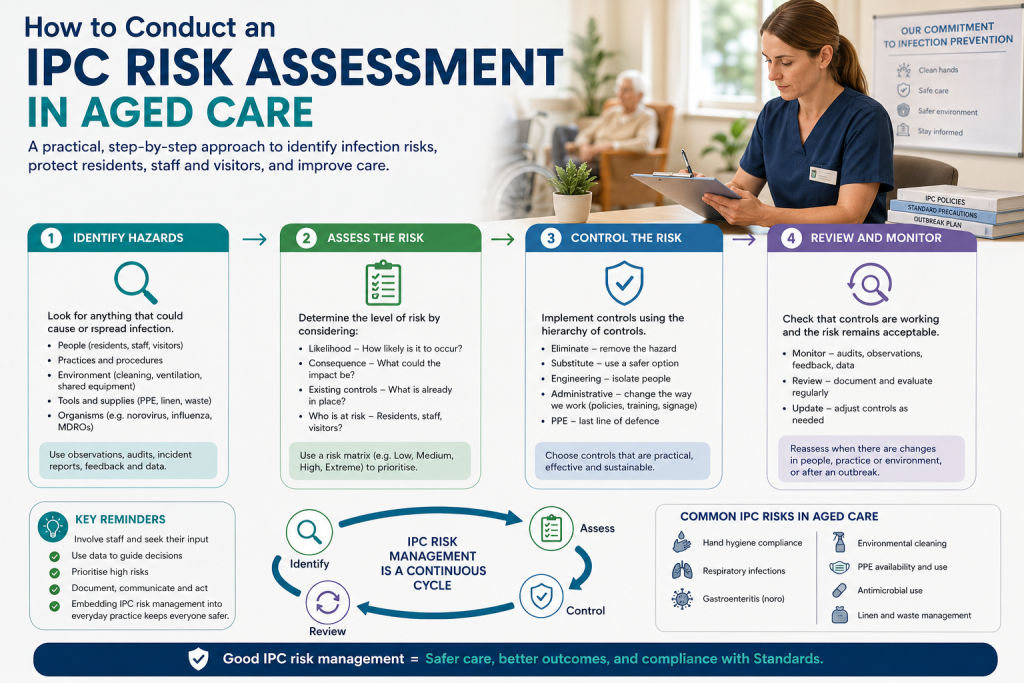
An IPC risk assessment in aged care follows a structured 4-step process: identify the hazard, assess the risk (using a likelihood x consequence matrix), implement controls following the hierarchy of controls, and schedule reviews. Risk assessments must be conducted at resident admission, during outbreaks, when procedures or environments change, and at routine intervals. The Strengthened Aged Care Quality Standards require documented IPC risk assessment as part of the IPC system (Standard 4, Outcome 4.2) and clinical governance (Standard 5, Outcome 5.1), with infection prevention in clinical care under Outcome 5.2.
When should an IPC Risk Assessment Be Conducted?
IPC risk assessments in aged care are not one-off exercises. They must be conducted at multiple trigger points and at regular scheduled intervals. The ACSQHC Aged Care IPC Guide (2024) identifies both proactive (scheduled) and reactive (triggered) assessments as essential components of an effective IPC program.
Scheduled (Routine) Assessments
Annual facility-wide IPC risk assessment — reviews all identified hazards, risk ratings, and controls across the entire facility
Quarterly risk register review — evaluates whether existing controls remain effective and whether new hazards have emerged
Seasonal risk assessments — conducted before the influenza season (typically March-April) and the gastroenteritis season (winter months)
Pre-construction or renovation risk assessments — conducted before any building work that may create dust, water, or ventilation hazards.
Triggered (Event-Based) Assessments
Resident admission or readmission from hospital — assess MDRO colonisation status, infection risk factors and device-related risks
Outbreak declaration — immediate risk assessment to identify transmission sources and determine control measures
Incident or near-miss — any infection-related incident should trigger a risk assessment to identify root causes
Introduction of new procedures or equipment — assess infection risks associated with the change
Change in resident acuity or clinical status — reassess individual infection risk when a resident’s condition changes significantly
Public health alert — new pathogen emergence, pandemic declarations, or jurisdictional health directives
A common gap in aged care IPC programs is conducting risk assessments only in response to events (reactive) while neglecting scheduled assessments (proactive). Both are required as part of the IPC system and clinical governance under the Strengthened Quality Standards.
Need help implementing this in your facility? The IPS Hub gives your IPC Lead instant access to ready-made policies, procedures, and audit tools — updated monthly.
How Do You Identify IPC Hazards in Aged Care?
Hazard identification is the first step of the IPC risk assessment process. An IPC hazard is any source, situation, or practice that has the potential to cause infection in residents, workers, visitors, or volunteers. Hazard identification should be systematic rather than ad hoc.
Effective hazard identification draws on multiple information sources. No single source provides a complete picture. Combining quantitative data (surveillance, audit results) with qualitative data (staff observations, resident feedback) produces the most thorough hazard inventory.
| Information Source | What It Reveals | Example |
|---|---|---|
| Infection surveillance data | Patterns, trends, emerging threats | Rising UTI rates in a specific wing; seasonal spike in gastroenteritis |
| Hand hygiene audit results | Compliance gaps and risk areas | Low compliance rates during night shifts; poor compliance in memory-support units |
| Environmental audit results | Physical hazards and cleaning gaps | Damaged surfaces preventing effective disinfection; inadequate hand hygiene stations |
| Incident and SIRS reports | Specific events that caused or could have caused harm | Needlestick injury; outbreak linked to contaminated equipment |
| Admission screening data | Resident-specific infection risks | MDRO colonisation status; indwelling device prevalence; vaccination status |
| Staff feedback | Practical barriers and emerging concerns | PPE supply shortages; inadequate isolation facilities; workflow challenges |
A facility-wide hazard identification should be conducted at least annually as part of the IPC program review. The results feed directly into the IPC risk register. For each identified hazard, record the hazard description, location or area affected, how the hazard was identified, and the date of identification.
How Do You Assess the Level of Risk?
Risk assessment combines two factors: the likelihood of the hazard causing harm and the consequence (severity) if harm occurs. Multiplying these two factors produces a risk rating that determines the priority and urgency of control measures.
What Is a Risk Matrix and How Is It Used?
A risk matrix is a grid that maps likelihood against consequence to produce a risk rating. The following 5×5 matrix is widely used in Australian aged care IPC risk management.
| Likelihood | Insignificant | Minor | Moderate | Major | Catastrophic |
|---|---|---|---|---|---|
| Almost certain | Moderate | High | High | Extreme | Extreme |
| Likely | Moderate | Moderate | High | High | Extreme |
| Possible | Low | Moderate | Moderate | High | High |
| Unlikely | Low | Low | Moderate | Moderate | High |
| Rare | Low | Low | Low | Moderate | Moderate |
How Should Likelihood Be Assessed?
| Rating | Descriptor | Definition |
|---|---|---|
| 5 | Almost certain | Expected to occur in most circumstances; has happened repeatedly at this facility |
| 4 | Likely | Will probably occur; has happened at this facility or is common in similar facilities |
| 3 | Possible | Could occur; has occurred in similar facilities or is plausible given current conditions |
| 2 | Unlikely | Not expected but conceivable; has occurred rarely in similar settings |
| 1 | Rare | May occur only in exceptional circumstances; no known precedent in aged care |
How Should Consequence Be Assessed?
| Rating | Descriptor | Health Impact | Operational Impact |
|---|---|---|---|
| 1 | Insignificant | No injury or illness; no clinical impact | Minimal disruption; managed within routine operations |
| 2 | Minor | Minor illness requiring first aid or short-term treatment | Some operational disruption; additional cleaning or monitoring |
| 3 | Moderate | Illness requiring medical treatment; temporary functional decline | Significant disruption; staff redeployment; regulatory notification possible |
| 4 | Major | Serious illness requiring hospitalisation; permanent functional decline | Major operational disruption; outbreak declared; public health unit notified in line with state or territory requirements (a SIRS report is needed only if the outbreak involves an incident that meets the SIRS reporting thresholds, such as an unexpected death or neglect) |
| 5 | Catastrophic | Death or life-threatening illness; multiple residents affected | Facility-wide crisis; regulatory intervention; media attention |
How Do You Select and Implement Controls?
Once the risk level has been determined, the next step is to select controls following the hierarchy of controls. The goal is to apply the most effective control that is reasonably practicable, starting from the top of the hierarchy (elimination) and working down to PPE.
For most IPC hazards in aged care, a single control is insufficient. Best practice applies multiple controls from different levels of the hierarchy simultaneously. This layered approach provides defence in depth — if one control fails, others remain in place.
For each control selected, document: the specific control measure, the level of the hierarchy it represents, the person responsible for implementation, the implementation timeline, the resources required, and the method for evaluating effectiveness.
How Does the Risk Rating Guide Action Timelines?
| Risk Rating | Action Required | Timeline | Escalation |
|---|---|---|---|
| Extreme | Immediate action required; senior management must be informed | Within 24 hours | Board/governing body notification; consider external specialist advice |
| High | Urgent action required; documented action plan needed | Within 1 week | Facility manager and IPC lead must review and approve controls |
| Moderate | Action required; schedule control implementation | Within 1 month | IPC committee review at next scheduled meeting |
| Low | Monitor and manage through routine procedures | Within 3 months | Include in next scheduled risk register review |
What Should Be Included in IPC Risk Assessment Documentation?
Documentation is not optional — it is an essential component of IPC risk assessment. Under the Strengthened Quality Standards, assessors will look for evidence that risk assessments are conducted, documented, acted upon, and reviewed. Verbal risk assessments without documentation have no evidentiary value.
Every IPC risk assessment record should include the following elements.
Date and time of the assessment
Name and role of the person(s) conducting the assessment
Trigger for the assessment (scheduled, incident-based, admission, outbreak)
Hazard description and location
Likelihood rating with rationale
Consequence rating with rationale
Overall risk rating
Controls already in place (existing controls)
Additional controls recommended
Residual risk rating after controls
Person responsible for implementing controls
Timeline for implementation
Review date
Signature or electronic approval
What Are Practical Examples of IPC Risk Assessment in Aged Care?
Example 1: New Resident Admission with MRSA Colonisation
A new resident is admitted to an RACF from hospital. The discharge summary indicates that the resident is colonised with methicillin-resistant Staphylococcus aureus (MRSA). The resident requires assistance with personal care including wound dressing to a chronic leg ulcer.
| Element | Assessment |
|---|---|
| Hazard | MRSA transmission from colonised resident to other residents or staff during direct care |
| Likelihood | Likely (4) — direct care activities involve close contact; wound is colonised |
| Consequence | Moderate (3) — MRSA infection could cause illness requiring medical treatment |
| Risk Rating | High (4 x 3 = 12) |
| Controls | Standard precautions for routine interactions; contact precautions (gloves, gown) for wound care; dedicated wound care equipment; enhanced cleaning of resident’s room; staff education on MRSA transmission; communication to all care staff via care plan |
| Residual Risk | Low-Moderate — resident can participate in all social activities; risk is managed through targeted controls |
| Review | Review in 2 weeks; reassess if wound status changes or additional residents develop MRSA |
Example 2: Gastroenteritis Outbreak in a Memory Support Unit
Three residents in a 20-bed memory support unit develop acute vomiting and diarrhoea within 24 hours. A gastroenteritis outbreak is suspected.
| Element | Assessment |
|---|---|
| Hazard | Transmission of gastroenteritis pathogen (likely norovirus) to other residents and staff |
| Likelihood | Almost certain (5) — norovirus is highly transmissible; residents in memory support have limited ability to perform hand hygiene independently |
| Consequence | Major (4) — gastroenteritis in frail older people can cause dehydration, hospitalisation, and in severe cases, death |
| Risk Rating | Extreme (5 x 4 = 20) |
| Controls | Immediate outbreak management plan activation; isolation or cohorting of symptomatic residents; enhanced environmental cleaning with chlorine-based disinfectant; contact precautions for all staff; restrict transfers; notify Public Health Unit; increase hand hygiene monitoring; dedicated staffing for affected area |
| Residual Risk | High — residual risk remains elevated until 48 hours after last symptomatic case |
| Review | Daily review during outbreak; formal post-outbreak review within 2 weeks of outbreak closure |
How Should Risk Assessments Be Reviewed and Updated?
Risk assessment review is Step 4 of the risk management cycle and is essential for ensuring controls remain effective. Reviews should evaluate whether controls have been implemented as planned, whether controls are achieving the intended risk reduction, and whether new hazards or changed circumstances require reassessment.
Quarterly review of the IPC risk register — assess all active risks and their controls
Post-outbreak review — within 2 weeks of outbreak closure, review the risk assessment and identify lessons learned
Post-incident review — after any IPC-related incident or SIRS report, review the relevant risk assessment
Annual IPC program review — comprehensive review of all risk assessments as part of the annual IPC program evaluation
Reviews should be documented and include the date of review, who conducted the review, findings, any changes to risk ratings or controls, and the next review date.
This article is part of the IPC Risk Management in Aged Care topic cluster. For the comprehensive pillar guide, see IPC Risk Management in Aged Care
Related articles:
The Hierarchy of Controls for Infection Prevention in Aged Care
Risk Acceptance in Aged Care IPC
IPC Risk Management in Home and Community Aged Care
IPC Scenario Risk Assessment Tool: Apply these risk management principles with our interactive IPC Scenario Risk Assessment Tool — designed specifically for aged care facilities to identify, assess, and control infection risks.
Frequently Asked Questions
Who should conduct IPC risk assessments in aged care?
IPC risk assessments should be conducted by staff with IPC competency, ideally the IPC lead or a trained delegate. Complex or high-risk assessments should involve multidisciplinary input, including clinical nurses, facility managers, and where appropriate, the facility’s medical practitioner.
What is the difference between a risk assessment and a risk register?
A risk assessment is the process of evaluating a specific hazard — its likelihood, consequence, and risk rating. A risk register is the centralised document that records all identified risks, assessments, controls, responsible persons, and review dates. The risk register is populated by individual risk assessments.
Can a single risk assessment cover multiple hazards?
While a facility-wide risk assessment may identify multiple hazards, each hazard should be assessed individually. Combining different hazards into a single assessment obscures the specific risk level and control requirements for each. Best practice records each hazard as a separate entry in the risk register.
Is there a mandatory template for IPC risk assessments?
There is no single mandatory template prescribed by regulators. However, the ACSQHC Aged Care IPC Guide (2024) provides recommended frameworks. The assessment must be documented, include the key elements listed above, and be retrievable for regulatory review.
References and Further Reading
The following authoritative sources inform the clinical and regulatory guidance in this article. Links open in a new tab.
- Aged Care Quality and Safety Commission. Strengthened Aged Care Quality Standards 2025 — Standard 5, Outcome 5.2: IPC Risk Management. Canberra: ACQSC; 2025.
- Australian Commission on Safety and Quality in Health Care. Infection Prevention and Control Guide for Residential Aged Care Facilities, Version 1.1. Sydney: ACSQHC; January 2025.
- Standards Australia. AS ISO 31000:2018 Risk Management — Guidelines. Sydney: Standards Australia; 2018.
- Australian Institute of Health and Welfare. Aged care safety and quality reporting — infection data. Canberra: AIHW; 2024.
- World Health Organization. Risk assessment for infection prevention and control. Geneva: WHO; 2023.
In This Article
- When Should an IPC Risk Assessment Be Conducted?
- How Do You Identify IPC Hazards in Aged Care?
- How Do You Assess the Level of Risk?
- How Do You Select and Implement Controls?
- What Should Be Included in IPC Risk Assessment Documentation?
- What Are Practical Examples of IPC Risk Assessment in Aged Care?
- How Should Risk Assessments Be Reviewed and Updated?
- Frequently Asked Questions
About the Author
Lyndon Forrest is the Managing Director of Bug Control — Infection Prevention Services, with over 30 years’ experience supporting aged care facilities across Australia and New Zealand with infection prevention, antimicrobial stewardship, and accreditation readiness.
Clinically reviewed by Bridgette Mackie & Dianne Newey, Clinical Directors.
IPC Scenario Risk Assessment Tool
Apply these risk management principles with our interactive IPC Scenario Risk Assessment Tool — designed specifically for aged care facilities to identify, assess, and control infection risks.
Ready to Strengthen Your Facility’s Infection Prevention?
The IPS Hub provides aged care facilities across Australia and New Zealand with continuously updated IPC policies, AMS tools, outbreak management resources, and direct support from experienced IPC professionals.