Home › Knowledge Hub › Infection Surveillance › UTI Surveillance and the To Dip or Not to Dip Framework in Aged Care
Infection Surveillance
By Lyndon Forrest, Managing Director · Clinically reviewed by Bridgette Mackie & Dianne Newey, Clinical Directors · July 2026 · Updated November 2026 · 10 min read
UTI Surveillance and the ‘To Dip or Not to Dip’ Framework in Aged Care
TL;DR —
UTI Surveillance in aged care is critical because urinary tract infection is one of the most common reasons antibiotics are prescribed in residential aged care, and some of those courses treat asymptomatic bacteriuria rather than infection. Asymptomatic bacteriuria (bacteria in urine without symptoms) is present in 25–50% of older women and 15–50% of older men in long-term care, and does not usually need treatment. There are a few exceptions, for example before urological procedures where mucosal bleeding is expected, so a medical practitioner should always decide. The Aged Care Quality and Safety Commission’s “To Dip or Not to Dip” resources, which include a clinical pathway and an audit tool, help facilities reduce unnecessary urine dipstick testing and improve UTI diagnosis. The McGeer criteria (Stone et al., 2012) define UTI for surveillance purposes – requiring both urinary symptoms AND a positive culture. Effective UTI Surveillance links directly to antimicrobial stewardship (AMS) by identifying unnecessary antibiotic prescribing.
Why Is UTI Surveillance a Priority in Aged Care?
UTI Surveillance in aged care is a priority because urinary tract infections are the most frequently reported infection in residential aged care facilities across Australia and internationally. However, the reported UTI rate in aged care is significantly inflated by the misclassification of asymptomatic bacteriuria as true UTI, leading to unnecessary antibiotic treatment, antimicrobial resistance, and adverse drug events.
The consequences of over-diagnosis and over-treatment of UTIs in aged care are significant:
Unnecessary antibiotic exposure: Antibiotics prescribed for asymptomatic bacteriuria provide no clinical benefit but cause adverse effects (Clostridioides difficile infection, antibiotic resistance, gastrointestinal side effects).
Antimicrobial resistance: Inappropriate antibiotic use drives the development of multidrug-resistant organisms (MDROs) in aged care facilities.
Inaccurate surveillance data: If asymptomatic bacteriuria is counted as a UTI, surveillance rates are artificially inflated and do not reflect the true infection burden.
Resource waste: Unnecessary urine testing, pathology processing, medical consultations, and antibiotic courses consume clinical resources without benefit to the resident.
For the link between UTI surveillance and antimicrobial stewardship, see Antimicrobial Stewardship in Aged Care
What Is the Difference Between Asymptomatic Bacteriuria and True UTI in Aged Care?
Asymptomatic bacteriuria is the presence of bacteria in the urine at significant colony counts without urinary symptoms. Asymptomatic bacteriuria is extremely common in older people living in residential care – prevalence estimates range from 25–50% in women and 15–50% in men (Nicolle et al., 2019).
A true UTI requires both urinary symptoms AND significant bacteriuria. The key distinction is the presence of specific urinary symptoms, and not the urine test result alone.
| Feature | Asymptomatic Bacteriuria | True UTI |
|---|---|---|
| Bacteria in urine | Yes — significant colony count | Yes — significant colony count |
| Urinary symptoms (dysuria, frequency, urgency, suprapubic pain) | Absent | Present — one or more specific symptoms required |
| Treatment | Antibiotic treatment is not recommended in most older residents (exceptions apply, see below) | Antibiotics may be indicated after clinical assessment; choice guided by current Therapeutic Guidelines, culture and sensitivity |
| Surveillance classification | Not a UTI. Do not count it | Counted as a UTI only if it meets the McGeer definition |
| Urine dipstick result | May be positive (nitrites, leucocytes) – does not indicate infection on its own | May be positive — but dipstick alone does not diagnose UTI |
Need help implementing this in your facility? The IPS Hub gives your IPC Lead instant access to ready-made policies, procedures, and audit tools — updated monthly.
Why Do Non-Specific Symptoms NOT Indicate UTI?
Non-specific symptoms – confusion, agitation, falls, lethargy, reduced oral intake, and general decline – are commonly attributed to UTI in aged care. These symptoms have many causes in older people (dehydration, medication effects, pain, constipation, infection at other sites) and are not reliable indicators of UTI on their own.
This does not mean they can be ignored. A resident with an acute change needs a clinical assessment straight away: observations (temperature, pulse, blood pressure, respiratory rate, oxygen saturation, level of consciousness), a look for other causes, and medical review. If the resident has fever or rigors, new confusion with abnormal observations, low blood pressure, a fast heart or breathing rate, or looks acutely unwell, escalate immediately using your facility’s deteriorating-resident and sepsis process. Do not wait for a urine result. A resident with an indwelling catheter who has rigors, fever or new delirium needs assessment for catheter-associated UTI (Loeb et al., 2001).
The practice of testing urine and prescribing antibiotics when a resident develops non-specific symptoms – without specific urinary symptoms – drives the cycle of over-diagnosis. Urine tested in a resident with asymptomatic bacteriuria will frequently return positive, confirming the clinician’s suspicion, but the bacteria were present before the symptoms and are not the cause.
What Is the ACQSC ‘To Dip or Not to Dip’ Audit Tool?
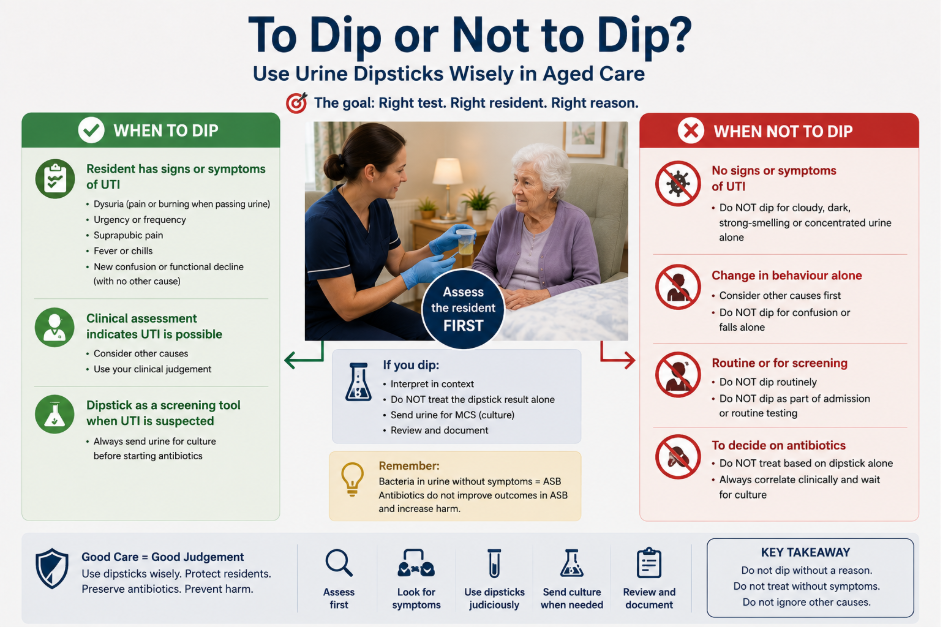
The Aged Care Quality and Safety Commission’s “To Dip or Not to Dip” resources are a quality improvement intervention for antimicrobial stewardship in aged care. They include case-based education, a staff video, a clinical pathway, a huddle tool and an audit tool, and aim to reduce unnecessary urine dipstick testing and improve UTI diagnosis.
The audit tool examines the following questions for each UTI episode reviewed:
Were specific urinary symptoms documented before urine testing was ordered?
Was a urine dipstick performed as the sole basis for diagnosis (without culture)?
Was a midstream urine (MSU) specimen collected appropriately?
Did the urine culture result meet colony count thresholds?
Was the antibiotic prescribed consistent with the culture and sensitivity result?
Was the duration of antibiotic treatment appropriate?
How Should Facilities Use the ‘To Dip or Not to Dip’ Tool?
The Commission’s audit tool can be used to review a sample of UTI episodes. How often to audit and how many episodes to review is a local decision. As a starting point, many facilities review a sample twice a year and more often if results show gaps. Check the current ACQSC tool for its own instructions. A typical audit involves: The audit process involves:
Sample selection: Identify all UTI diagnoses (or antibiotic courses prescribed for UTI) during the audit period. Randomly select 20–30 episodes for review.
Record review: For each episode, review the clinical notes, pathology results, medication chart, and care plan to answer the audit questions.
Scoring: Score each episode against the audit criteria – was urine testing appropriate? Was the diagnosis supported? Was treatment appropriate?
Analysis: Calculate the percentage of episodes that met each criterion. Identify common failures (e.g., urine tested without urinary symptoms documented, dipstick used as sole diagnostic tool).
Action plan: Develop targeted interventions to address the identified failures. Common interventions include clinical decision support tools, staff education, and GP engagement.
Re-audit: Repeat the audit 6 months after implementing interventions to measure improvement.
The “To Dip or Not to Dip” audit links directly to antimicrobial stewardship – reducing unnecessary urine testing reduces unnecessary antibiotic prescribing. For AMS program integration, see Antimicrobial Stewardship in Aged Care
What Are the McGeer Criteria for UTI Surveillance in Aged Care?
The McGeer criteria (Stone et al., 2012) define UTI for surveillance purposes in long-term care. The McGeer criteria are more stringent than the criteria used to decide on treatment. They are designed to count infections consistently, not to decide whether an individual resident should be treated, so a resident can be appropriately treated for a UTI that does not meet the surveillance definition.
McGeer UTI Criteria for Residents WITHOUT an Indwelling Catheter
For residents without an indwelling urinary catheter, a UTI for surveillance purposes requires BOTH of the following:
1. At least one of these sign or symptom criteria:
- Acute dysuria, or acute pain, swelling or tenderness of the testes, epididymis or prostate.
- Fever or leucocytosis AND at least one of: acute costovertebral angle (flank) pain or tenderness; suprapubic pain; gross haematuria; new or marked increase in incontinence; new or marked increase in urgency; new or marked increase in frequency.
- If there is no fever or leucocytosis, at least two of: suprapubic pain; gross haematuria; new or marked increase in incontinence; new or marked increase in urgency; new or marked increase in frequency.
2. A positive urine culture: at least 10⁵ CFU/mL of no more than two species of microorganism in a voided sample, or at least 10² CFU/mL of any number of organisms in a specimen collected by in-and-out catheter.
McGeer UTI Criteria for Residents WITH an Indwelling Catheter
For residents with an indwelling urinary catheter (catheter-associated UTI/CAUTI), the criteria differ because classic urinary symptoms (dysuria, frequency, urgency) are unreliable in catheterised residents:
At least one of the following:
- fever, rigors or new-onset hypotension, with no alternate site of infection
- acute change in mental status or acute functional decline, with no alternate diagnosis, AND leucocytosis
- new-onset suprapubic pain, or costovertebral angle pain or tenderness
- purulent discharge from around the catheter, or acute pain, swelling or tenderness of the testes, epididymis or prostate
AND a urinary catheter specimen culture with at least 10⁵ CFU/mL of any organism(s). If the catheter has been in place for more than 14 days, collect the specimen after replacing the catheter.
The McGeer criteria do not count a positive urine culture without the required clinical signs, and a dipstick result is not part of the criteria. Cloudy or foul-smelling urine alone is not a sign of UTI (Loeb et al., 2001).
How Can Aged Care Facilities Reduce Unnecessary Urine Testing?
Reducing unnecessary urine testing is one of the most impactful interventions to improve UTI Surveillance accuracy and reduce inappropriate antibiotic use in aged care. A urine test ordered without clinical indication will frequently return positive in residents with asymptomatic bacteriuria – triggering an unnecessary cascade of treatment.
Evidence-based strategies to reduce unnecessary urine testing include:
Clinical decision support: Implement a checklist or algorithm at the point of urine test ordering that requires documentation of specific urinary symptoms before testing proceeds.
Staff education: Train all nursing staff and GPs on the distinction between asymptomatic bacteriuria and true UTI. Emphasise that cloudy urine, malodorous urine and non-specific symptoms on their own are not reasons to send a urine specimen. They are reasons to assess the resident for the many other causes.
Restrict urine dipstick use: Urine dipsticks have poor positive predictive value in aged care populations with high baseline bacteriuria. Consider restricting dipstick use and requiring midstream urine culture when UTI is clinically suspected.
GP engagement: Engage visiting GPs and after-hours medical services in the facility’s UTI management protocol. Provide a laminated decision support card summarising when to test and when not to test.
Audit and feedback: Conduct regular “To Dip or Not to Dip” audits and feed results back to clinical staff and prescribers.
How Should UTI Surveillance Data Be Linked to Antimicrobial Stewardship?
UTI surveillance and antimicrobial stewardship (AMS) are interdependent. Surveillance data identifies the infection patterns; AMS data identifies the prescribing trends. Together, they reveal whether antibiotic use is appropriate, targeted, and necessary.
Linking UTI Surveillance to AMS involves monitoring the following metrics together:
| Metric | What It Reveals | Data Source |
|---|---|---|
| UTI incidence rate (per 1,000 resident days) | How often true UTIs are occurring | Surveillance data (McGeer criteria) |
| Antibiotic courses prescribed for UTI (per 1,000 resident days) | How often antibiotics are prescribed for UTI — comparison with UTI rate reveals potential over-prescribing | Medication charts / pharmacy data |
| Proportion of UTI diagnoses with urinary symptoms documented | Whether UTI diagnoses are clinically supported or based on positive urine tests alone | ‘To Dip or Not to Dip’ audit |
| Proportion of antibiotic courses consistent with culture and sensitivity | Whether prescribing is targeted to the identified organism | Pathology results cross-referenced with medication charts |
| Antibiotic duration for UTI | Whether courses are appropriate duration (shorter courses are preferred where evidence supports) | Medication charts |
When the antibiotic prescribing rate for UTIs is much higher than the surveillance UTI rate, the gap is a prompt to look closer. It may mean antibiotics are being prescribed for asymptomatic bacteriuria. It may also reflect residents who were treated appropriately for an infection that did not meet the conservative surveillance definition. Review a sample of the treated episodes against the Loeb minimum criteria and the current Therapeutic Guidelines before drawing conclusions.
What Are the Common Documentation Failures in UTI Surveillance?
Documentation failures undermine both UTI Surveillance accuracy and clinical decision-making. Common documentation failures identified through clinical audit in aged care include:
| Documentation Failure | Consequence | Corrective Action |
|---|---|---|
| Urinary symptoms not documented before urine testing ordered | Cannot determine whether testing was clinically indicated; surveillance classification unclear | Mandatory symptom documentation field on urine test request form |
| Urine dipstick result recorded but MSU not collected | Dipstick alone has poor predictive value; no culture data to guide treatment | Policy requiring MSU collection when UTI is suspected; dipstick alone not sufficient |
| Positive culture documented but colony count and organism not recorded | Cannot apply McGeer criteria without specific culture results | Pathology result filed in resident record with full detail; IPC Lead reviews |
| Antibiotic prescribed without documented indication | Cannot link antibiotic use to infection; AMS data incomplete | Antibiotic indication recorded on medication chart at time of prescribing |
| Non-specific symptoms recorded as UTI diagnosis | Asymptomatic bacteriuria misclassified as UTI; inflated UTI rates | Clinical decision support tool; staff education; ‘To Dip or Not to Dip’ audit |
Frequently Asked Questions
What is asymptomatic bacteriuria?
Asymptomatic bacteriuria is the presence of bacteria in the urine at significant colony counts (≥10⁵ CFU/mL) without urinary symptoms. It is present in 25–50% of women and 15–50% of men in long-term care (Nicolle et al., 2019). Asymptomatic bacteriuria does NOT require antibiotic treatment – treatment provides no benefit, may cause unwanted side effects and promotes antimicrobial resistance.
Should cloudy or smelly urine be tested?
Cloudy or malodorous urine alone is not an indication for urine testing or antibiotic treatment. Urine appearance is affected by hydration, diet and medications. The Loeb minimum criteria say antibiotics should not be started for cloudy or foul-smelling urine, and the ACQSC To Dip or Not to Dip resources support assessing symptoms rather than urine appearance.
What is the ‘To Dip or Not to Dip’ tool?
The “To Dip or Not to Dip” tool is a standardised clinical audit instrument developed by the Aged Care Quality and Safety Commission (ACQSC). It enables facilities to retrospectively audit a sample of UTI diagnoses to determine whether urine testing was clinically indicated, whether the diagnosis met accepted criteria, and whether antibiotic treatment was appropriate.
How often should facilities audit UTI management practices?
The Commission’s audit tool can be used to review a sample of UTI episodes. How often to audit and how many episodes to review is a local decision. As a starting point, many facilities review a sample twice a year and more often if results show gaps. Check the current ACQSC tool for its own instructions. Re-audit after targeted interventions to measure improvement.
Can urine dipsticks diagnose UTI in aged care residents?
Urine dipsticks have poor positive predictive value in aged care populations with high baseline bacteriuria. A positive dipstick (nitrites or leucocytes) does not diagnose a UTI; it may simply reflect asymptomatic bacteriuria. Midstream urine culture is required for UTI diagnosis, and only when specific urinary symptoms are present.
Related Articles
Infection Surveillance in Aged Care — Complete Guide
How to Set Up an Infection Surveillance Program in Aged Care
Infection Surveillance Data Collection and Analysis for Aged Care
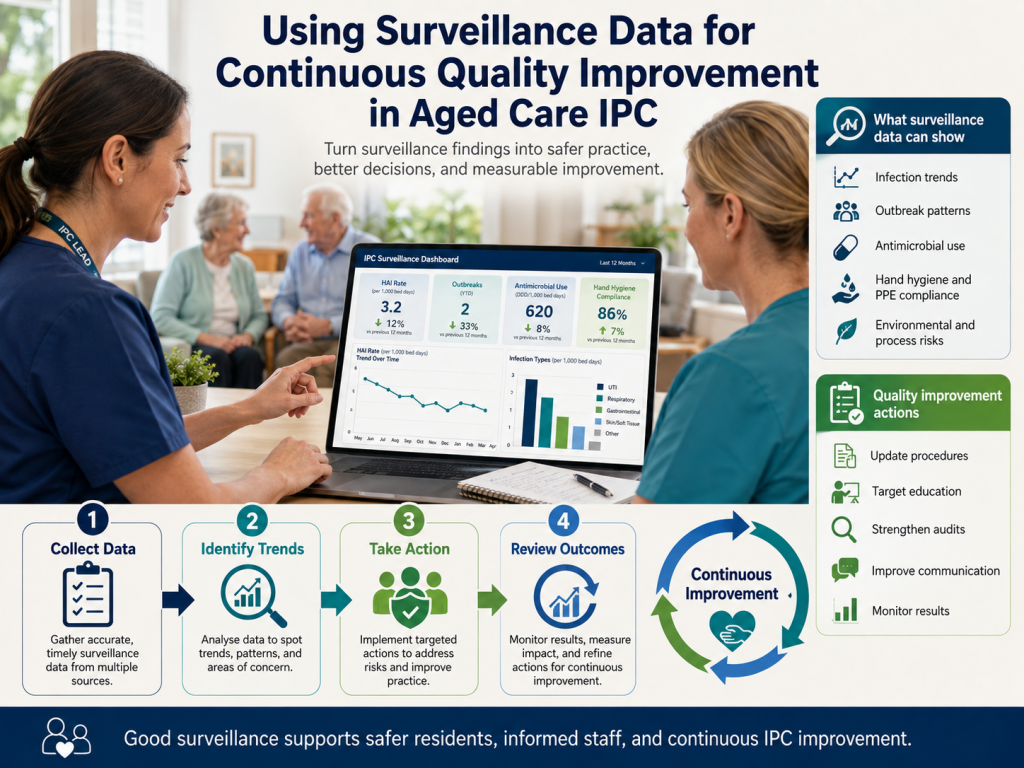
Using Surveillance Data for CQI in Aged Care IPC
Antimicrobial Stewardship in Aged Care
Outbreak Management in Aged Care
References and Further Reading
The following authoritative sources inform the clinical and regulatory guidance in this article. Links open in a new tab.
- Australian Commission on Safety and Quality in Health Care. Infection Prevention and Control Guide for Residential Aged Care Facilities, Version 1.1. Sydney: ACSQHC; January 2025.
- Aged Care Quality and Safety Commission. Aged care quality and safety reporting — infection data. Canberra: ACQSC; 2025.
- Stone ND, Ashraf MS, Calder J, et al. Surveillance Definitions of Infections in Long-Term Care Facilities: Revisiting the McGeer Criteria. Infect Control Hosp Epidemiol. 2012;33(10):965–977.
- Australian Institute of Health and Welfare. Aged care safety and quality surveillance data. Canberra: AIHW; 2024.
- Communicable Diseases Network Australia. CDNA National Guidelines — surveillance of communicable diseases. Canberra: DoH; 2023.
In This Article
- UTI Surveillance and the ‘To Dip or Not to Dip’ Framework in Aged Care
- Why Is UTI Surveillance a Priority in Aged Care?
- What Is the Difference Between Asymptomatic Bacteriuria and True UTI in Aged Care?
- What Is the ACQSC ‘To Dip or Not to Dip’ Audit Tool?
- What Are the McGeer Criteria for UTI Surveillance in Aged Care?
- How Can Aged Care Facilities Reduce Unnecessary Urine Testing?
- How Should UTI Surveillance Data Be Linked to Antimicrobial Stewardship?
- What Are the Common Documentation Failures in UTI Surveillance?
- Frequently Asked Questions
- Related Articles
About the Author
Lyndon Forrest is the Managing Director of Bug Control — Infection Prevention Services, with over 30 years’ experience supporting aged care facilities across Australia and New Zealand with infection prevention, antimicrobial stewardship, and accreditation readiness.
Clinically reviewed by Bridgette Mackie & Dianne Newey, Clinical Directors.
Ready to Strengthen Your Facility’s Infection Prevention?
The IPS Hub provides aged care facilities across Australia and New Zealand with continuously updated IPC policies, AMS tools, outbreak management resources, and direct support from experienced IPC professionals.