Home › Knowledge Hub › Risk Management › IPC Risk Management in Aged Care
Pillar Page
By Lyndon Forrest, Managing Director · Clinically reviewed by Bridgette Mackie & Dianne Newey, Clinical Directors · September 2026 · 13 min read
IPC Risk Management in Aged Care
TL;DR —
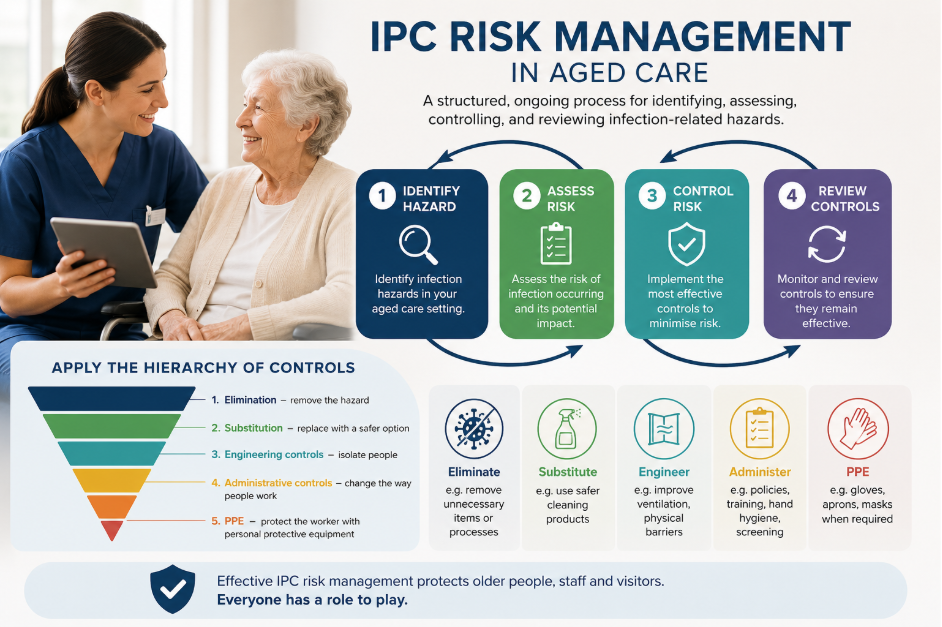
IPC risk management in aged care is a structured, ongoing process for identifying, assessing, controlling, and reviewing infection-related hazards. It follows a 4-step cycle (identify hazard, assess risk,control risk, review controls) and applies the hierarchy of controls — from elimination through to PPE. Aged Care Quality and Safety Commission. Strengthened Aged Care Quality Standards (effective 1 November 2025) — Standard 4, Outcome 4.2 (Infection prevention and control); Standard 5, Outcome 5.2 (Preventing and controlling infections). Canberra: ACQSC. Effective IPC risk management balances infection prevention with residents’ rights to quality of life, dignity, and choice under the Statement of Rights.
What Is IPC Risk Management in Aged Care?
IPC risk management in aged care is the systematic process of identifying infection hazards, assessing the likelihood and consequences of those hazards causing harm, implementing controls to reduce the risk, and reviewing those controls over time. It is the foundation upon which every infection prevention and control program is built.
Unlike acute hospital settings where residents stay briefly, and environments are highly controlled, residential aged care facilities (RACFs) are long-term living environments. Residents eat, socialise, receive visitors, and participate in activities within the same spaces where clinical care is delivered. This dual function — home and healthcare setting — makes IPC risk management in aged care fundamentally different from hospital infection control.
The Work Health and Safety Act 2011 establishes a legal duty for persons conducting a business or undertaking (PCBUs) to eliminate risks to health and safety, or if elimination is not reasonably practicable, to minimise those risks so far as is reasonably practicable. For aged care providers, this includes infection-related risks forboth workers and residents.
The Strengthened Aged Care Quality Standards, effective from 1 November 2025, place IPC in two places. Standard 4 (The Environment), Outcome 4.2 requires an appropriate IPC system, led by an appropriately qualified and trained IPC Lead, that follows contemporary, evidence-based practice (Action 4.2.1). Standard 5 (Clinical Care), Outcome 5.1 covers clinical governance, and Outcome 5.2 requires an antimicrobial stewardship system (Action 5.2.1) and processes to minimise and manage infection in clinical care (Action 5.2.2). Choosing which precautions to apply, whether standard or transmission-based, is a risk assessment decision.
The ACSQHC Aged Care IPC Guide (2024) provides detailed guidance on applying risk management principles specifically to infection prevention in aged care. The Guide emphasises that risk management must be proportionate, person-centred, and responsive to changing circumstances within each facility
What Are the Four Steps of IPC Risk Management?
IPC risk management follows a standardised 4-step cycle: identify the hazard, assess the risk, control the risk, and review the controls. This cycle is continuous — it does not end after a single assessment. Hazards evolve, new risks emerge, and controls must be evaluated for effectiveness
Step 1: Identify the Hazard
Hazard identification involves recognising anything in the aged care environment that could cause infection. Hazards may be biological (pathogens), environmental (shared bathrooms, ventilation), procedural (wound care practices), or behavioural (hand hygiene compliance). Effective hazard identification uses multiple sources of information.
Surveillance data (infection rates, outbreak alerts, antibiogram results)
Incident reports and near-miss notifications
Workplace inspections and environmental audits
Hand hygiene audit results
Resident admission screening and transfer documentation
Staff feedback and clinical observations
Seasonal epidemiological data (e.g., influenza surveillance from the Australian Government Department of Health)
Need help implementing this in your facility? The IPS Hub gives your IPC Lead instant access to ready-made policies, procedures, and audit tools — updated monthly.
Step 2: Assess the Risk
Risk assessment determines the level of risk by evaluating two factors: the likelihood that the hazard will cause harm and the consequence (severity) if harm occurs. These factors are combined using a risk matrix to produce a risk rating (low, moderate, high, or extreme). The risk rating determines the urgency and extent of control measures required.
For detailed guidance on conducting IPC risk assessments in aged care, including risk matrices and practical examples, see How to Conduct an IPC Risk Assessment in Aged Care
Step 3: Control the Risk
Risk controls are measures implemented to eliminate or reduce identified risks. Controls should follow the hierarchy of controls, which ranks interventions from most effective (elimination) to least effective (PPE). In practice, most IPC hazards in aged care require a combination of controls from multiple levels of the hierarchy.
The 6-level hierarchy of controls for IPC in aged care is: Elimination, Substitution, Isolation, Engineering Controls, Administrative Controls, and Personal Protective Equipment (PPE). For a thorough analysis of each level with aged care examples, see The Hierarchy of Controls for Infection Prevention in Aged Care
Step 4: Review Controls
Review is the most frequently neglected step in IPC risk management. Controls must be evaluated for effectiveness at defined intervals and whenever circumstances change — such as after an outbreak, a change in resident acuity, a building modification, or a new public health directive.
Scheduled reviews at defined intervals (monthly, quarterly, annually)
Triggered reviews after incidents, outbreaks, or significant changes
Comparison of infection rates before and after control implementation
Staff feedback on whether controls are practical and sustainable
Audit results measuring compliance with control measures
How Does the Hierarchy of Controls Apply to IPC in Aged Care?
The hierarchy of controls is a framework that ranks risk control measures from most effective to least effective. Originally developed for workplace health and safety, the hierarchy is directly applicable to infection prevention and control in aged care settings. The principle is simple: always start at the top of the hierarchy and work down.
| Level | Control Type | IPC Example in Aged Care |
|---|---|---|
| 1 | Elimination | Removing unnecessary invasive devices; ceasing unnecessary catheterisation |
| 2 | Substitution | Replacing multi-dose vials with single-dose vials; switching from high-splash to low-splash cleaning methods |
| 3 | Isolation | Placing a resident with active pulmonary tuberculosis in a single room with negative pressure |
| 4 | Engineering Controls | Installing alcohol-based hand rub dispensers at point of care; improving ventilation systems |
| 5 | Administrative Controls | Hand hygiene training; IPC policies and procedures; surveillance programmes; outbreak response plans |
| 6 | PPE | Gloves, gowns, masks, eye protection — used as the last layer of defence when higher-level controls cannot eliminate the risk |
A common error in aged care IPC is over-reliance on PPE while neglecting higher-level controls. PPE protects only the individual wearer (and only when used correctly). Controls higher up the hierarchy protect everyone in the environment and do not depend on individual compliance. Effective IPC risk management applies multiple layers of controls simultaneously.
For a detailed analysis of each level with practical aged care case studies, see The Hierarchy of Controls for Infection Prevention in Aged Care
What Does Risk Acceptance Mean in Aged Care IPC?
Risk acceptance in aged care IPC is the deliberate, documented decision to accept a residual level of infection risk after controls have been implemented and a resident’s rights, preferences, and quality of life have been considered. Risk acceptance acknowledges that not all infection risk can — or should — be eliminated in a setting that is the resident’s home.
The Statement of Rights(Aged Care Act 2024) gives every resident the right to live in a safe and comfortable environment, the right to receive care that is safe and of high quality, and the right to make informed choices about their own care. These rights can create tension with strict infection control measures — for example, a resident’s right to have visitors versus the risk of introducing infections during an outbreak.
The essential visitor’s mechanism, implemented during the COVID-19 pandemic, demonstrated that blanket restrictions on visitors are not acceptable in aged care. Even during outbreaks, residents have the right to receive essential visitors. IPC risk management must accommodate these rights through tailored controls rather than blanket prohibitions.
For thorough guidance on risk acceptance frameworks, documentation requirements, and communicating risk to families, see Risk Acceptance in Aged Care IPC: Balancing Safety and Quality of Life
How Should IPC Risk Management Be Applied Across Different Care Settings?
IPC risk management principles are universal, but their application must be adapted to the specific care setting. Residential aged care, home care, and community-based care each present distinct challenges. The Strengthened Aged Care Quality Standards apply to all registered aged care providers, regardless of the setting in which care is delivered.
Residential Aged Care Facilities
In residential aged care, providers control the physical environment, staffing, and clinical systems. Risk management benefits from centralised governance, on-site IPC lead roles, and facility-level surveillance. Hazards are relatively predictable — shared spaces, communal dining, high-touch surfaces, and close-proximity living — and controls can be systematically implemented.
Key risk management activities in residential settings include routine environmental cleaning audits, hand hygiene compliance monitoring, seasonal vaccination programs for staff and residents, admission screening for multi-drug resistant organisms (MDROs), and outbreak preparedness planning.
Home and Community Aged Care
Home and community care settings present unique challenges because the provider does not control the physical environment. The Support at Home program, which commenced 1 November 2025, has expanded the range of services delivered in private homes, increasing the need for IPC risk management frameworks that work outside institutional settings.
For detailed guidance on IPC risk management in home and community settings, see IPC Risk Management in Home and Community Aged Care
What Are the Regulatory Requirements for IPC Risk Management?
Multiple regulatory frameworks impose obligations on aged care providers to manage infection-related risks. These frameworks operate concurrently, and compliance requires an integrated approach.
| Regulatory Framework | Key Requirement | IPC Risk Management Relevance |
|---|---|---|
| Strengthened Aged Care Quality Standards (Nov 2025) | Standard 4, Outcome 4.2, Action 4.2.1 | IPC system used wherever funded services are delivered, led by a qualified IPC Lead |
| Strengthened Aged Care Quality Standards (Nov 2025) | Standard 5, Outcome 5.2, Actions 5.2.1 and 5.2.2 | Antimicrobial stewardship; minimising and managing infection in clinical care |
| Work Health and Safety Act 2011 | Sections 17-19 | Duty to eliminate or minimise risks to workers |
| Serious Incident Response Scheme (SIRS) | Reporting obligations | Incidents that meet SIRS thresholds, such as an unexpected death or neglect, must be reported within 24 hours (Priority 1) or 30 days (Priority 2) |
| ACSQHC Aged Care IPC Guide (2024) | Best-practice guidance | Framework for risk-based IPC programmes |
| Charter of Aged Care Rights | Rights-based care | Risk management must respect resident autonomy and dignity |
The Strengthened Aged Care Quality Standards are the primary regulatory framework for IPC in aged care. Action 4.2.1 requires an IPC system, with a qualified IPC Lead, that is used wherever funded services are delivered. Outcome 5.1 (clinical governance) sits behind it. IPC committees, workforce IPC competency, surveillance and documented risk management are ways providers show these systems work, and the Aged Care Infection Prevention and Control Guide describes them.
Action 4.2.1 describes appropriate use of standard and transmission-based precautions. Determinination of which precautions are “appropriate” in each situation is fundamentally a risk assessment decision. Precautions must be proportionate to the identified risk — neither insufficient nor excessive.
The Serious Incident Response Scheme (SIRS) requires reporting of incidents that result in serious harm. An infection outbreak is not itself a reportable incident type under SIRS. If an outbreak involves an incident of one of the eight SIRS types, such as an unexpected death (always Priority 1) or neglect (Priority 1 where it caused harm needing medical or psychological treatment), it must be reported to the Aged Care Quality and Safety Commission within 24 hours of becoming aware. Outbreaks are also notified to the public health unit under state or territory law. An effective IPC risk management system reduces the likelihood of such incidents occurring.
The Work Health and Safety Act 2011 requires PCBUs to eliminate risks to workers’ health and safety, or where elimination is not reasonably practicable, to minimise those risks. For aged care workers, infection is a recognised occupational hazard. Risk management controls such as vaccination programs, PPE provision, and safe sharps handling directly address WHS obligations.
How Should IPC Risk Management Be Documented?
Documentation of IPC risk management serves three purposes: it provides evidence of compliance, it supports clinical decision-making, and it enables continuity of care. Under the Strengthened Quality Standards, assessors will look for documented evidence that risk management processes are embedded in practice — not just written in a policy.
IPC risk register: a living document listing identified hazards, risk ratings, controls, responsible persons, and review dates
Risk assessment records: completed assessments for specific hazards, events, or situations
Control implementation records: evidence that controls have been put in place (e.g., purchase orders for equipment, training records)
Review and audit records: evidence of scheduled and triggered reviews, with outcomes documented
Incident and outbreak records: documentation of IPC incidents, investigations, and corrective actions
Risk acceptance decisions: documented rationale for accepting residual risk, including resident/family consultation
An IPC risk register should be a dynamic document, reviewed at least quarterly by the IPC committee or governance body. Each entry should include the hazard description, date identified, current risk rating, controls in place, residual risk rating, responsible person, and next review date.
What Is the Role of Person-Centred Care in IPC Risk Management?
Person-centred care is not an add-on to IPC risk management — it is integral to it. The Strengthened Quality Standards require that all care, including infection prevention measures, is delivered in a way that respects residents’ dignity, preferences, and autonomy. Risk management decisions must consider the impact on each resident’s quality of life.
Practical examples of person-centred IPC risk management include: consulting with residents about how IPC measures will be implemented in their personal spaces, offering choices where clinically appropriate (e.g., type of hand sanitiser, timing of room cleaning), and avoiding unnecessary restrictions on movement, socialisation, or visitor access.
A risk-averse approach that prioritises infection prevention above all other considerations is neither person-centred nor proportionate. The ACSQHC Aged Care IPC Guide (2024) explicitly recognises that aged care IPC must balance safety with quality of life, and that residents have the right to take informed risks.
The COVID-19 pandemic demonstrated the harm that disproportionate IPC restrictions can cause to aged care residents — including psychological distress, social isolation, functional decline, and accelerated cognitive deterioration. These lessons must inform ongoing IPC risk management practice.
How Does IPC Risk Management Link to Outbreak Management?
IIPC risk management and outbreak management are closely linked. Effective risk management reduces the likelihood of outbreaks occurring. When outbreaks do occur, risk management principles guide the response — assessing the severity of the outbreak, identifying transmission pathways, implementing controls, and reviewing their effectiveness.
Outbreak preparedness is itself a risk management activity. Facilities should conduct risk assessments for seasonal threats (influenza, gastroenteritis), emerging pathogens, and facility-specific vulnerabilities. Outbreak response plans should be developed, tested through simulation exercises, and reviewed annually.
For thorough guidance on outbreak management in aged care, see Outbreak Management in Aged Care
How Does Antimicrobial Stewardship Integrate with IPC Risk Management?
Antimicrobial stewardship (AMS) and IPC risk management are complementary strategies. AMS reduces the selection pressure that drives antimicrobial resistance, while IPC risk management prevents the transmission of resistant organisms. Together, they form the two pillars of a thorough strategy against antimicrobial resistance in aged care.
Under Action 5.2.1 of the Strengthened Quality Standards, IPC governance must include antimicrobial stewardship. IPC risk assessments should consider antibiotic prescribing trends, resistance data (antibiograms), and the facility’s participation in the Aged Care National Antimicrobial Prescribing Survey (NAPS).
For detailed guidance on antimicrobial stewardship in aged care, see Antimicrobial Stewardship in Aged Care
What Are Common Failures in IPC Risk Management?
Understanding common failures helps facilities identify gaps in their own systems. The following failures are consistently observed in aged care IPC audits and regulatory assessments.
| Common Failure | Impact | Corrective Action |
|---|---|---|
| Risk assessments not conducted or not documented | Hazards remain unidentified and uncontrolled | Implement scheduled and triggered risk assessment programme |
| Over-reliance on PPE as the sole control | Higher-level, more effective controls are neglected | Apply hierarchy of controls; use PPE as last layer only |
| Risk register is static and not regularly reviewed | Controls become outdated as circumstances change | Schedule quarterly reviews; require triggered reviews after incidents |
| Blanket IPC restrictions without individual risk assessment | Resident rights and quality of life are compromised | Conduct individual risk assessments; document risk acceptance decisions |
| No link between surveillance data and risk management decisions | Risk management is reactive rather than proactive | Use surveillance trends to inform prospective risk assessments |
| Outbreak plans not tested or updated | Response is delayed and disorganised during actual outbreaks | Conduct annual simulation exercises; review plans after each outbreak |
IPC Scenario Risk Assessment Tool: Apply these risk management principles with our interactive IPC Scenario Risk Assessment Tool — designed specifically for aged care facilities to identify, assess, and control infection risks.
Frequently Asked Questions
What is the difference between a hazard and a risk in IPC?
A hazard is anything that has the potential to cause infection — for example, a contaminated surface or an invasive device. A risk is the likelihood and consequence of that hazard actually causing harm. IPC risk management addresses both: identifying hazards and then assessing and controlling the risks they present.
How often should IPC risk assessments be conducted?
IPC risk assessments should be conducted routinely (at defined intervals such as quarterly or annually), at the time of each resident’s admission, and whenever circumstances change — including during outbreaks, after incidents, when new procedures are introduced, or when building modifications occur. The ACSQHC Aged Care IPC Guide (2024) recommends both scheduled and triggered assessments.
Is it acceptable to accept infection risk in aged care?
Yes — risk acceptance is a legitimate and necessary part of IPC risk management in aged care. After controls have been implemented, some residual risk will remain. Risk acceptance decisions must be informed, documented, proportionate, and respectful of the resident’s preferences under the Statement of Rights. Blanket prohibitions that compromise quality of life are not acceptable as a substitute for risk assessment.
What is the most effective level of the hierarchy of controls?
Elimination is the most effective level because it removes the hazard entirely. However, elimination is not always possible in aged care IPC. Where elimination is not reasonably practicable, controls should be applied from the highest feasible level of the hierarchy, and multiple layers of controls should be used in combination.
How does SIRS relate to IPC risk management?
Infection outbreaks are notified to the relevant public health unit in accordance with state or territory requirements. An outbreak is not itself a SIRS reportable incident type. Where an outbreak involves an unexpected death or neglect, that may be a reportable incident under the Serious Incident Response Scheme (SIRS) — SIRS Priority 1 incidents are reported within 24 hours and Priority 2 within 30 days. When incidents do occur, the risk management review process (Step 4) should incorporate the findings from SIRS investigations to improve controls.
References and Further Reading
The following authoritative sources inform the clinical and regulatory guidance in this article. Links open in a new tab.
- Aged Care Quality and Safety Commission. Strengthened Aged Care Quality Standards 2025 — Standard 5, Outcome 5.2: IPC Risk Management. Canberra: ACQSC; 2025.
- Australian Commission on Safety and Quality in Health Care. Infection Prevention and Control Guide for Residential Aged Care Facilities, Version 1.1. Sydney: ACSQHC; January 2025.
- Standards Australia. AS ISO 31000:2018 Risk Management — Guidelines. Sydney: Standards Australia; 2018.
- Australian Institute of Health and Welfare. Aged care safety and quality reporting — infection data. Canberra: AIHW; 2024.
- World Health Organization. Risk assessment for infection prevention and control. Geneva: WHO; 2023.
In This Article
- What Is IPC Risk Management in Aged Care?
- What Are the Four Steps of IPC Risk Management?
- How Does the Hierarchy of Controls Apply to IPC in Aged Care?
- What Does Risk Acceptance Mean in Aged Care IPC?
- How Should IPC Risk Management Be Applied Across Different Care Settings?
- What Are the Regulatory Requirements for IPC Risk Management?
- How Should IPC Risk Management Be Documented?
- What Is the Role of Person-Centred Care in IPC Risk Management?
- How Does IPC Risk Management Link to Outbreak Management?
- How Does Antimicrobial Stewardship Integrate with IPC Risk Management?
- What Are Common Failures in IPC Risk Management?
- Frequently Asked Questions
About the Author
Lyndon Forrest is the Managing Director of Bug Control — Infection Prevention Services, with over 30 years’ experience supporting aged care facilities across Australia and New Zealand with infection prevention, antimicrobial stewardship, and accreditation readiness.
Clinically reviewed by Bridgette Mackie & Dianne Newey, Clinical Directors.
IPC Scenario Risk Assessment Tool
Apply these risk management principles with our interactive IPC Scenario Risk Assessment Tool — designed specifically for aged care facilities to identify, assess, and control infection risks.
Ready to Strengthen Your Facility’s Infection Prevention?
The IPS Hub provides aged care facilities across Australia and New Zealand with continuously updated IPC policies, AMS tools, outbreak management resources, and direct support from experienced IPC professionals.